A short note on Rishikesh
This note is not historical. Part musing, part historiography.
Once, the town was Haridwar’s poor cousin.
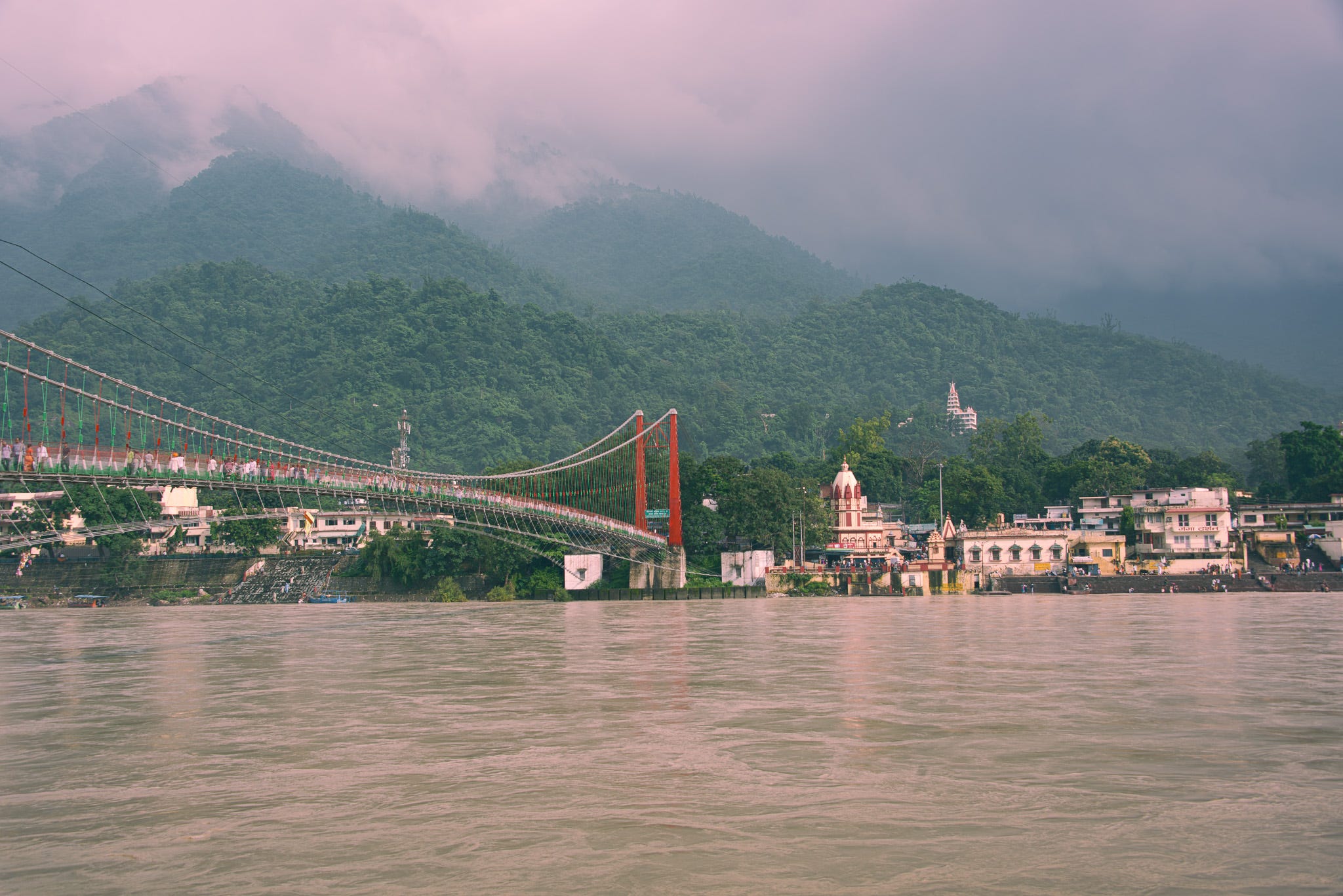
I remember my first visits to Rishikesh during my time in consumer sales. Rishikesh was like a lonely, forgotten backwater town, lost in Haridwar’s ephemeral glitter. We’d book our hotel stays in Haridwar’s tiny hotels, travel to Rishikesh for a day trip before concluding our business, and return to Haridwar for the night. Rishikesh had no worthwhile hotels or hostels in those days, and if you spent the night in the town, there was always the possibility that your money would disappear into the night.
Then, Rishikesh became an international yoga center.
When I returned to North India a little over a decade ago, Rishikesh had transformed itself into an international yoga center, and solemn, earnest, serious, pale-faced Westerners could be seen doing yoga all over the place or having intense discussions about Jiddu Krishnamurthy’s philosophy. They congregate in their pale enclaves, and whenever they meet you, they fold their hands comically and say ‘namaste,’ assuming that every Indian always says ‘namaste.’
Unlike Haridwar, which has kept its pious Hindu culture while acquiring a vast industrial backyard, Rishikesh has changed. Indian corporations and schools have also discovered Rishikesh, and you will find campsites upstream, populated by young corporates on a team-building exercise or schoolkids out on a trip.
Sitting by the banks of the river, you will observe young professionals whooping and wearing safety gear as they sail along the river in rubber boats.
Rishikesh represents a threshold.
The Ganges meets the plains a few kilometers upstream from Rishikesh, and the water is clean and rapid. The river basin is rocky and will break your bones if you are foolhardy enough to venture to the middle of the rapid stream. If you are foolhardy, your friends and family may have to search for your bones in Haridwar, as the river will carry you away.
Rishikesh is also the place from where pilgrims begin their ascent into the mountains en route to the holy shrines in the hills.
I always assumed the name “Rishikesh” translates into “The hair of the Rishis,” but, of course, I am wrong. The original name was probably “Hrishikesh,” meaning “Lord of the Senses,” a name for Vishnu. Rishikesh, therefore, clearly has Vaishnavite origins.
Vaishnavism developed slowly. Most modern Indians believe that Vishnu was a major god during the Vedic times but, this belief seems unwarranted. However, it does appear that Vishnu was a minor god during the Vedic times, which was always my impression. Gradually, several cults seem to have merged to create Vaishnavism in ‘Hindu’ belief systems - the merging of the Vedic Solar god, the Vasudeva-Krishna, pastoral Krishna and Narayana worship. The transition and history is complex and, possibly, disputed.
If you wish to take a more philosophical view of Rishikesh, you can compare the town to a threshold. A pilgrim will travel from Haridwar to Rishikesh (the threshold) to the final spiritual destinations in the hills (Kedarnath and Badrinath). With the growing rigidity of temple rules and focus on exterior signs of piety, I wonder how long Badrinath and Kedarnath will keep their original spirituality.
Rishikesh is also a physical threshold in two ways. One, it is from here that pilgrims begin their ascent into the mountains. Two, it is here that the Ganges crosses the threshold from the hills to the plains. Most people do not realize a simple fact: although the river remains the same, it takes on different names as it journeys to the plains. The river starts at the Bhagirathi, meets at the Alaknanda, and finally becomes the Ganga.
The location of Rishikesh at the twin gateways of a pilgrim’s journey to the holy sites in the hills, and the transition of the Ganga’s journey from the hills to the plains, is significant from both a geographical and a religious-mythical perspective. Rishikesh has always been a center of meditation. I don’t know how many people have visited Rishikesh, but it’s a town with the river flowing between forested hills on either side. The hills and the pure water define Rishikesh.
The town retains its ‘cool’ vibe, even now.
Despite its deep association with meditation, the town has not (at least not until my last visit) acquired overly religious terms. I’ve written many times that narrow religiosity is overtaking India, but Rishikesh has so far escaped that fate.
Rishikesh’s transformation began in the late 19th and early 20th centuries when ashrams, such as those associated with Swami Sivananda, sprang up, transforming Rishikesh into a site of organized spiritual pedagogy. These institutions systematized the teachings of yoga, Vedanta, and meditation, making them accessible not only to Indian seekers but increasingly to an international audience.
I am convinced that the next push happened when the Beatles and Donovan visited Rishikesh in the 1960s, catapulting it into international fame. Yet, I do not remember seeing Westerners thronging the yoga centers of Rishikesh during my earliest visits. The Westerners were probably there, but maybe there weren’t many, which is why I did not notice them. I also admit that I focused on getting into the town, conducting my business, and leaving.
The other major belief system in South Asia, was Shaivism. Shaivism and Vaishnavism often clashed and have different world views. I believe that Vaishnavism is essentially Brahmanical in nature. Even though I am atheist, Shaivism has always attracted me: I consider it more mystical.
Shaivism is probably one of the oldest continuous religious traditions in South Asia.
Many historians connect Shaivism with pre-Vedic and indigenous religious practices and fertility symbolism, yoga, asceticism, mountain cults, serpent worship and phallic symbolism.
Over time people identified the Vedic god, Rudra, with Shiva and many local cults got absorbed into the broader Shaivite traditions.
My tunnel vision would have made me oblivious to everything happening around me, and it was only when I visited the town again as a photographer that I noticed the pale faces flooding the town. These people have not come to proselytize. These foreigners are not big spenders. They come to Rishikesh, stay in reasonably priced accommodation for months, and focus on yoga and Jiddu Krishnamurthy. Some want to understand India’s caste system, and in attempting to do so, tie themselves into knots.
The wellness revolution in Rishikesh also received a boost when the Parmarth Ashram started becoming popular. The wellness revolution also received a boost when expensive resorts like Ananda Spa opened. I met a few of the rich women who stayed at the Ananda Spa and visited the Parmarth Ashram to attend the evening aarti. She sat a few rows behind the main ‘Swami’ who, after the aarti concluded, looked straight at her, telling her he sensed the power of her spiritual energy. I remember suppressing a smirk as I listened to her breathless retelling, congratulating myself on my self-control.
“He must have sensed the sparkle of your diamonds,” I remember thinking.
Running an ashram is exactly the same as running a corporation; the scale differs. An ashram’s business has a halo because it is supposed to be spiritual, whereas a corporation tries to gain a halo by pretending to engage in sustainable practices.
My cousin used to volunteer at a neighborhood temple but stopped when he realized that the other volunteers–especially the well-known and well-off people–only viewed the temple as a stepping stone to a political career. When you blend religion with politics and the business of the state, you get a mixture that has an awful texture and stinks.
Should I return one day?
Rishikesh, luckily, still possesses a peaceful atmosphere. The combination of the river, the bridges, the wooded hills, and the unpretentious yoga gives the town an enduring charm. Nothing is in your face. Nothing is bombastic.
Unlike the river’s rapid flow, life’s flow here is calm, unhurried, gentle, and peaceful. It is time I revisited Rishikesh.
I edited the image using Lightroom Desktop, not Lightroom Classic. This is a brilliant, simple tool to edit your photos. I am not an affiliate so, if you wish to explore the Photographer plan, do so!


I enjoy your take on comparing ashrams and corporations. There is no bigger business than spirituality and religion, IMO.