
A short, very short trip to Neelkanth.
A temple in honor of Shiva, drinking 'Halahala.'

The Backstory
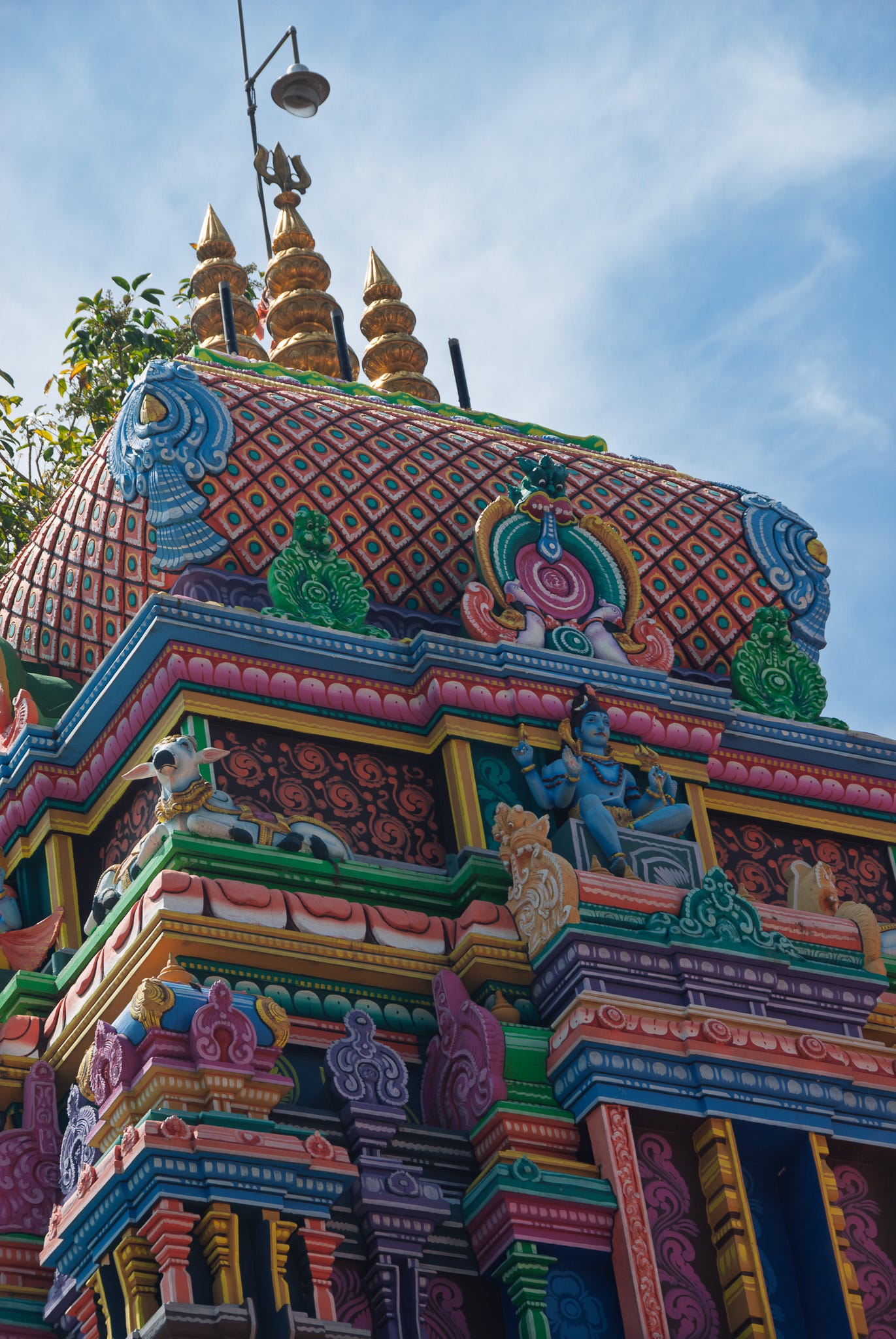
Once upon a time, there lived the gods (devas) and ‘demons’(asuras). Once upon a time, there was a sage called Sage Durvasa who cursed the devas, causing them to lose their strength. Some say that, at first, the devas were not immortal and sought to break the chains of mortality. The version of the myth is unimportant to this tale. What is important is that the devas and the asuras agreed to cooperate to churn the ocean of milk to get ‘amrit,’ the nectar of immortality.
I won’t describe the entire tale here, but while churning, a lethal poison called ‘Halahala’ emerged first, threatening to destroy the universe. Vishnu sought Shiva’s help, and Shiva agreed to consume the poison, which turned his throat blue, earning him the name ‘Neelkanth,’ or ‘the one with the blue throat.’
The devas got the entire lot of the ‘amrit.’ Vishnu took the form of the seductive Mohini, distracting the asuras and enabling the devas to steal the amrit. The devas became immortal, and the asuras retained their mortality.
There is a link between this tale and the Kumbh Melas. The myth says that Garuda (Vishnu’s vehicle, or vahana) took the pot (Kumbh) away from the site. Four drops of nectar fell to earth at Prayag (Allahabad), Haridwar, Ujjain, and Nasik, and we celebrate the Kumbh Mela at these spots.
All myths are allegories.
We are not meant to take myths literally: they are allegories meant to illustrate timeless principles. Unfortunately, there is a growing tendency to communicate and to interpret myths literally.
Diana L. Eck wrote a book called “India: A Sacred Geography.” I read this book many years ago, and the central thesis is fascinating. She postulated that India is a civilizational geography, linked by a dense network of sacred places, rivers, towns, temples, and journeys. These bind the geography into a shared cultural-religious imagination. There is merit to this thesis.
One of the first people who created a unified kingdom was Aurangzeb, but his empire collapsed. Then came the Brits. Then, Jawaharlal Nehru and Sardar Vallabhai Patel unified the geography by abolishing over 300 princely states.
The concept of a shared civilization must come from India being, what Diana Eck calls, ‘a sacred geography.’ Be clear, however: there is a thesis, and there are details behind it.
The devout believe that Shiva consumed the awful poison, Halahala, at the site of the Neelkanth temple near Rishikesh.
We drove up to Neelkanth. We did not do the trek.


You approach Neelkanth from Rishikesh by one of two ways. You can drive 32 km up the hilly road, or you can take the 12km trek from a point near Ram Jhula. My friend had no intention of walking, so we drove to Neelkanth.
If you stand in the middle of the Ganges River and face north, you will take the road on the right-hand side of the river and drive up. Once again, we hired a rickshaw and drove up to Neelkanth.
The temple was under renovation when we arrived, making photography difficult. I managed one or two images of the temple without the plastic covers. I don’t know what I was to expect, but I felt no sanctity. Maybe I have the sensitivity of a block of stone, but I feel the power of nature when I am out in nature. Does the power of nature, the feeling of absolute freedom, express divine power? Is this god? I don’t know and don’t wish to explore the topic.
Experience teaches me that when we start to walk into the analysis-paralysis puzzle, we tie ourselves in knots and then get lost. Maybe we fear pure emotion. It is also possible that we do not permit ourselves the luxury of simply enjoying life and nature.
To each their own, I say, but the cynical part of me still wants to discuss religious belief. Why do we wish to visit temples, discuss scripture – supposedly written by God – and argue over whose religion is better?
Fear is one force that drives us to places of worship. We’ve sinned and continue to sin, but depend on god’s eternal mercy. If we make enough offerings to this god, then we will – we hope – go to heaven.
Life screws some of us, and we see no hope in our current life on earth. We go to temples and pray for a better life when we are reborn.
Considering the conflict and genocide raging in the world, I postulate that god has not been successful in his/her mission of making us wise, benevolent, genuinely repentant, spiritual, or good people.
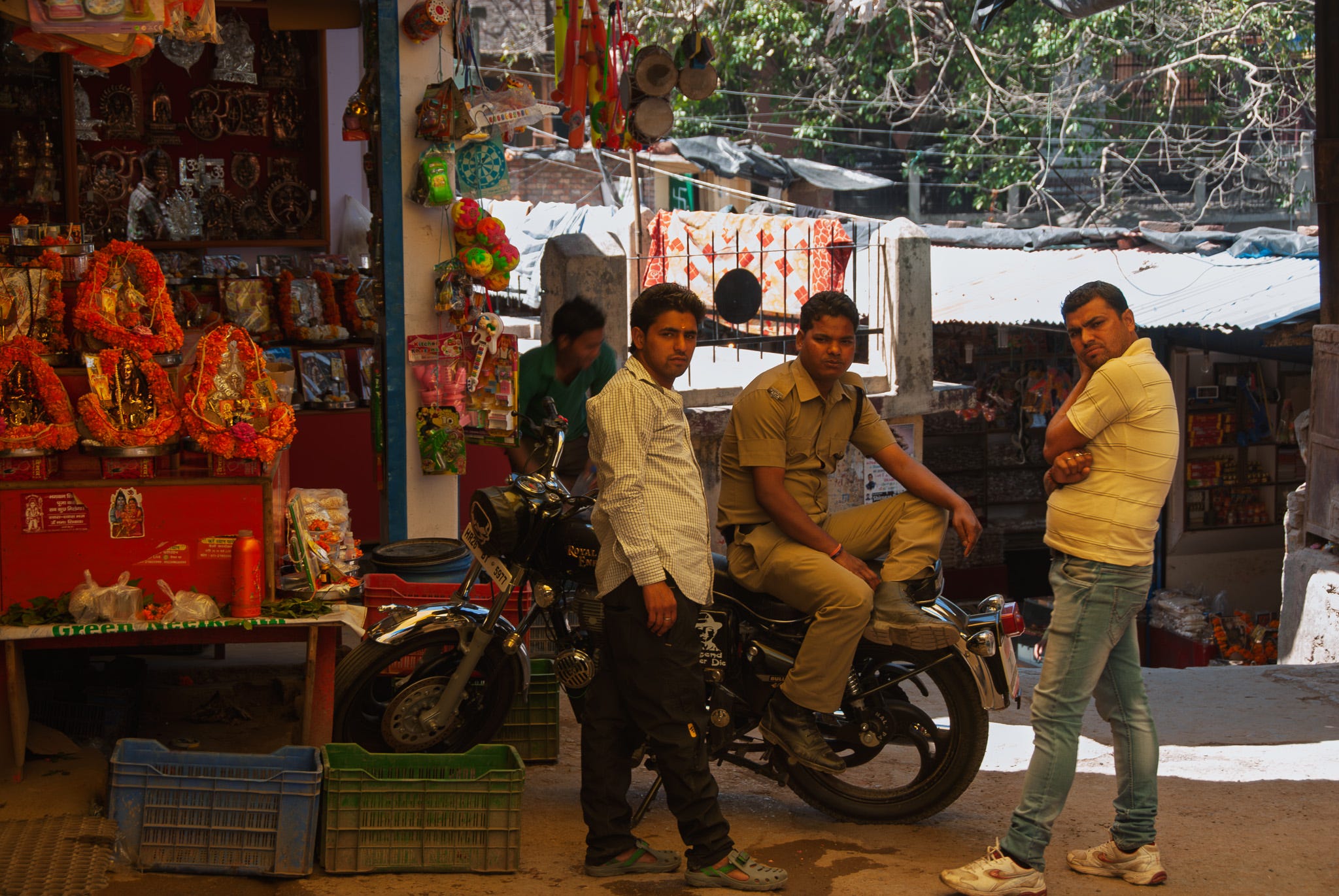
I noticed a few security barriers at the temple compound’s entry and a few policemen guarding the premises. Does God need a policeman, or do the temple authorities need protection? Methinks, the latter.
I was not happy about entering and circumambulating the temple premises. The floor was wet, and the water seemed dirty. I would have jumped for joy on leaving the temple precincts, but something told me to look devout and serious.
On pakoras. Do not call them fritters!
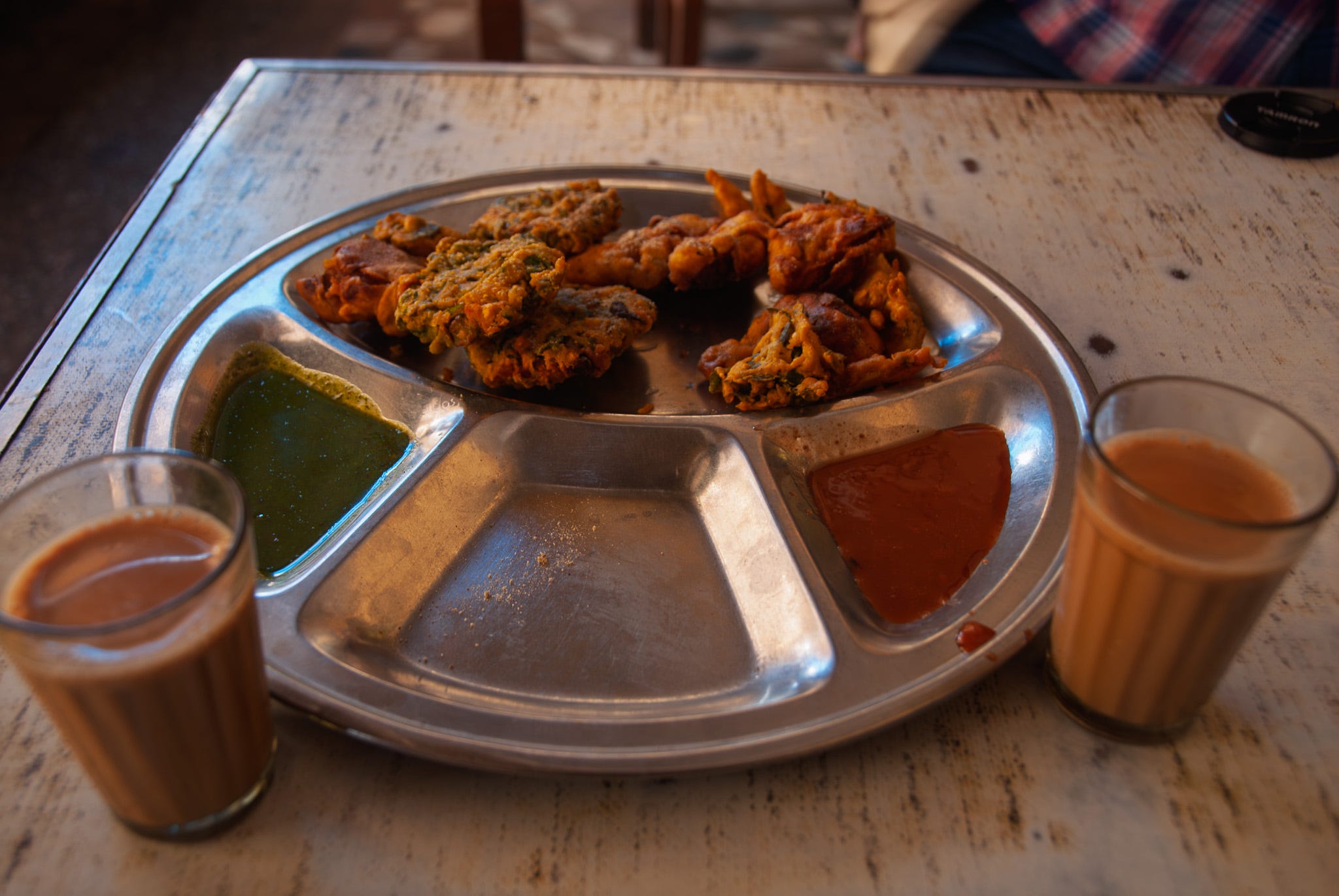
I found true joy when we entered a tiny eatery and gorged on pakoras and chai. The closest word in English that my brain conjures is fritters, but when you use the word ‘fritters,’ you rob pakoras of all their romance.
My favorite pakoras are the type you see in the image – thinly sliced potatoes, onions, or green chilies. There are other kinds of pakora as well, all deep-fried and coated with a gram-flour batter. It is the gram flour that makes them crispy, and they make a perfect pairing with chai.
When do you eat pakoras? While I avoid them at the peak of summer, pakoras exercise an undeniable charm, inviting you to eat them whenever greed overcomes you. Otherwise, pakoras at the peak of winter, or when it is raining heavily, are a perfect combination.
Visualize yourself sitting at a dhaba. It is raining outside. Even better when a fierce storm (an ‘aandhi’ or a ‘toofan’) is raging. You don’t want a wind (aandhi) that raises the dust. A ‘toofan’ that rages and makes the rain come down at a sharp angle rings the bell of hungry anticipation. When you are safely stationed in a dhaba and smell the pakoras being fried, you don’t care if you’ve left your umbrella behind. Time stands still, and waits only on the comfort food that is about to bring you much joy.
The smell of wet earth reaches your nostrils, excites your gastric juices, and causes saliva to spread through your mouth in anticipation. You close your eyes, smile, and call your faithful server to dish up a plate of pakoras accompanied by a cup of good Indian chai. Then, you eat. A meditative smile washes across your face. The rain continues, and maybe you call for a second helping of pakoras and a refill of chai. All is good with the world. Dirty politicians, businesspeople, and their evil deeds fade away as the warm glow envelopes your soul.
There are almost no comfort foods that will ever beat the humble pakora. No one knows who invented pakoras, but the original creator is definitely living in the heavens, smiling benevolently at us. The inventor of the pakora has spread much joy through the land, spreading happiness through the generations, a true saint.
The Bell & the pump.
Temple Bells.
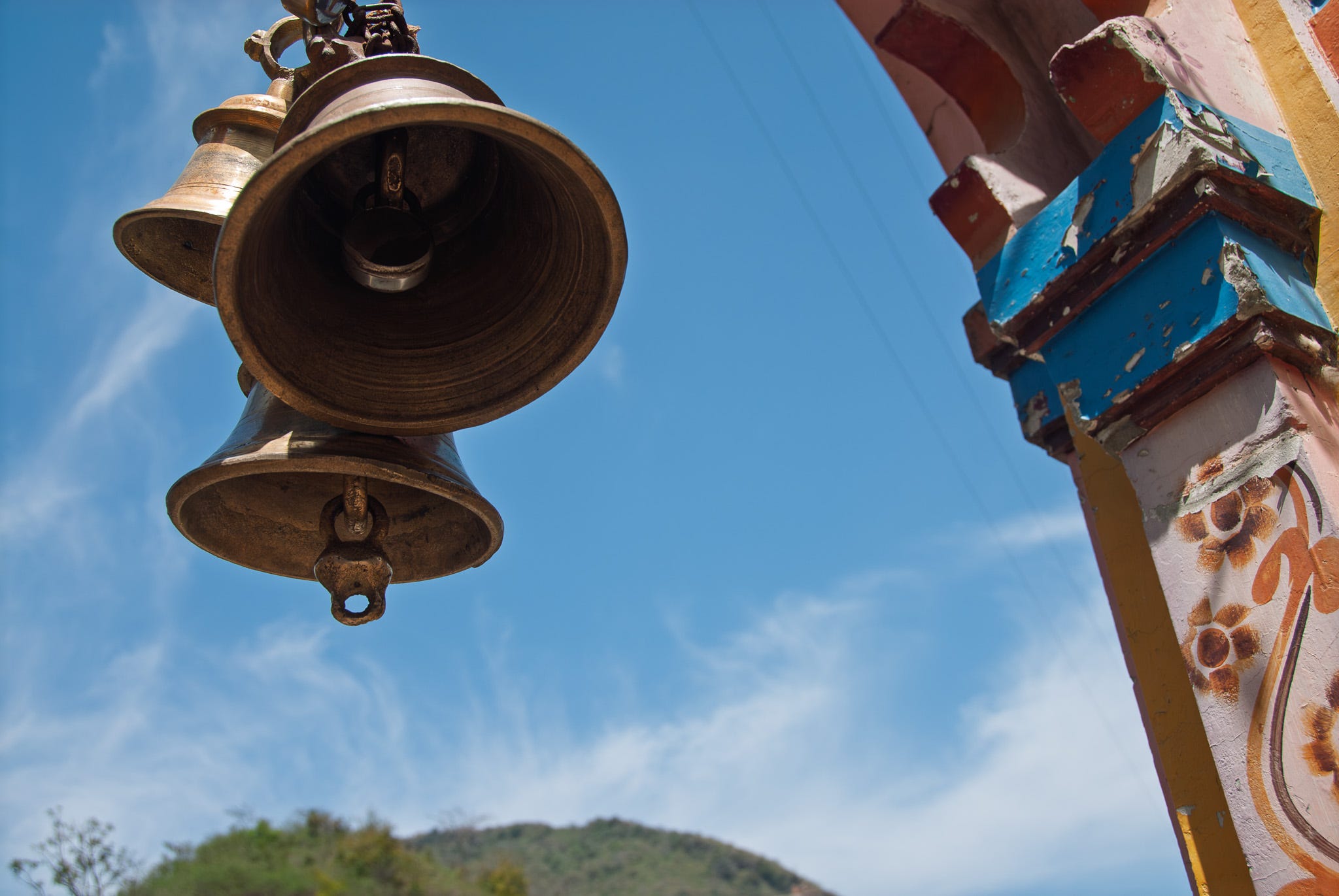
I’d like to leave all of you with two images: the bell and the pump. When we enter or leave temples, we ring a bell, and the bell carries our attendance to the heavens. You get full marks for the day.
Water pumps in villages. I have used them.
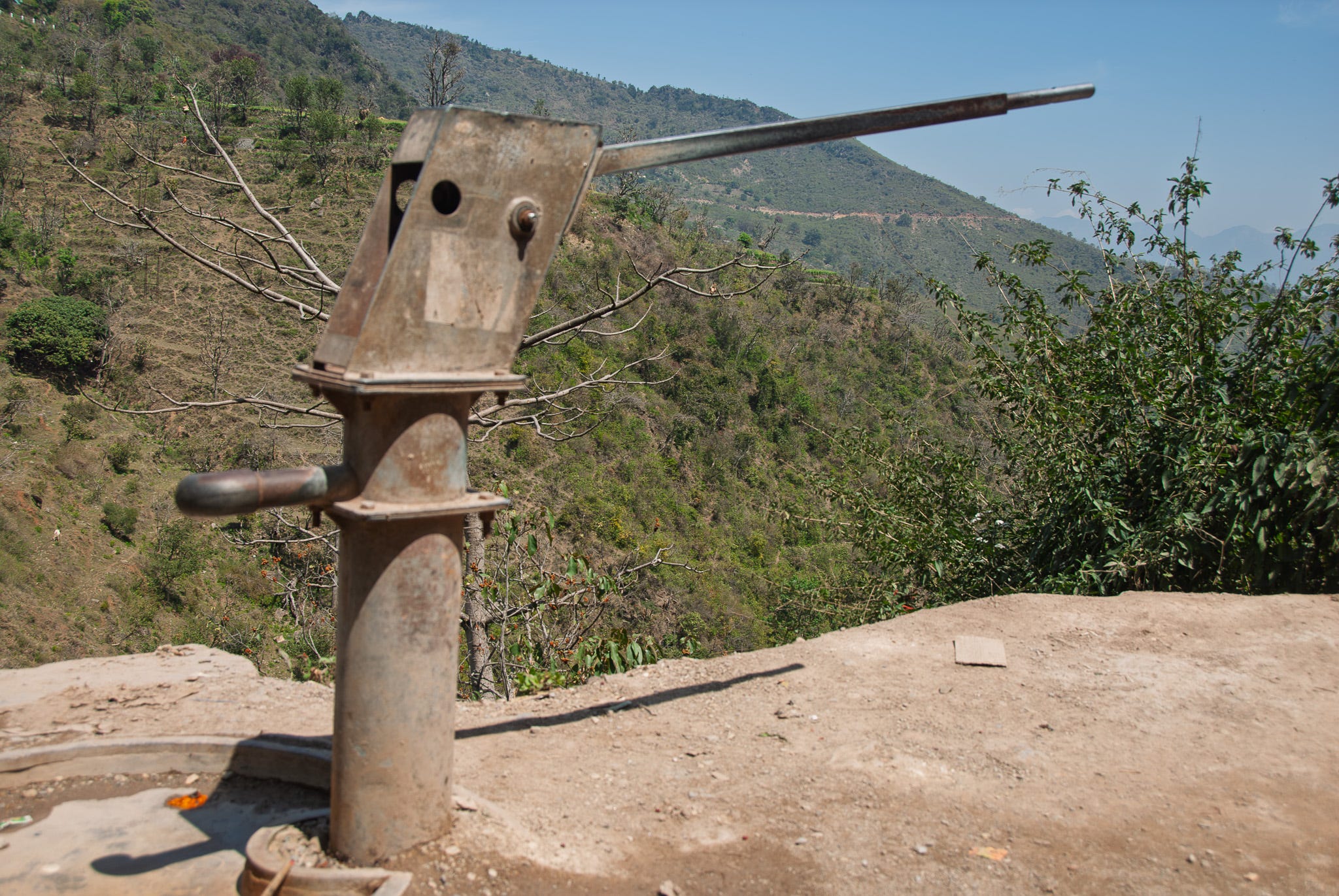
The pump draws groundwater up and was once a common sight in villages and small cities. When I used to travel in India’s rural hinterlands, these pumps were a lifesaver, quenching my thirst and providing enough water to wash my face and dunk my head under, cooling the fires raging through my skull.
As groundwater levels drop and water pollution becomes rampant, these pumps are slowly becoming relics of the past. The young don’t want to pump water out of the ground, preferring bottled water, and adding plastic waste to the environment. I always liked the taste of the water I pumped from the ground. I may be romantic, but there was always something in the earth that added a tiny bit of flavor to the water. You get almost the same taste when you drink water from an earthen pot, called a ‘ghara.’ We lived a year without a refrigerator whilst living in an army transit accommodation and used a ghara instead. Water from the ghara is cool, refreshing, rural, unfashionable, and much cheaper than water cooled in a fridge!
And then, it was time to leave the Neelkanth Temple. Everything comes to an end, and one day, so shall we. I shall now leave you on that somber note!
I am experimenting with a Paypal link.
Since I cannot integrate Stripe with my account, I have created a Paypal payment link, and I have not added an amount: I leave that to you.
So, if you’d like to support me, try clicking the above button.