

Borrowing from the VSI series of books.
This month features very short history lessons, similar to the “Very Short Introduction” series but much shorter.
Dharamshala is the principal town in Kangra, and I will write about Dharamshala and the Tibetans in the next and subsequent posts.
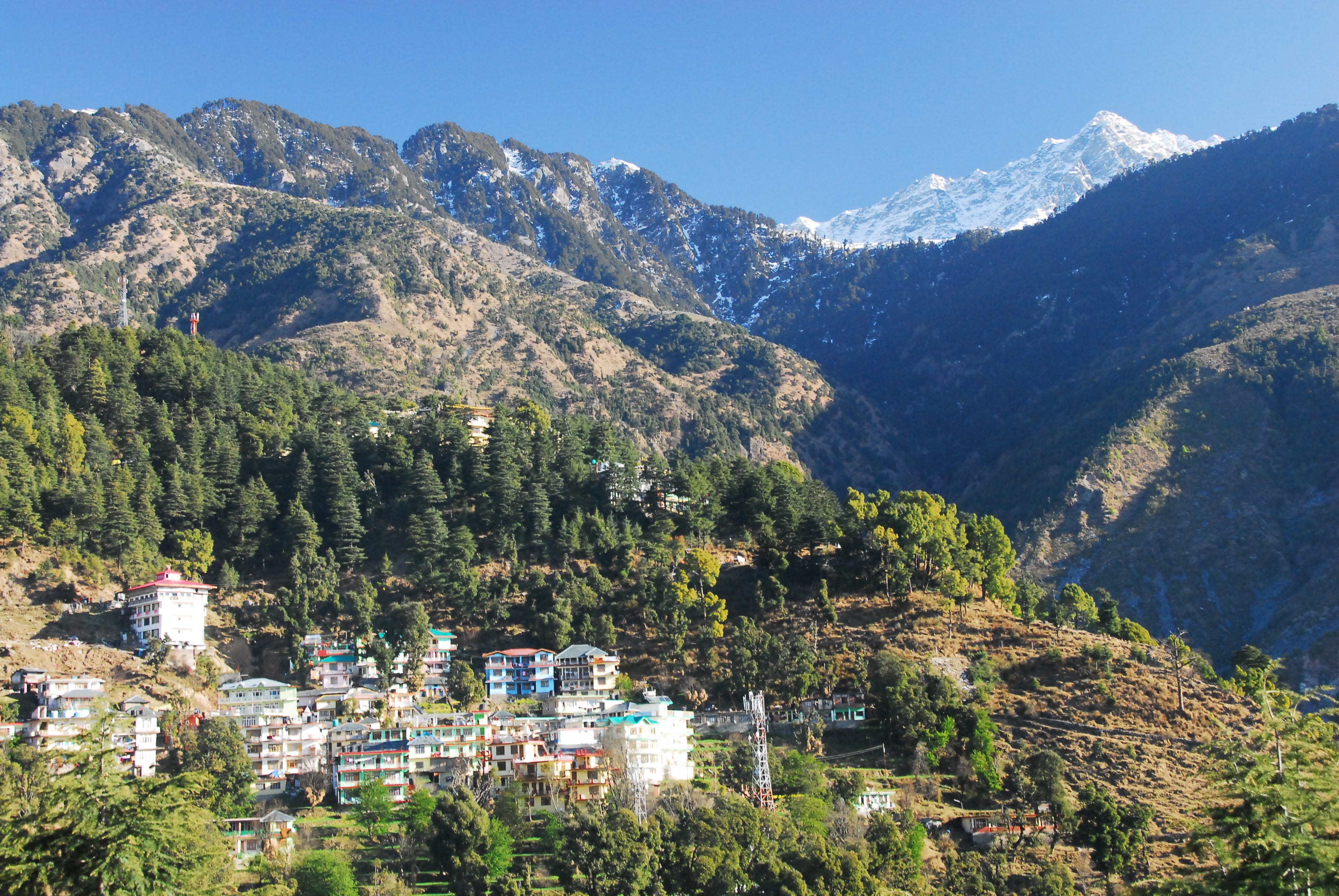
McLeod Ganj is a major suburb of Dharamshala and is a considerably more charming town of the two. McLeod Ganj’s history is quite new. The town is almost like a toddler.
The British founded the town in the mid-19th century, while looking for a suitable place to shift their administration and to set up a cantonment. You will find traces of the British settlements scattered across several parts of McLeod Ganj: a few cottages, a church, and a graveyard that I will discuss later.
The town lies in the shadow of the Dhauladhar mountains: mountains that are stunning. When I visited the town in the last week of December 2015, the snow on the mountains and the sky were stunning. A student visited McLeod Ganj in December 2025 – last year – and the snow had disappeared.
Global warming and McLeod Ganj.
I know that many fools deny the twin realities of global warming and the breakdown of climate systems. The same people deny the evidence staring them in the face. Ministers, greedy businesspeople, lobbyists, the press and scientists gather annually for the COP (Conference of the Parties) meetings – meetings that the fossil fuel companies are hijacking. They sit around meeting tables, piously intoning the need to change, debating charts that predict calamity, watching the Doomsday Clock tick, and discussing ‘exciting’ technologies like blocking the sun, without considering the world as a system, while the snow disappears from the mountains.
Meanwhile, we – the public – discuss the latest watches, the most expensive brands of whisky, and debate religious divides. Meanwhile, the Doomsday Clock brings us closer to midnight. Read this article: in the top-right corner, you may notice that we are 85 seconds from midnight. Have I scared you sufficiently? I certainly hope so.
Who was McLeod?
Now, let’s return to McLeod Ganj. Who was McLeod? The correct pronunciation is McCloud, or something close. I am grateful to the man for ‘discovering’ McLeod Ganj, though he was evidently vain enough to name the town after himself. But I acknowledge that he was no more vain than others guilty of the same sin. Sir Donald Friell McLeod was the area’s governor when McLeod Ganj came under colonial rule after the Anglo-Sikh Wars. Born in Calcutta, he was perhaps a cool character; he founded the Lahore Oriental College, now part of Punjab University (in Pakistan), and invested in education and philanthropy.
A spot of mythology and history.
Like many Indian towns, McLeod Ganj has a mythological past, mentioned in ancient texts. But it appears Panini (India’s premier grammarian), the Chinese traveler Xuanzang, and King Harshavardhana were also familiar with this region.
The Katoch Dynasty ruled McLeod Ganj, and I really have no idea what the ancient name was. Later, as the Katoch Dynasty’s fortunes declined during the Mughal Era, the town became part of the Mughal Empire. As the Mughal Empire began its long slide toward doom, McLeod Ganj’s fortunes followed Kangra’s: it became independent, then part of the Sikh Empire, then part of the British Empire, before finally becoming part of independent India.
The town and region’s character changed again in 1959, when the Dalai Lama set up his base there.
I will leave you with this ‘Very Short Introduction” to McLeod Ganj, and in the next post, I will turn my attention to the Buddhists in this area. And from October, I will start writing about my trip to Kangra.
Until next week, then.
Be healthy, be safe, be patient!
PayPal
Stripe absolutely refuses to support us in India. If you’d like to support me, do so by clicking this button. And if you do, let me know, and I will add you to the founder list.