
Benares has changed beyond recognition
Developments made by the Prime Minister have changed the town

Visiting Benares after a decade.
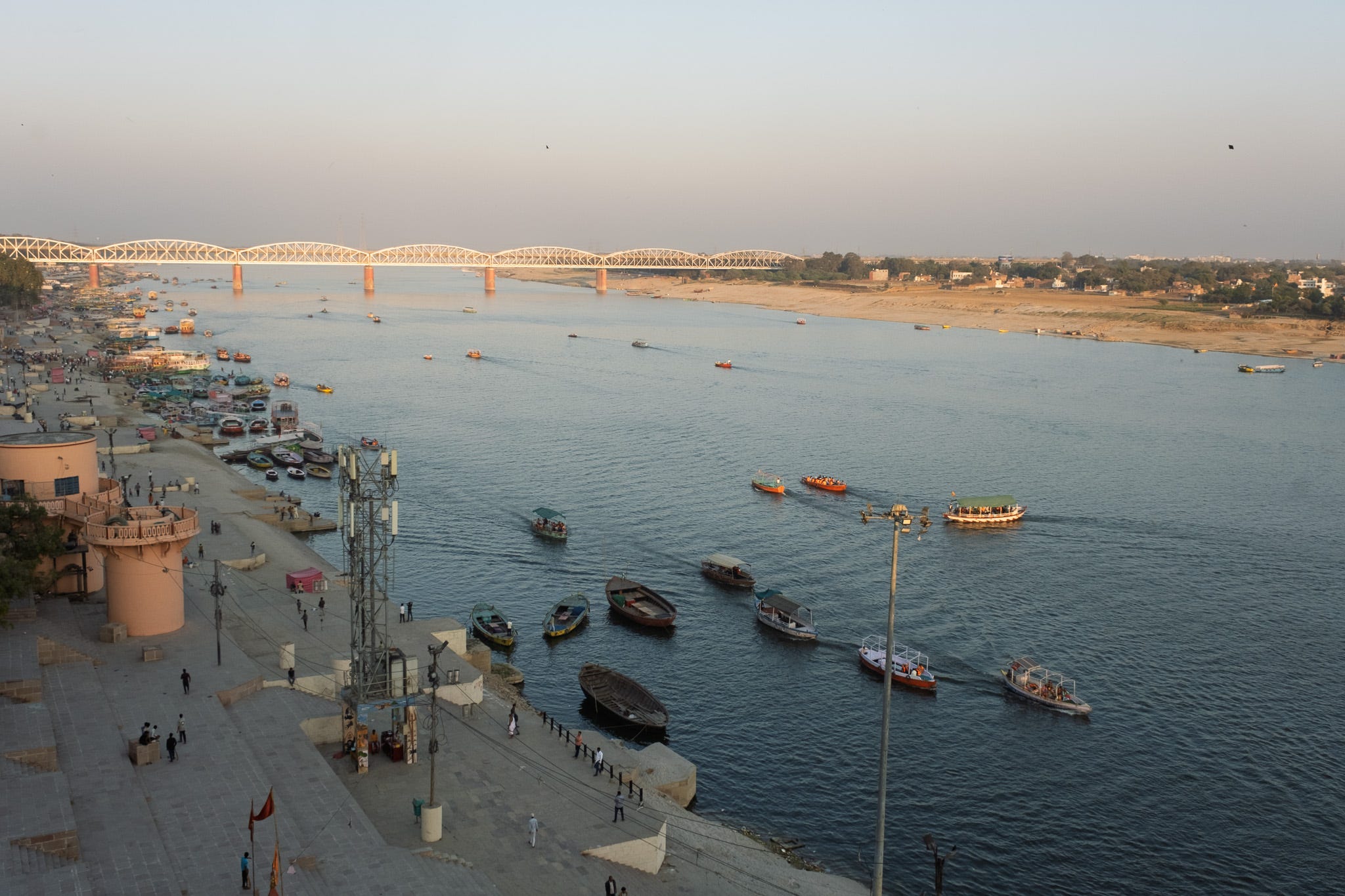
I was in Benares in February this year. Or was it March? The actual month is unimportant. What is important is that I visited the town after more than a decade. You will find, and can read, my old posts by clicking on the links at the bottom of this page.
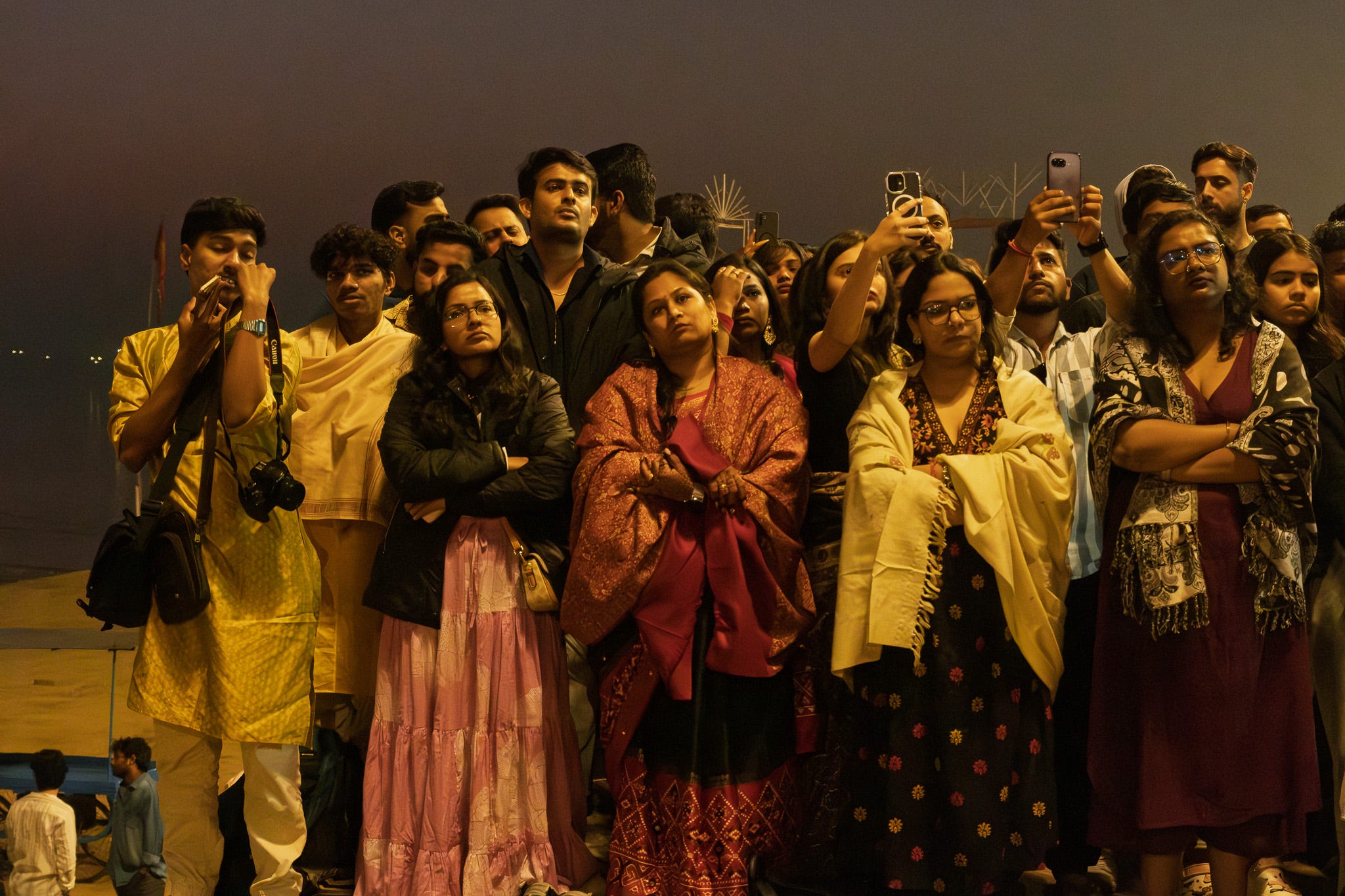
I visited Benares in November 2014/15 during the Kartik Purnima festival. That was the first time I noticed the grand aarti, or evening prayer, that happens on the ghats. There must have been between 20,000 and 50,000 people at the Dashashwamedh Ghats that evening, and I felt as though half of India had arrived to watch the ceremony. When I wandered the ghats the next evening, I noticed the aarti happening again, and I guessed that this was now a daily affair.
VIP treatment.
VIPs, politicians, and other people watched the aarti from the comfort of a boat, not deigning to mingle with the hoi polloi.
I walked into the winding lane leading to the Kashi Vishwanath temple one morning and photographed the line of faithful pilgrims waiting for their 10-second darshan with the lingam enshrined in the temple.
Unless you are the Prime Minister, temple authorities always forbid you from photographing idols, claiming we are not allowed to photograph God.
I shall pause my reflections for now and reserve them for the next post.
Narendra Modi became Prime Minister in 2014, and my last visit happened in February 2015. I remember this well because in November 2014, we traveled by train to Benares and got chatting with a few security personnel who were travelling with a firebrand, Uma Bharti, who was then a part of Modi’s government. Modi had launched his ‘Clean Ganga’ project with much fanfare, and she was visiting Benares for that purpose. Like many of his grand schemes, this one also went up in smoke.
When I visited in February 2015, I traveled alone by train. My companions noticed me collecting my garbage in a paper (or plastic) bag and then putting it into the dustbin. They copied my behavior and laughed about politicians who posed for photo-ops to prove to Modi that they had aligned themselves with his “Clean India” mission. Like many of his schemes, this one also went up in smoke, and India has become filthier in the last decade.
I mention Modi because his constituency is Benares, and he claimed the river goddess had called him to the city. Since then, he has focused on a few grand schemes to change the city as per his vision.
Changes at the Kashi Vishwanath Temple.
Let’s first talk about the Kali Vishwanath Temple. He (Modi) created a wide corridor leading to the temple, claiming he was making it easier for Shiva to reach it. I’ve never understood how people swallow such garbage because, if Shiva needs a human to make a path for him, does it mean that the human (a priest or a Prime Minister) has more power than a god? In doing so, he destroyed many old temples that had existed in the gullies for centuries. Some priests claim that Modi has destroyed more temples than Aurangzeb, but I don’t know if these accusations are valid.
A large, ugly concrete structure has been built, and opposite it is a new office belonging to the Kashi Vishwanath Trust. I admit that it has become easier to visit the temple now. Rather than waiting hours in a line, you walk into the office, pay Rs 400/- (about 4 US Dollars), and traipse in and out. The process takes thirty minutes. Also, if you wish to attend a special aarti at an unearthly hour, you can book your slot online. I discovered that you must book your slot two months in advance: my wife tried to book a slot a month before our visit, and they were sold out!
You can argue that religion has been commercialized and commoditized, and you would be correct. On the other hand, our population has been increasing (as per the latest data, our birth rate has fallen below the replacement rate, which is a relief), and we have become more overtly religious. More people make a show of visiting temples than before 2014, so both online and offline bookings are convenient.
My wife and our Singaporean friend went into the temple, while I stood outside. I have visited the temple twice with my boss, when I was a lowly Area Sales Manager: once for the evening aarti in the temple’s inner sanctum, and once for a morning visit.
The Evening Prayer. And now, a morning prayer.
The evening aarti was magnificent and mesmerizing, but a priest broke the spell as soon as it ended by grabbing my collar and demanding money. The next morning, my boss took me back to the temple – my raise depended on my compliance – and insisted I bow to the priest. The priest whacked my back in benediction – I think – and I snapped up, glaring at him. I am proud of my self-control, and I restrained myself from giving him a black eye.
Those two temple visits may have been instrumental in converting me to atheism/animism.
People love selfies.
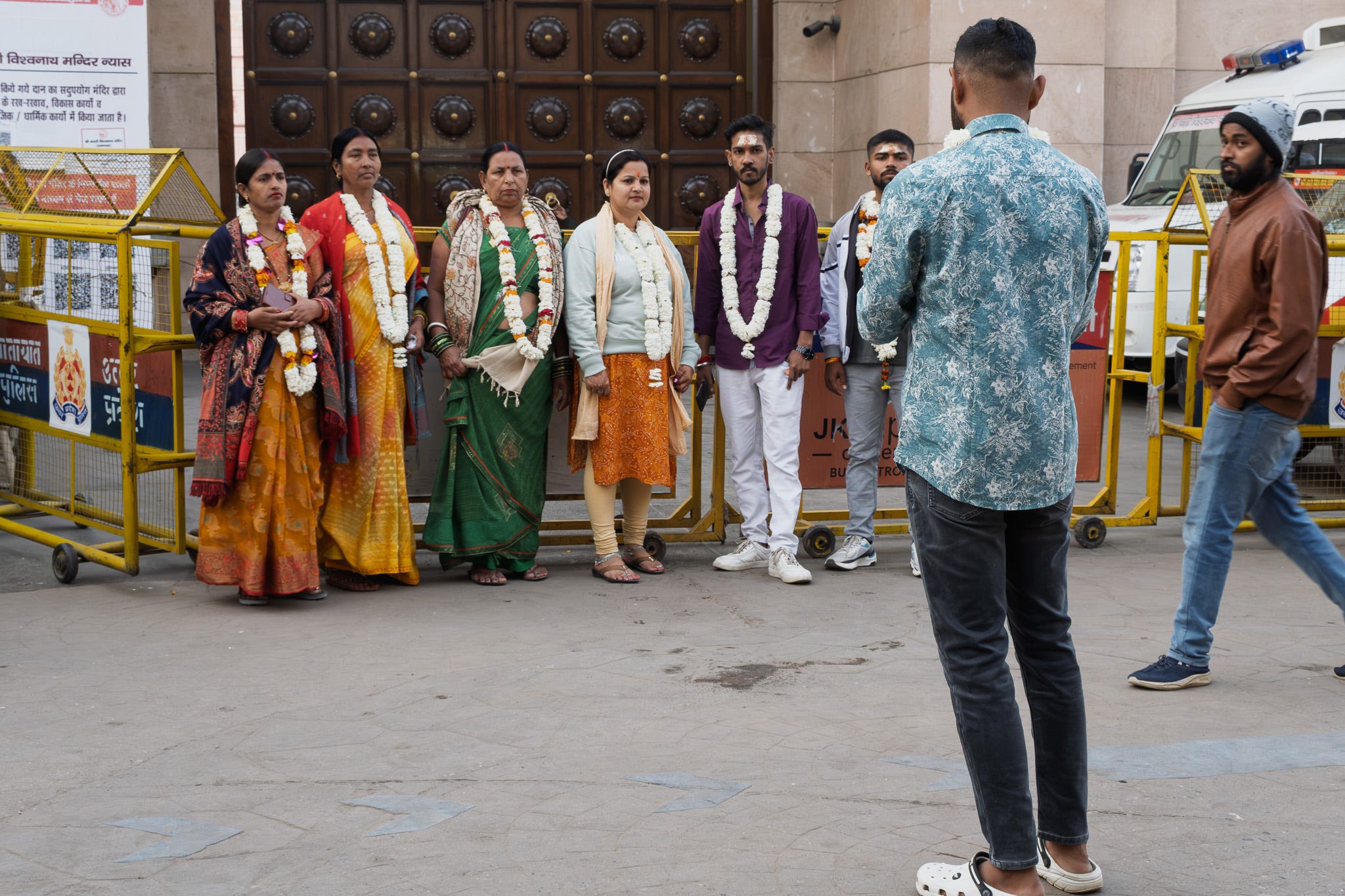
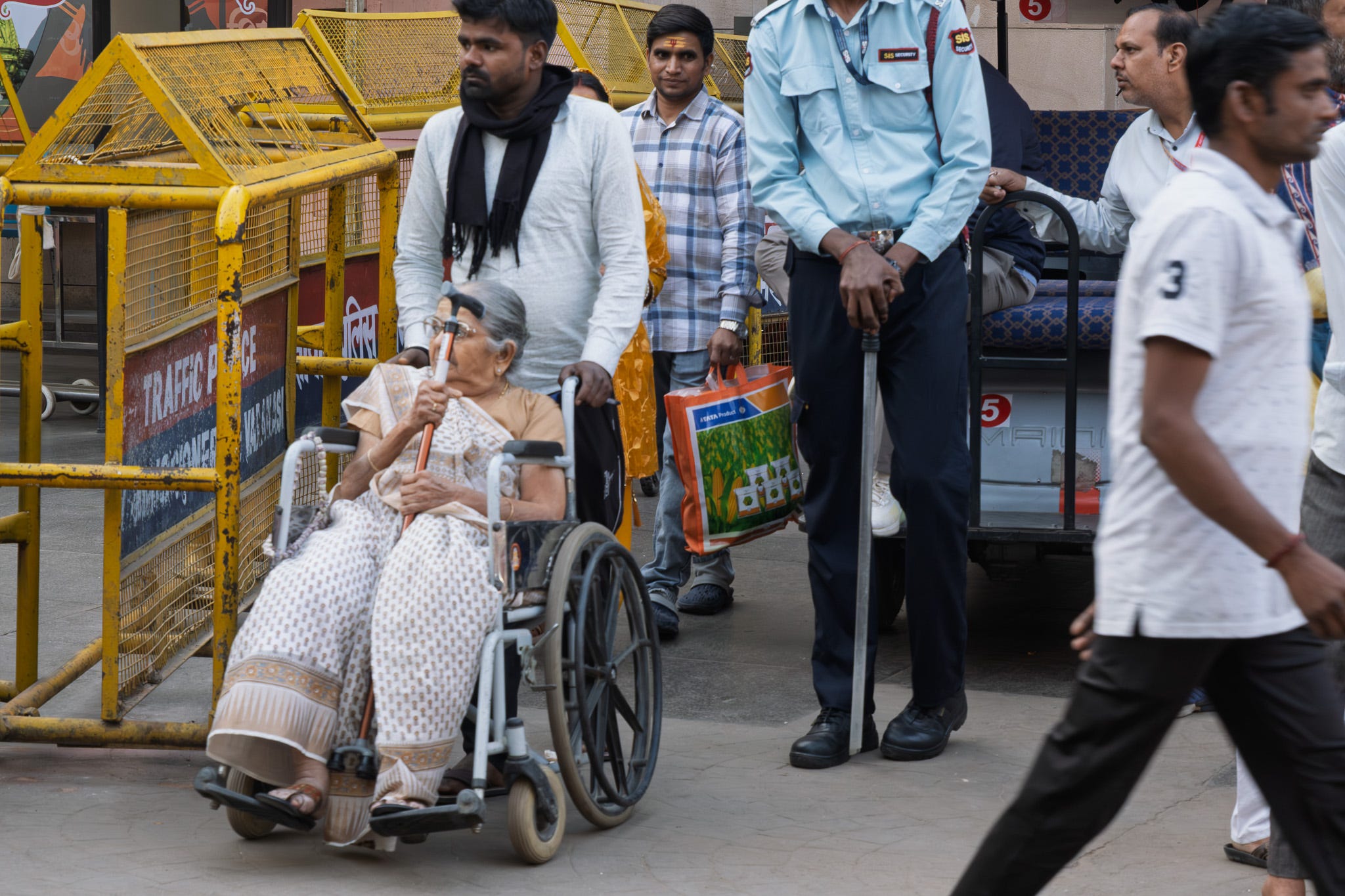
On this trip in February, I stood outside, watching people enter and exit the temple. Behind me, stores selling temple offerings made good business. Police barriers and barricades have now become a prominent part of the landscape, as have police officers. Many hang around, wondering what to do with their feet.
The wide corridor to the temple and the paved (I assume) pathway to the temple precincts have made it convenient for wheelchair users to visit the temple. A large screen on the ugly concrete structure designed by Modi’s favorite architect shows the priests conducting their prayers, and another shows our Prime Minister. The scenes on the screen loop with different visuals, ensuring viewers don’t get bored.
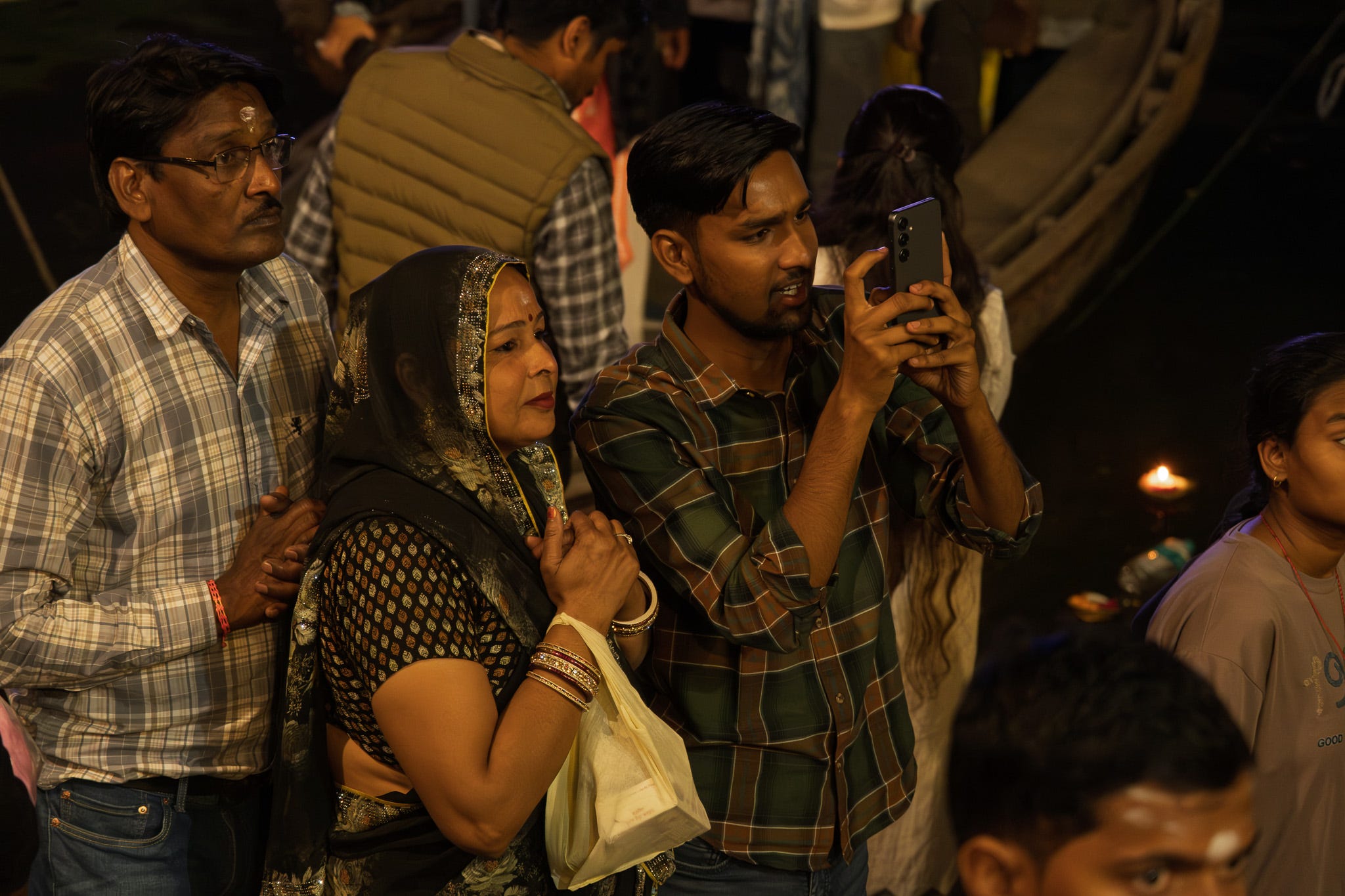
We live in a selfie universe, and I photographed people taking group pictures and selfies. Everyone wears garlands and religious markings on their foreheads. Most carry a steel plate (a thali) with offerings. The focus is on the photo-op.
At one point, I sidled up to a two-meter-tall constable. Looking up at him, I asked if the new social mores now make selfies and photo-ops mandatory. He looked down at me from his lofty Himalayan heights and laughed.
“I sometimes wonder if people visit to pray, or to take selfies,” he replied, smirking.
There is a change in the air.
Gadolia has changed. Conversations over chai.
Now, let’s move on to Gadolia, the market leading to the main Dashashwamedh Ghat. Please read the following paragraph to understand the mythological significance of this ghat. Once, the road at Gadolia was paved but rough. There was a chai shop in the center that became the meeting point for our small group traveling to Benares. The chai shop has disappeared, swallowed by the rough march of big commerce. Also swallowed are the conversations we’d have with local people over a cup of chai.
Now, there is a properly paved road, encouraging two-wheeler drivers to dash around with gay abandon. The shops now have a standard front-facing design that they copied from Amritsar. The crossing at one end of Gadolia still exists, but the shops at the far end are large, with huge displays showing shopkeepers showcasing saris to Neeta Ambani, the wife of Mukesh Ambani, the Chairperson of Reliance Industries. She now postures as the uncrowned queen of India. A cable car is coming up to transport people from the train station to Gadolia and back.
A badly maintained kiddie play area has come up next to the Dashashwamedh Ghat. The steps to the Varanasi Jantar Mantar still exist, as does the Jantar Mantar, but now you must buy a ticket to enter.
If you are facing the Ganges, the ghats stretch out to the right, ending at Assi Ghat. Now, they have a pre-dawn aarti at the Assi Ghat, and people mentioned that the authorities plan an evening aarti as well.
The Manikarnika Ghat will be remodeled.
Standing at the Dashashwamedh Ghat, walk left. The first ghat you encounter is the Manikarnika Ghat, which is being dismantled. No doubt another ugly structure will come up in the next few months. Continue down the path towards the bridge at the far end, and you will reach the NaMo Ghat, a ghat Narendra Modi named after himself. Since the crowds have increased, this is the one ghat you can drive up to and then take a CNG-powered boat to travel along the river, or to attend the evening aarti without getting into the crowd.
The Ashvamedha was an unusual blend of ritual and geopolitics. A horse was set free to roam across the landscape, carrying with it the authority of the king who had released it. Wherever it travelled, local rulers had to decide whether to submit or resist. The horse thus became a living proclamation of power. Its eventual sacrifice marked not merely the end of a ritual, but the symbolic conversion of conquest into cosmic order. Dashashwamedh—“the place of ten horse sacrifices”—preserves
Private Ghats. Disappearing rowboats and vultures.
Modi has built a helipad at the NaMo ghat for his exclusive use: no one else, not even the state’s chief minister, is allowed to use it.
The rowboats have almost all disappeared, a massive tragedy. You cannot compare the experience of sitting in a rowboat and waiting for the sunrise, or watching the ghats light up as the sun rises. Sitting there, listening to the water, feeling the breeze, chatting with the boatman, and watching a dog pick at a skull in the river is an unbeatable experience. The vultures on the far shore have disappeared. Many years ago, they used to perch along the shoreline.
The city away from the ghats has not changed much, but luxury hotels have sprouted up, and rooms there cost between $800 and $1,000 a night. Big business has moved into the town, and you will see billboards announcing the presence of the Adani companies dotting the skyline. Where Modi goes, Adani is sure to follow.
The people are changing.
The people have changed. My wife and her friend wanted to visit the Kashi Vishwanath temple, and the hotel driver promised a quick trip to the hotel, at the princely sum of R.3,000/- (over $300). Luckily, the trip did not materialize, and they discovered they could buy a 400-rupee ticket and enter.
I met a local from Varanasi when I was driving in the Kumaon hills, and he told me that people in the town are not as warm as they used to be. They are out to make a quick buck, and the old practice of a leisurely conversation over paan or chai is disappearing. A decade ago, the hotel driver would not try to cheat us.
Anger lurks under the surface. When I was having chai, I praised the upcoming cable car. A local pounced on me, stating that the cable car would rob rickshaw drivers of their income. I conversed with a boat owner who claimed that most of the new business opportunities are going to Gujaratis, Modi’s home state.
They are deeply upset about the temples that have been broken down, and the ruthless way the Manikarnika Ghat is being bulldozed, but no one wishes to speak up. They fear reprisals, and no one wants the state to put them in prison, take away their business, beat them up, or bulldoze their homes.
Change is in the air.
The boat owner also told me that now, with the corridor to the Kashi Vishwanath Temple open, almost 100,000 people visit the ghats daily. I am tempted to believe him because, while I have always considered the area to be crowded, nothing prepared me for the absolute crush of humanity on the streets or the Dashashwamedh Ghat in the evening. It felt as though people were materializing from the roads, the steps, the walls, and the air.
Change is in the air.
Change is in the air.
The show of religiosity has become commonplace, and now it is risky to tell people you don’t believe in God. The reactions can be almost violent.
Change is in the air.
The city’s warmth and amiability have diminished, and a close friend of mine, one from an old Benares family, wishes to cut his ties with the city.
Change is in the air.
Small businesses are under threat, and big businesses are elbowing their way in.
Change is in the air, and the old ways coexist with the new, for the moment.
But the city has existed for several thousand years and has changed many times. Yet, I believe, the city’s essential character and pluralism have remained intact. The city will be around even after the current PM disappears into history’s dust.
I will not live for the next few thousand years and have no wish to be around for that long. Will Benares change and become a city of ruthless, grubby people, or will they laugh again?
Let’s reconnect a few thousand years from now, and compare notes!
https://en.wikipedia.org/wiki/Ashvamedha
https://en.wikipedia.org/wiki/Dashashwamedh_Ghat
Thanks for sharing ☺️🙏🏼
Varanasi is one of those places where change feels almost impossible until you return years later and realize the city has moved on without asking your permission. I was there not long ago after my own earlier visits, and what struck me wasn’t that the ghats looked different or that the infrastructure had improved. It was the feeling that a place famous for timelessness had somehow become more efficient while still remaining unmistakably itself.
What I find fascinating about cities like Benares is that visitors often arrive hoping to preserve them in memory exactly as they were. The people who actually live there rarely have that luxury. They want cleaner streets, better transport, safer riverfronts, and opportunities for their children. The tension between preservation and progress exists everywhere, but it feels especially visible in places that carry so much history. Reading this reminded me how often we confuse familiarity with authenticity. Sometimes a place changes dramatically and somehow remains exactly what it has always been.