
Benares has not changed at all.
Despite the Prime Mister’s efforts, some things don’t change

Benares is old. Almost ancient.
Benares has been around for a few thousand years and will be around for a very long time to come. I make no predictions. Those in the prediction game may hazard a guess. How long will Benares stick around for? Ten years? A hundred? A thousand? No one knows.
Even though the city has been around for a few thousand years and carries both the weight of age and eternity (in human terms, at least), it only requires a few insane people with a nuclear weapon to create mayhem. My advice: make no predictions and enjoy Benares for what it is.
Benares has changed. Of course, it has changed!
In my last post, I mentioned that Benares has changed, and it has. Even the washermen – the dhobis - at the Assi Ghat have disappeared. The authorities now forbid dhobis from washing clothes at the ghat. I may have been one of the last to have photographed them years ago, and I remember they were not happy with me pointing my camera at them.
If you wish to experience Benares, I’d suggest you wander around in the morning. When I talk of morning, I refer to the pre-dawn and dawn period. They have a pre-dawn puja, which is fantastic if you are religious, but may not be your favorite activity if you wish to enjoy nature’s calm before the world awakens.
Instead, take a rickshaw to Gadolia and walk to the Dashashwamedh Ghat. Someone mentioned that the authorities wish to start a morning prayer ceremony at this ghat also but, I hope they are not serious.
When you walk along the ghats just before and just after the sun comes up, time seems to stand still. Yes, I know the last phrase is a cliché, but it fits the case.
Walk along the ghats and sit quietly. I visited with our friend, and she was rushing about, photographing people, not wanting to miss a moment. I’ve always believed that photography exists in the silence between the noisy spaces. I did not articulate this thought, or philosophy, to myself when I started out in photography, but film slows you down.
As my hair has grayed, I have begun to believe in this philosophy, and I repeat: “photography begins in the silence between the noisy spaces.” That is my line!
Walk along the ghats in the morning.
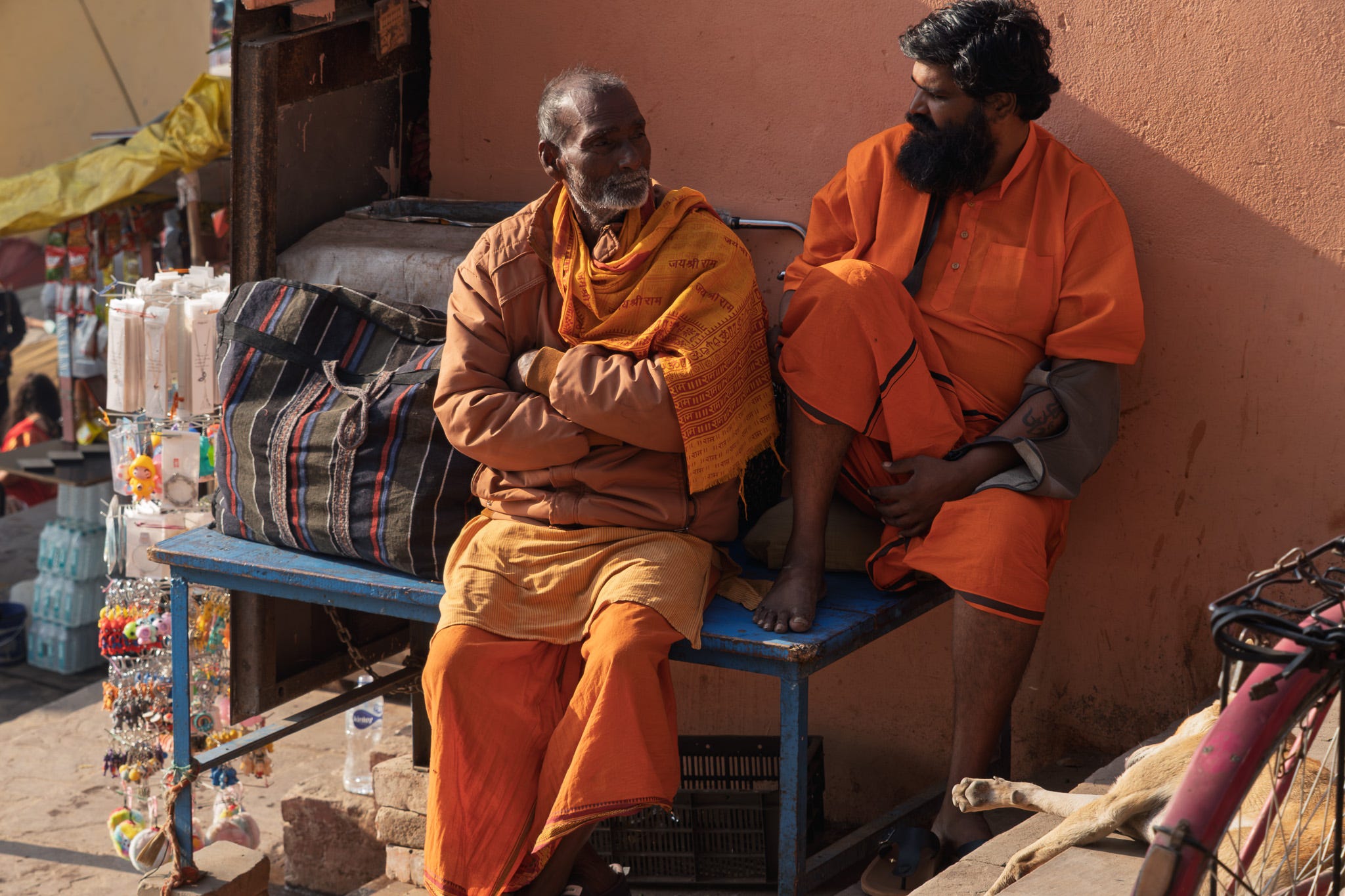
Walk along the ghats in the morning, and listen to people gathering in groups to chant their morning hymns. I sat with a group, listening to them chant, and when I looked back, I noticed they were all just happy together. A Japanese or Korean man sat next to them in companionable silence, and the men did not mind his presence.
Continue walking, and you will see people bathing in the river, as they have always done. Prayer platforms line the ghats, and you can sit on them and let the breeze sweep over you, if you take your shoes off.
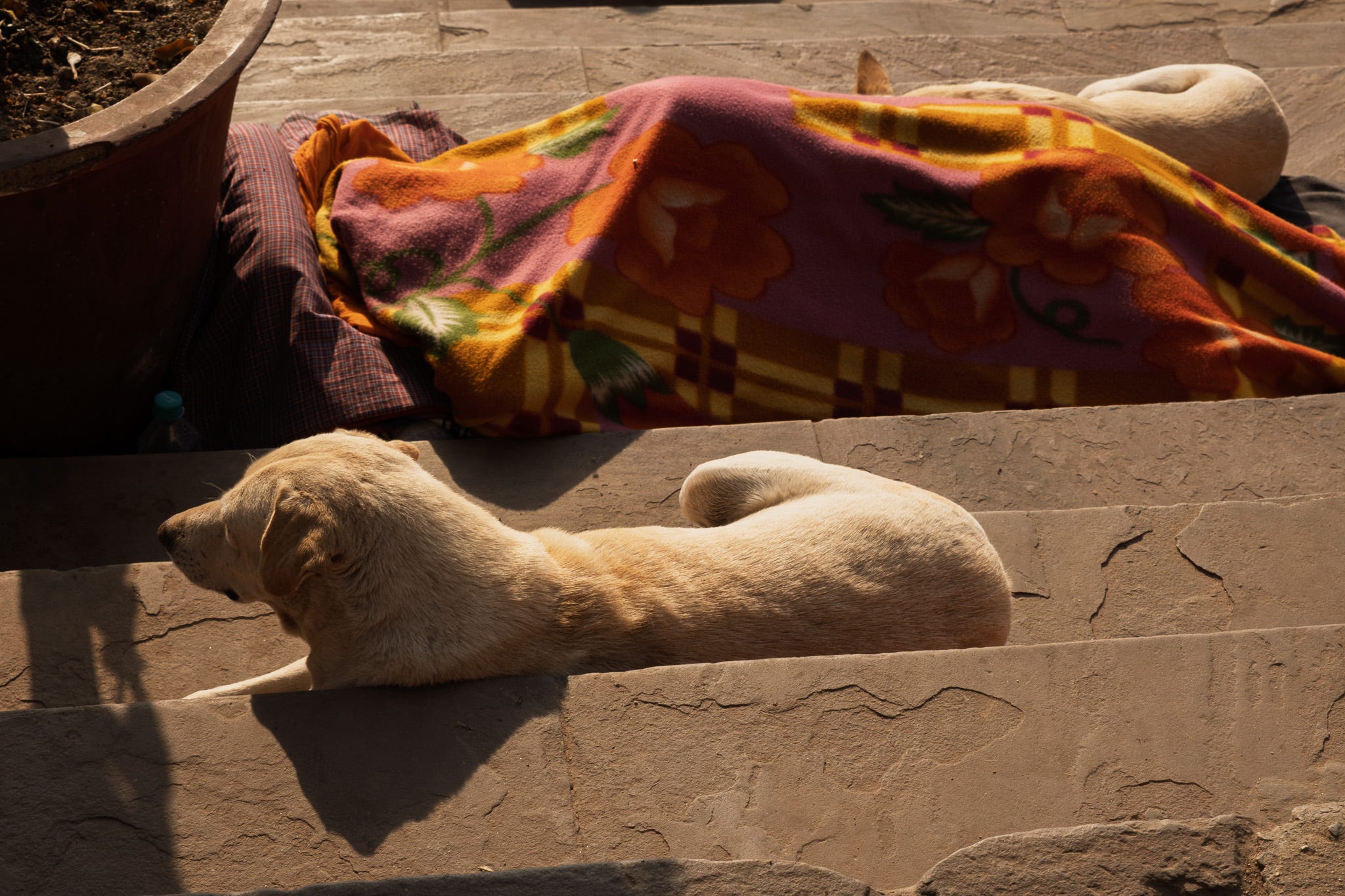
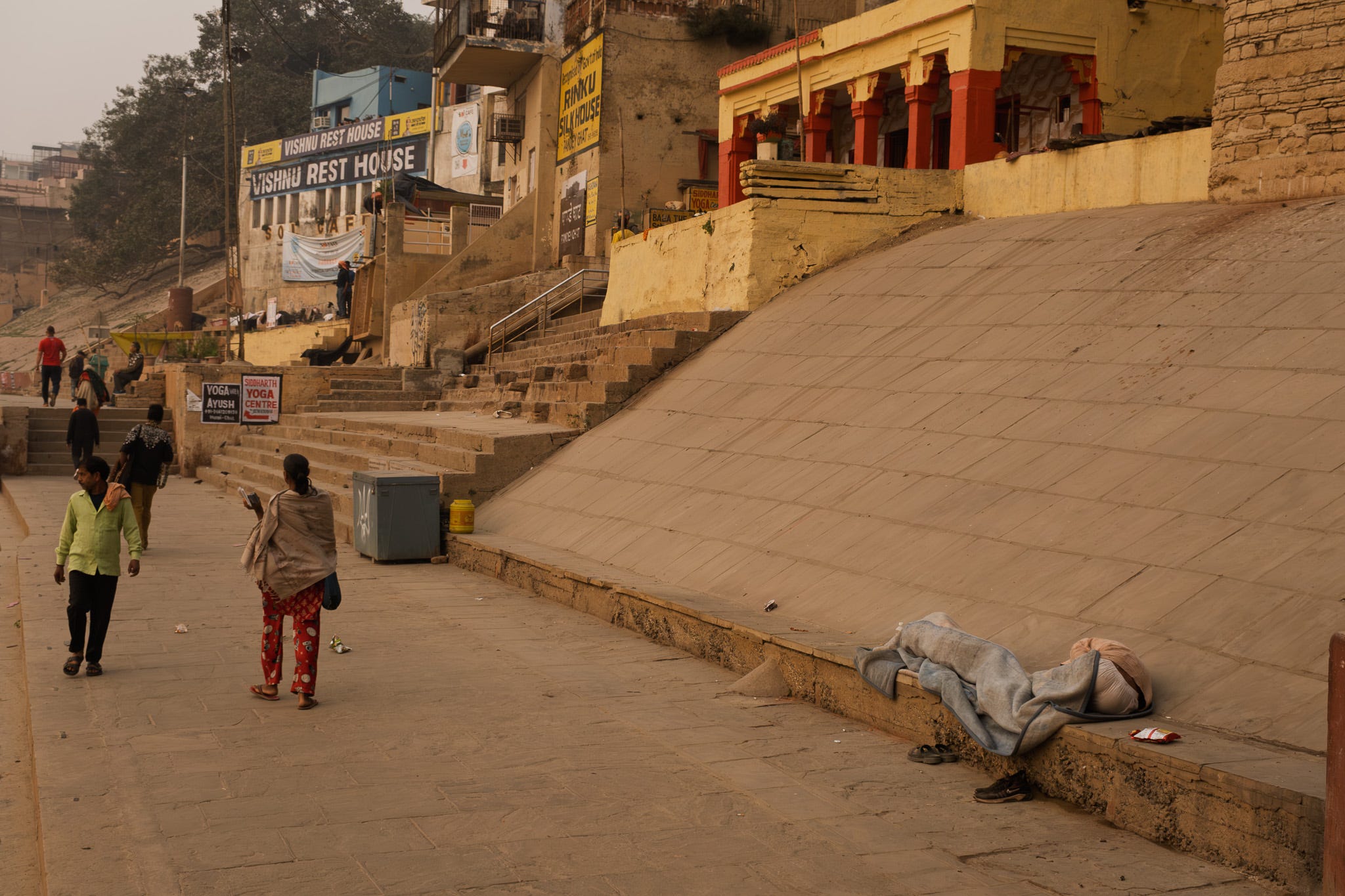
Further along, you will encounter the homeless, lying on the steps or the slope of the ghats, wrapped in the blanket someone probably donated to them.
Continue walking, and you will meet people doing yoga. The men and women – Japanese or Korean – twisted themselves into impossible knots, and I wondered if they would need help untying them. A man sat in the ‘vajrasana,’ oblivious to my presence or the possibly unwelcome gaze of my camera lenses. The yoga practitioners, similarly, ignored me and continued their journey towards becoming unrecognizable human balls of knots.
I met a local boat owner, and we talked as if we had known each other for several lifetimes. We exchanged phone numbers, in case I returned to Benares and asked for a boat. I insisted that I wanted a rowboat, not one of those newfangled things that rush along the river’s surface.
Share a chai and a conversation with people.
Morning is also a superb time to have chai with someone and chat. It’s good that I have been to Benares more than fifty times: the familiarity I have with the town’s culture helps break down a few barriers, and people are willing to talk. One morning, I had chai and listened to a local grumble about the cable car being built and forecast how it would take business away from the local rickshaw wallahs. As we spoke, I watched a man pray at a small corner temple before going home (I assume) to prepare for the day. Small, almost personal temples co-exist with the big ones.
Despite political interference, people love to live in peace.
While Hindus remain suspicious of Muslims, placing themselves above Muslims, the two communities live in harmony, each recognizing their mutual dependence. However, since 2014, the Hindus I spoke to insist on placing themselves on a pedestal, saying that the Hindu community never sparks off any violence, riot, or religious violence.
We love the fiction we create for ourselves and live in our fantasy world with ease.
The homeless, the pious, the trader, and the artisan live in harmony as before. Tensions simmer, stoked by right-wing groups of all communities. Benares has historically not witnessed large-scale religious riots, and I doubt the town will in the near future.
The slow rhythm persists.
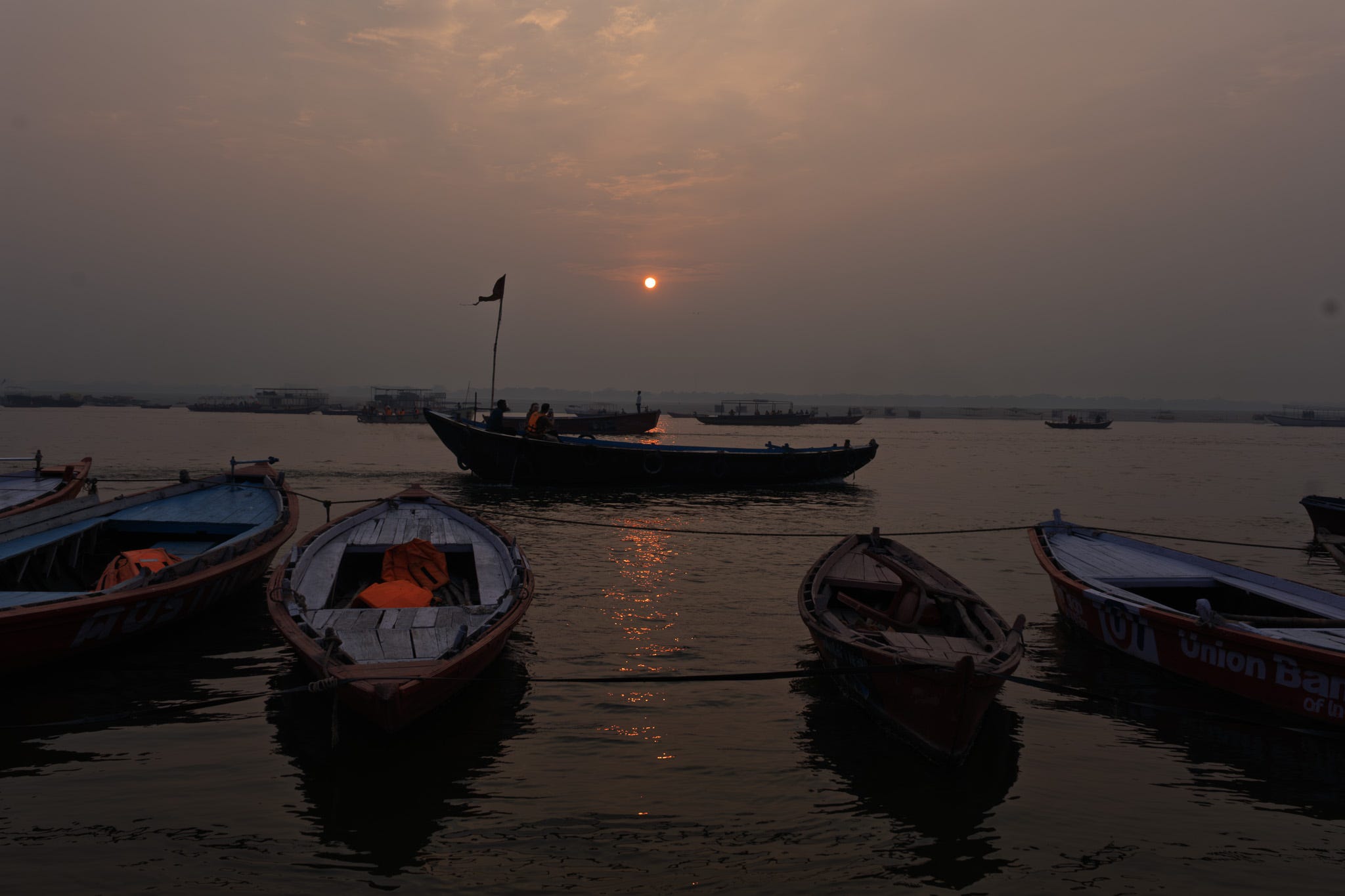
I believe that the town’s slow rhythm still exists: the river flows, people do yoga, pray at the ghats, bathe in the water, greet the morning sun on a boat, drink chai, gossip, and do business.
Queen Ahilyabai and the Marathas built the modern ghats in the 19th century, and a ghat is named in her honor, but I doubt anyone has heard of the great queen. Ahilyabai was a great queen, but in our patriarchal writing of history, we have written many great Indian women out of the dusty pages and swept them into oblivion. Few remember them.
Does the city retain something of its ancient character? No.
For one, the tawaifs have disappeared (read my post on the tawaifs), and with their disappearance, a fantastic tradition has also disappeared into the dusty pages of history. We do them a great injustice.
Does the city retain any of its old character? Maybe in its rhythms, but it is foolish to assume life in Benares is the same as it was five or ten centuries ago. People dress and speak differently. Since the British set foot in India and made cannabis illegal, you won’t see as many people smoking a chillum on the riverbanks as you used to. We can blame the British, but we must apportion some blame to ourselves: despite the growth of machine learning, human intelligence is also becoming artificial, and we are becoming moralistic and preachy. The recent ban on meat near the temple – but not on booze – shows how preachy and hypocritical we have become. The huge LED signs near the temples, promoting saris and other garments, speak of commerce, not piety.
Yet, the city retains some of its old rhythms, the rhythms I have become familiar with. The dhobis are a vanishing breed, and vultures have disappeared. You won’t encounter a dog nibbling a skull in the water, as I did many years ago.
And yet, the gentle rhythm continues, despite the helipads, the evening crowds, the CNG-driven boats, the luxury hotels, and political attempts to recast the city in their image.
The city existed before the current crop of politicians and will continue to thrive long after their names have been ground into history’s dust.
Stripe refuses to support Indian writers, so consider supporting me on PayPal.

Rajiv,
Whenever everything looks too grim I will only need to look at this post. It is comforting. If Benares can exist for so long maybe I can last a bit longer despite all the imminent negative event threats that the world will end in the near future.
Larry B.