
Benares: The City of Death & Release.
From Kapal Kriya to Manikarnika Ghat. An exploration of mortality in India

Benares. The city of death and moksha.
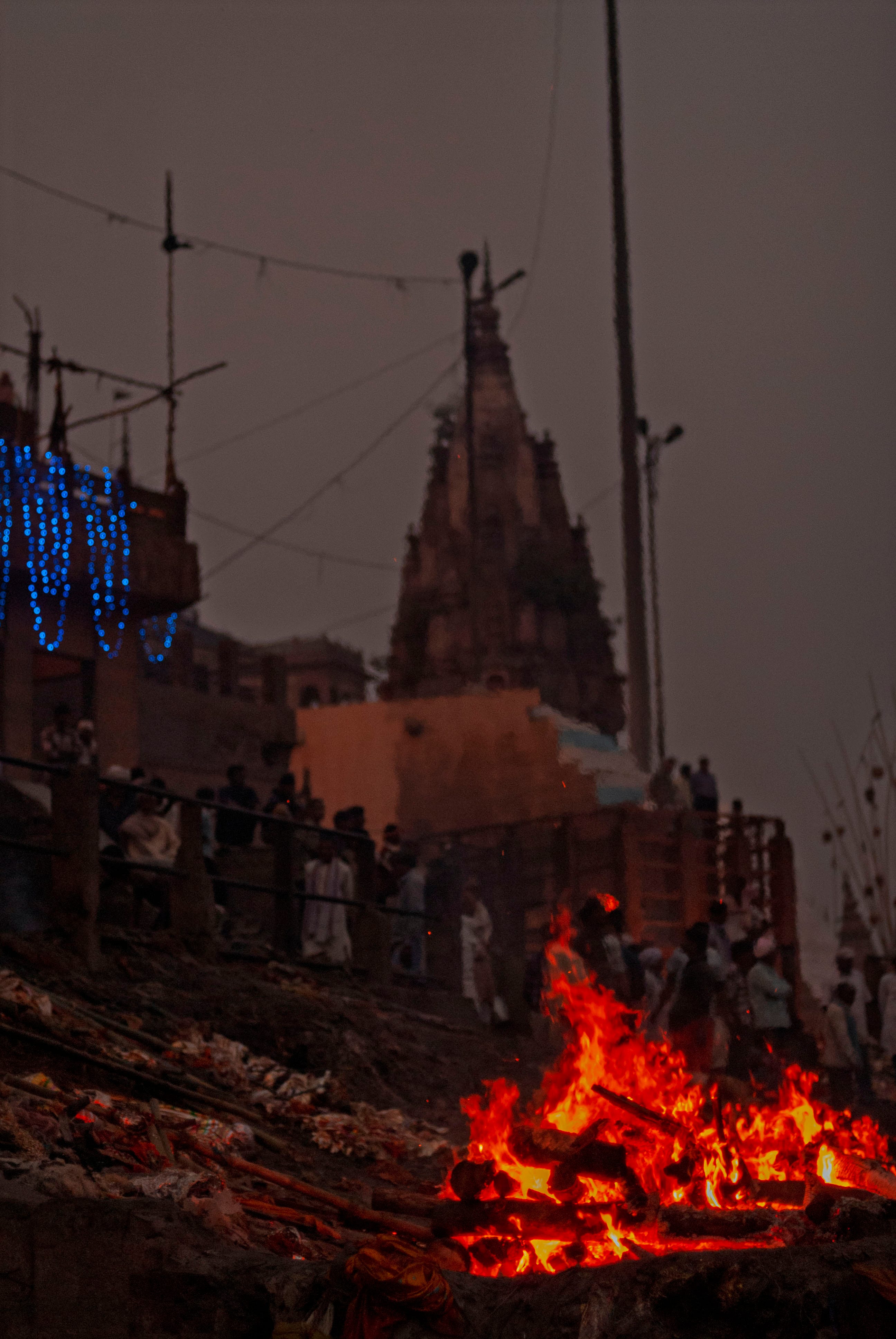
Benares is the city of death. Benares is the city where you come to die or to be cremated if you wish to escape the endless cycle of birth, life, death, and rebirth. I am Indian, and while we speak of heaven (swarag) and hell (narak), I don’t have a visual or other image of what heaven or hell look like.
Many images depict gods and goddesses sitting together. Some depict Shiva in the mountains, and most modern images depict gods and goddesses in an antiseptic manner.
But if you ask me to describe heaven or hell, I won’t be able to answer. I don’t know if there is a link between the Buddhist belief that life on earth is hell and the idea that we need to act in a manner that eventually releases us from this cycle of life and rebirth.
We will not explore concepts like karma deeply.
I will not explore concepts like ‘dharma,’ ‘karma,’ ‘moksha,’ and ‘nirvana.’ I will state that, despite Western insistence that ‘dharma’ is a Buddhist philosophy, it is not. Dharma predates Buddhism and is very complex. ‘Karma,’ very loosely, refers to the fruit of your actions. People like to say that if you are a horrible person in this life, you may be born as a cockroach in the next life, but if you are a good person, you will be born as a better person in the next life. The cycle continues until you have paid accumulated debts (karma) from previous lives, and then your soul finds release from this endless cycle and is released into the cosmos. We call this ‘moksha’ or ‘nirvana.’ Contrary to Western thought, karma is not a bitch, and nirvana is not a rock band.
Death and cremation in Benares bring release.
Benares is the city of Shiva, and people believe that if you die or are cremated here, Lord Shiva whispers the ‘Taraka mantra‘ into the dead person’s ear, releasing their soul into the cosmos.
I had written about my trip to Khajuraho and the crazy guide I met. This worthy gentleman told me that the other name for Benares is ‘Moksha Bhoomi,’ or the land/earth where your soul finds release from this eternal cycle of life and rebirth.
Cremations take place at the Manikarnika Ghat, and many people call it the ‘Maha Shamshana’ or ‘The Great Cremation Ground.’ The fires never stop burning, and even our Prime Minister, while sending bulldozers to demolish the ghat (presumably to rebuild it in his image), would never dare demolish it entirely and stop the cremations.
I don’t know the status, but when I visited in February, I saw that he had demolished part of the ghat, and I assume they will demolish and reconstruct small sections, one at a time. Even so, people were incensed. Silence does not mean consent or acceptance. The few people I spoke to, considered the demolitions to be sacrilegious. I assume that the local populace would have been more at peace if the authorities had taken them into confidence rather than adopting a heavy-handed approach.
Do not photograph a cremation ceremony.
I took the photograph you see in this brief essay over a decade ago with my Nikon D200, and it is noisy. Notwithstanding my earlier arrogance (my soul still carried memories of the designation I had in my last job – CEO), I was a bit wary when I made the photos, and I have never photographed a burning pyre since then.
Why, you may ask?
Even though cremations take place in the open, in full public view, funerals are deeply personal events, and families object to the cremation being turned into a public spectacle. Many Western publications sensationalized the public and mass cremations that happened during COVID-19, acts many of us considered shameful, hypocritical, and disgusting.
Apart from this, people also believe that cremations mark the transition from life to the afterlife, and that the soul of the deceased travels to the cosmos to be released or to await rebirth. Hindus believe that the person actually dies during the cremation ceremony and that photography disturbs this journey. Yet you will see many tourists – Indian and international – sitting on boats or wandering along the Manikarnika Ghat, gawking like fools and whipping out their cameras.
The Dom Community.
By doing so, they make a spectacle of a private and spiritual event.
The Dom Raja – the ‘king’ of the Dom Community – controls cremations and always has deep political connections. Yet, because the Dom Community is from a lower caste, locals discriminate against them in temples, in markets, and in daily life. This discrimination is ironic and hypocritical because, without the Dom Community, there would be no cremation and no ‘moksha’ for the deceased.
I cannot explain this strange duality in India. You may call it hypocritical if you wish. If you like, I invite you to investigate this strange behavior, but I assure you that you will not understand the duality. Accept it for what it is, for better or for worse.
Death is personal in India, in ways that may seem strange to others.
No one likes to talk about death, and we Indians do not differ from other people in this respect. Yet, death is deeply personal in that we get involved with the dead.
The dead always come home (unless the person died of a highly infectious disease) before being taken to the cremation ground. The final journey begins at home. We do not embalm the dead, and many people – friends and family – come to bid farewell to the deceased before the final journey begins.
I have no intention of writing every detail of the cremation – death – process, and you will have to be satisfied with the abbreviated version. If the cremation is done in the traditional manner – wood fire, not electric – friends and family form a chain and pass the wood from one to the other until it reaches the pyre. The priest places the body on the pyre and covers it well.
Then, the chief mourner (usually the eldest son or male member) will place a burning flame in the dead person’s mouth (mukh agni). During the cremation, the priest then invites the chief mourner to crack the skull (kapal kriya or ‘skull ritual ‘), and this releases the dead person’s soul.
Some people are uncomfortable with this act, and I have witnessed priests offering the mourners the option of passing on this responsibility to the priest, and they do this via a small, symbolic ceremony – dropping a mud container onto the ground.
The next morning, the chief mourner, with close relatives, will visit the pyre and collect the ashes and remaining bones of the deceased and place them in an urn. It is our responsibility to collect the ashes or the ‘phool’ (flowers), as we refer to the ashes and remaining bones. Finally, we go to a river or another place to immerse the ashes and bid farewell to the dead as they begin their final journey to the afterlife.
I must point out that we carry the dead on a bamboo stretcher to the cremation ground, and one fear that haunts many people is this: who will carry me when I die? You may call this process the ‘antim sanskar’ or the ‘antyetsi.’ Walk along an Indian street, especially in small towns and villages, and you will see a funeral procession happening on the road. Not every day, though!
The last respects.
The term ‘Antim Sanskar’ means ‘last sacrifice’. You can read this as the ‘last respects’ we pay to the dead. These last rites return the body to the five elements.
The process is more complex than the simple statement ‘ashes to ashes.’ Yet we come from the elements and return to them.
Read the hymn from the Rig Veda.
The practice and rituals are ancient.
This post marks the end of my Benares writing. I don’t know when, or if, I will return to Benares. Oh, no, no, no, no, no!!
I will return, but as part of a longer - almost three-week-long - road trip. That will be a fascinating trip, combining two themes in one.
Apart from that journey, Benares is not on my horizon, except possibly to lead a group of young, hopeful photographers there.
Since Stripe refuses to support Indian content writers, you can support me here.
I will start making subscriber-only posts very soon!
This is an excellent piece, you know you are in the hands of a talented writer when their word's transport you to the tale that is being told.
This is an excellent explanation of different concepts and excellent defining of the words that represent so much that we sometimes misunderstand or where there is much to them that is not easily explained. I like how you visit all over India and I would be happy if you dropped by Benares every once and a while to see it is still and hasn't been remade into of India Disneyland of sorts. Some people feel to talk about death indicates a lack of sensitivity, but I think it indicates caring because if someone is upset. Better to try and alleviate their anxiety by talking of death in a way makes it more comfortably understandable. This is not easy. You need to find someone who has confronted the idea and figured out its worst aspects in the most comfortable way possible. The Asian attitude is more basic, and some things are better confronted in the simplest way possible. These posts are excellent in telling us all about cultures and how they deal with some of life's most important questions are. Indeed, lead the way to some good answers.