

Blind as a Bat. With due apologies to Meat Loaf
Scientists say that bats are blind. Scientists also state that bats have excellent navigational skills because of their sonar capabilities. The same men and women also inform us that bats have robust immune systems.
I am inferior to a bat in many ways, and it pains me to make this confession. We humans implicitly claim to be gods and to rule the planet, yet, in many ways, we are inferior to our animal friends.
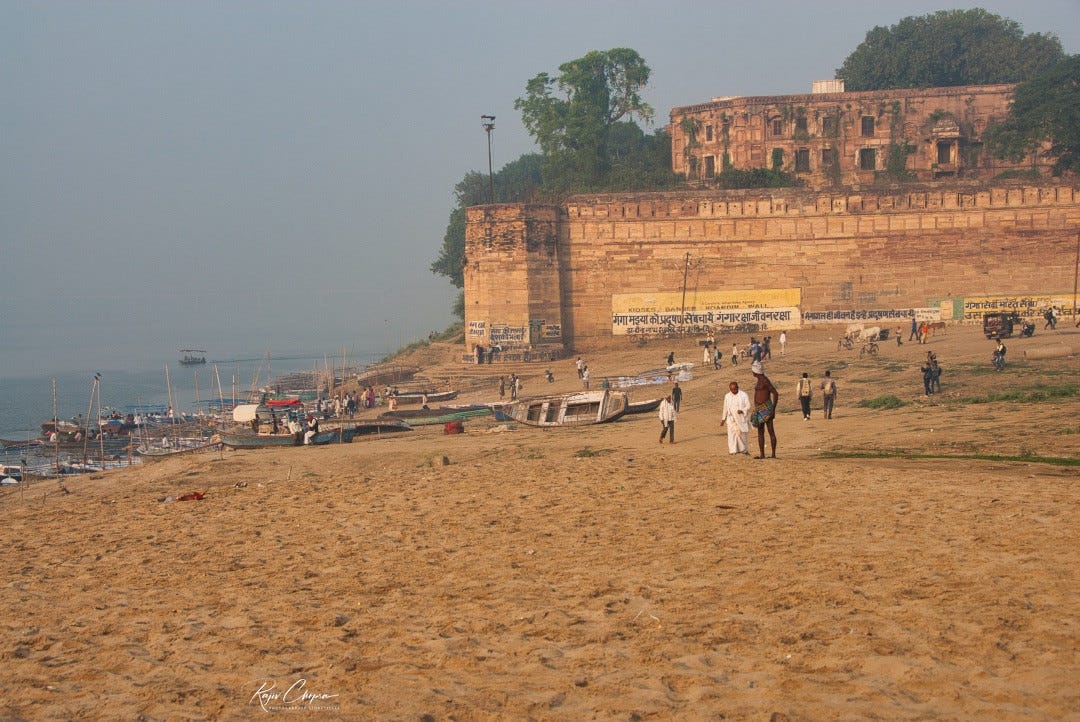
I do not make this confession lightly, so let me place the matter in a context that is comprehensible to all readers. My memory rarely fails me. I distinctly remember visiting the banks of the Yamuna when I was a strapping teenager, but I do not recall seeing the Allahabad fort, built by Akbar in 1583 CE. Since the fort could not have disappeared during my teenage visit, and reappeared afterwards, I confess to being inferior to bats.
There is not much you can see inside the fort.
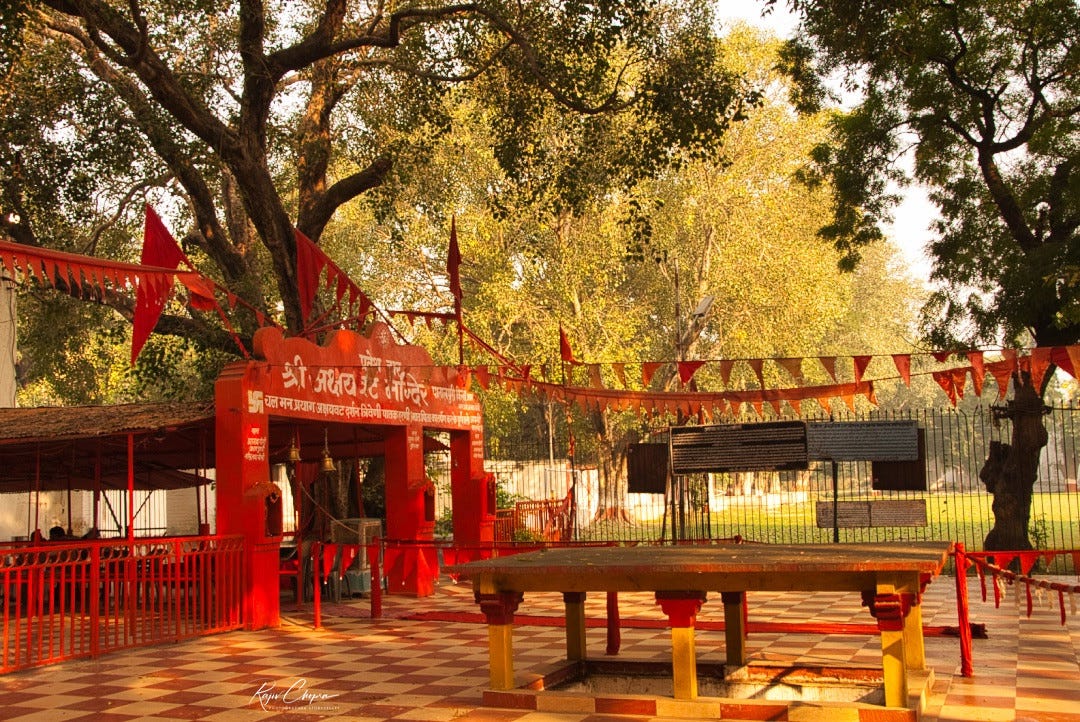
I also confess to being disappointed when I entered the fort, because the police or the army had taken over most of the area inside, leaving us with only a tiny spot to explore. The authorities have not surrendered their right to occupy the fort premises to intrepid travelers like me, using it to keep guard, especially during festivals like the Kumbh Mela.
My friend and I arrived at the shores, took a boat ride at dawn, and when we returned from our sojourn to the sangam, we explored Akbar’s creation. There was not much we could see. After walking up the sloping path and entering the massive gates, we reached a courtyard. A temple occupies centre-stage in the compound, and I assume that the authorities who occupy the fort use it for their prayers.
A few logs of wood lay scattered around the wall, and the only sensation I felt was one of stupor, forgetfulness, and decay. Please bear with me. The grounds themselves are not decaying, and what I sensed was the decay of history, the decay of memory, deliberate forgetfulness, and the dawn of bigotry.
Many websites state that an Ashokan pillar stands on the premises, but we did not spot it. I don’t believe we spent more than half an hour inside, and the only person we encountered was a hostile priest who teetered on the edge of abusive behavior. I don’t know whether priests are required to take vows of celibacy or good behavior, or whether the nonexistent regulations demand they follow a strict moral code. The caste system, which the British inadvertently strengthened, ensured the Brahmins arrogated pride of place in the Indian pecking order. Brahmanism is alive and well, much to the detriment of Indian society overall. Since only Brahmins can become priests, I doubt they must undergo any training protocol or swear an oath to be chaste and morally incorruptible.
Akbar’s fort and the drama of history.
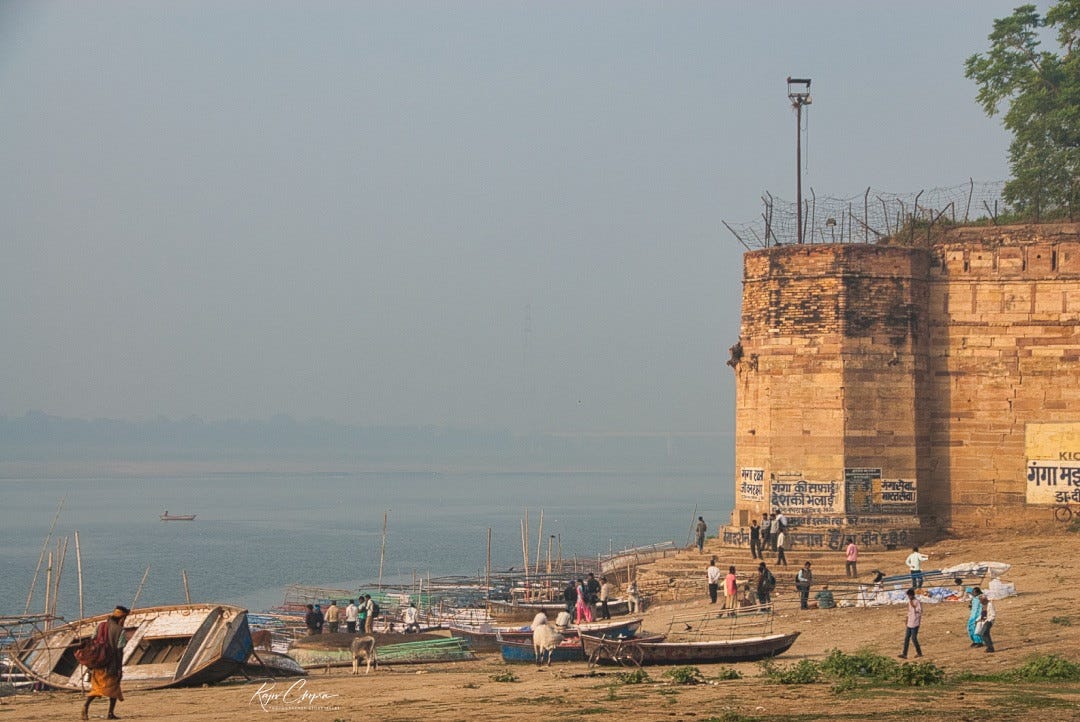
The fort’s stones bear witness to ages of drama, which we Indians are unaware of, and considering the retrograde amendments the government is making to our education system, we will have an entire generation of moronic bigots growing into adulthood in India.
I do not blame people for being unaware of our history. Teachers have converted history into one of the most boring subjects in our curriculum, relegating it to the bottom of the heap, making it easy for politicians anywhere in the world to manipulate the past, to change the present, and control the future. I misquote, of course, from George Orwell.
Allow me, therefore, to write a few words about Allahabad Fort, its history, some of the drama that the fort witnessed, and its passing into British hands.
Akbar & Salim
Akbar built the fort in 1583 CE. You do not build forts because of vanity, though some kings have done so in the past. By placing the fort on the riverbank, Akbar ensured control over the waterways, especially since the site is at the confluence of two rivers. He also established his kingdom at a crucial location, enabling him to defend and control his expanding empire. Finally, by placing the fort at one of India’s holy sites, he ensured his presence within the local culture. Akbar was a shrewd and wise king. A lesser mortal would have subjugated the local population and tried to convert them to his religion. Akbar did nothing of the kind, binding the local people to his court.
Deadly succession battles
His son, Prince Salim (later called Jehangir), was the first of the Mughal princes to rebel against his father to gain control of the throne. Sibling rivalry was nothing new to the Mughals: Humayun and Akbar both contended with rebellions from their brothers and half-brothers. While these led to wars, they did not lead to murder and bloodshed.
The famous Persian/Urdu saying (originating from central Asia) – ‘ya takht ya tabut’ took on increasingly more deadly overtones with the accession of Jehangir, Shah Jahan, and Aurangzeb to the Mughal throne. In essence, the saying roughly translates as ‘the throne or the coffin,’ signifying the deadly stakes the Timurid princes played for the kingship.
Jehangir rebelled against his father. Akbar was a great king but a terrible father, and, while it is impossible to state that he sometimes belittled his sons, I have read that the young princes found it almost impossible to shine in his presence and became hopeless drunkards and addicts. Akbar’s shadow was long, dark, and hard.
Prince Salim was the only successful rebel amongst his siblings, and thanks to three powerful women at Akbar’s court, he got away -literally- with murder. Salim murdered Abul Fazl, one of Akbar’s most trusted advisors, and had it not been for Hamida Banu Begum (Akbar’s mother), Salima Sultan Begum (one of Akbar’s wives), and Gulbadan Begum (Akbar’s aunt), the reprisals would have been swift and merciless.
Jehangir set up a parallel court in Allahabad, took control of the fort his father had built, and even issued coins in his own name! Jehangir reconciled with Akbar before the king’s death and continued to use the fort as a strategic location when he became king.
Later, when Prince Khurram (Shah Jahan) rebelled against his father, he also besieged Allahabad Fort.
From Timurid to British control
Power is transitory, and history is the story of empires that rose and fell along history’s long trajectory. When you consider this small fact, you must pause and wonder at the arrogance of all leaders, past and present. Humility is not a virtue people admire.
The Timurid dynasty faded, and the ragged English East India Company began its rise to power. The British viewed the fort primarily as a strategic location, especially as they continued their ruthless advance westwards, from Calcutta to Delhi.
Buxar
Shah Alam, the Mughal Emperor of the time, fought the British and lost at the Battle of Buxar in 1764. As a result, the British confined the emperor to the palace and signed the Treaty of Allahabad in 1765 CE. A key point of the treaty was that the Mughal Emperor granted the diwani of Bengal to the British, giving them control over Bengal’s finances and transforming them from a trading company into a ruling authority.
The Battle of Buxar and its aftermath changed the subcontinent forever.
During the 1857-58 uprising, rebel forces killed several English people, but after the rebellion, Lord Canning read Queen Victoria’s proclamation, transforming the subcontinent into a Crown territory. The British then transformed the Mughal city into a British genteel town, creating the Civil Lines, the University, and the High Court.
I have been to Buxar once, by accident and not by design. Our history teachers used to drill historical dates into our brains, and a few such dates have become part of my waking memory.
The First Battle of Panipat of 1526. My schoolteachers did not teach us about the Second and Third Battles of Panipat.
The Battle of Plassey of 1757. They taught us about Mir Jafar’s perfidy and Clive’s ‘bravery.’ Still, they forgot to mention the role of the Jagat Seth family in brokering the deal, which led Mir Jafar to abandon Siraj-ud-Daulah in the middle of the battle. The Jagath Seth family was arguably the world’s wealthiest in 1757 CE. Still, in less than half a century, the East India Company reduced them to the status of pensioners.
I was travelling to Ballia in the far eastern part of Uttar Pradesh; I took a train from Delhi to Buxar and a smoky motorcycle rickshaw from Buxar to Ballia. I walked around Buxar for thirty minutes before travelling on to Ballia, curious to explore the site of the famous battle. Buxar is a dusty, dirty town with no memory of a battle that changed the history of the subcontinent. In fact, I’d even say that Buxar is a disgusting town!
The archdiocese of Allahabad held considerable sway over religious and other affairs, including schools. My school was under the archdiocese of Allahabad in the early part of the last century.
Will the fort vanish one day in the distant future?
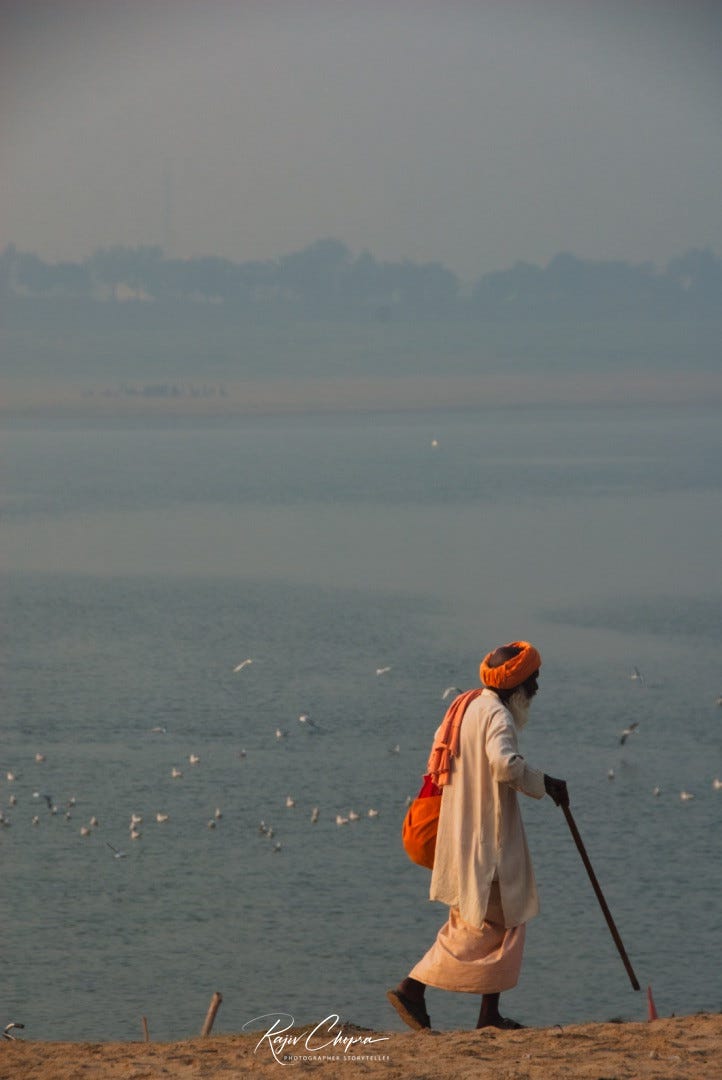
Today, when you wander in the restricted areas allowed to the public, the gods of history may forgive you if you are ignorant of the drama that often played itself out in the fort.
The fort stands on the banks of the Yamuna, its stories forgotten, its historical significance ignored. As the stories surrounding the structure fall beneath the dust of ignorance, indifference, and the fist of bigotry, the fort itself may crumble into the river’s water, and only then will the dead soul of the fort find peace.
Links!
https://www.differenttruths.com/allahabad-fort-from-the-grandeur-of-akbar-to-the-tyranny-of-raj/
https://www.tripuntold.com/india/uttar-pradesh/allahabad/allahabad-fort/
https://academic.oup.com/book/36128/chapter-abstract/313664303?redirectedFrom=fulltext
https://www.peepultree.world/livehistoryindia/story/places/the-british-legacy-in-allahabad
https://wieils.iiita.ac.in/?p=832