

Ferozepore is an important cantonment town
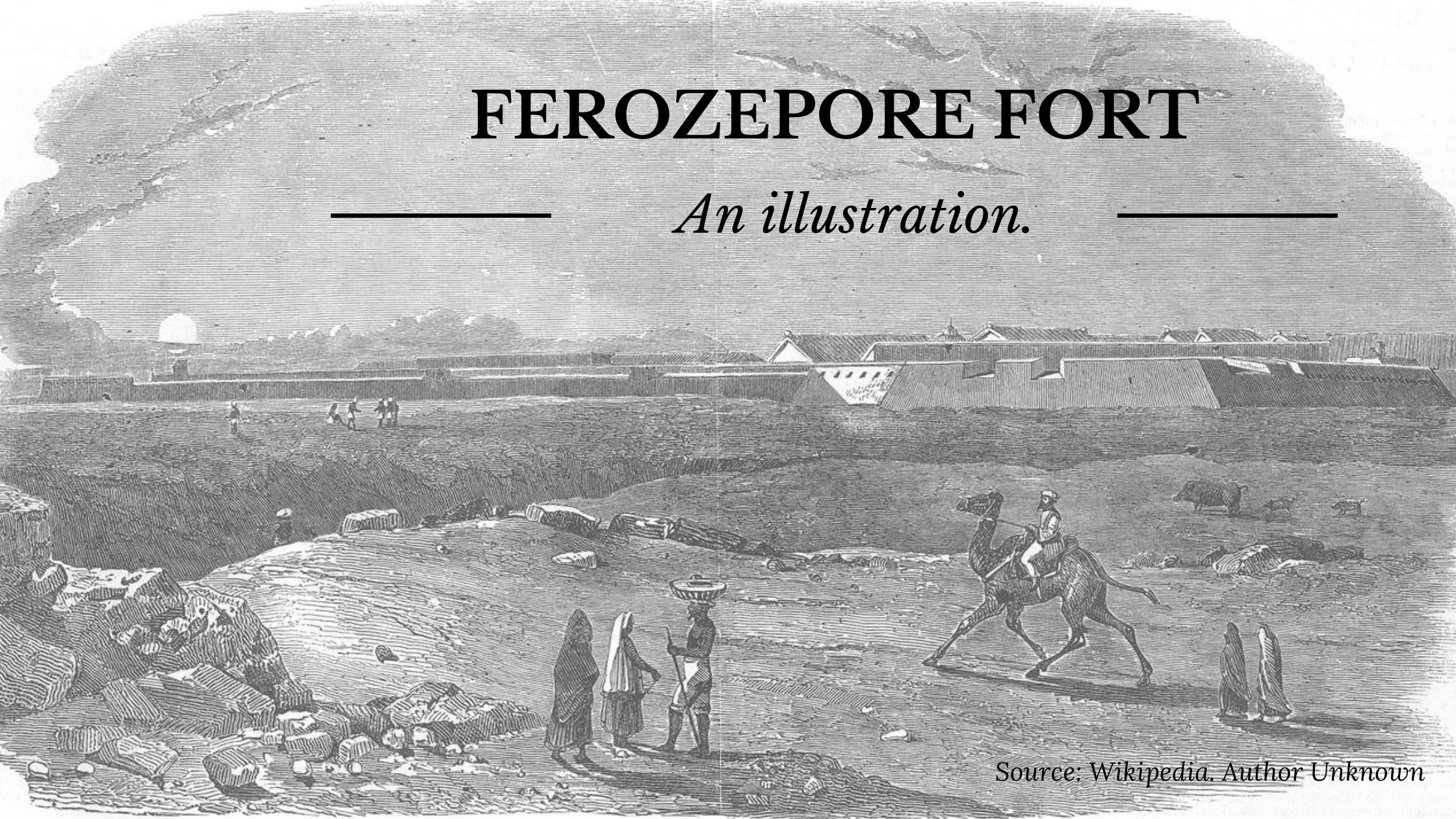
I was born in Ferozepore, Punjab, many moons ago. My late father served in the Army and was posted to the cantonment town for a few years. This is where my younger sister and I were born, a little over a year apart. We had an Alsatian named Gypsy, who was stolen. According to family stories, I’d ride on Gypsy’s back, and he was protective of me, so I wonder how someone stole the blighter.
I had not returned to Ferozepore since we moved away when I was two years old. We moved to Bombay (now called Mumbai), and from there we moved to England, living on the outskirts of London in Kenton, Harrow, Middlesex. Since those heady days in England, I have developed a healthy grouse against the English East India Company, while realizing that we natives were also guilty of allowing the Brits to take over our land and then divide it. But that is another story.
Ferozepore is a border town.
The Hussaini Wala Border is about 11 kilometers from Ferozepore, so the town is an important border town, with a sizeable Army Cantonment.
I finally returned to Ferozepore last year on my birthday because I was keen to see the town and the hospital where I decided to show up on this planet. We made a family trip out of it, also going to Amritsar. My wife cracked her tooth while we were driving to Ferozepore, so we had to hurry back to Amritsar.
I hate to admit that Ferozepore is not a grand town. I want to return in the next one or two years and explore the place properly, but while looking for places to stay, I found advice from other travelers to stay in the neighboring town. Luckily, there is one small South Indian restaurant on the outskirts of the town, so I won’t starve!
A brief history of Ferozepore.
It is time to explore the history of the place where I was born. Since it is my birthday month, I shall do this in two parts, so indulge me. The tradition of kings and others naming towns after themselves is not new. Ferozepore is neither young nor old. It is probably just past adolescence. The Tughlaq king, Firoz Shah Tughlaq, founded the town sometime between 1351 and 1388 CE and named it after himself. This is the same king who founded Firozabad, the fifth city of Delhi – Firoz Shah Kotla, and, if memory serves, Jaunpur in West Uttar Pradesh. This is the same king who carefully transported an Ashokan pillar to his capital, Firoz Shah Kotla, ensuring it arrived in good condition.
Some people refuse to accept the Tughlaq founding of Ferozepore, believing that the Sikhs founded the town a few centuries later.
The Misls and the eventual passing the torch to the British.
After Guru Gobind Singh died, the Sikhs divided into a kind of commonwealth of provinces called ‘misls.’ The word ‘misl’ is of Persian/Arabic origin and signifies equality. While there were large and small misls, they banded together as one unit when faced with an external threat. The Sikhs fought the Mughals (some historians believe the Sikhs set the Mughal Empire on its downward slope) and Afghan invaders such as Nadir Shah. I won’t write about the misls here and will leave that tale to a future date.
However, the Bhangi misl controlled Ferozepore, and after them the town passed to a person named Gurbaksh Singh and finally to his widow, Rani Lachhman Kaur. The word ‘Kaur,’ used for Sikh women, means ‘princess.’
After the Rani’s death, Ferozepore passed into British hands, and for the first time, the British had a foothold at the borders of Sikh territory. Maharaja Ranjit Singh was in his final years, and probably his health was declining. The Maharaja died in 1839 CE and, like Aurangzeb, one of his major failings was that he had no succession plan in place.
The Anglo-Sikh Wars.
Maharaja Ranjit Singh’s death set the stage for the East India Company’s next phase of expansion in India, and the Anglo-Sikh Wars followed. The First Anglo-Sikh War occurred between 1845 and 1846 CE and, by all accounts, was a fierce, bloody conflict, with both sides almost evenly matched. At one point, Governor General Hardinge was ready to admit defeat and even contemplated dying in the war. In the end, the British prevailed, paving the way for the next Anglo-Sikh War.
Ferozepore was the strategic pivot of the battle, which may have led to the establishment of a cantonment in the town. Now that it is a border town, its importance as an Army cantonment remains unchallenged.
There is a memorial erected in 1976 honoring the dead of Mudki, Ferozeshah, Sobraon, and Chillianwala (all villages and battle sites), so maybe when I return to Ferozepore, I will go and have a look at the memorial that has been built.
I’d like to mention a point: Ferozepore did not pass into British hands at the end of the First Anglo-Sikh War. Ferozepore passed into British hands when Rani Lachhman Kaur died in 1835 CE. Since the Rani did not leave a male heir, the British claimed that it had lapsed into their hands. Ferozepore lies close to the Sutlej River, which the British deemed strategically important; they may have insisted on the takeover because of the town’s location, and they used the lack of a male heir to justify it.
I do not know if this takeover was the precursor of the doctrine of lapse later espoused by Lord Dalhousie (that doctrine of lapse was one of the reasons for the Uprising of 1857-58), but it may well have been the case.
As soon as the British completed the takeover in 1839 CE, they established a cantonment there. The political takeover occurred half a decade before the First Anglo-Sikh War. Therefore, the First Anglo-Sikh War was a battle for control of Ferozepore, a strategic military location.
The result of the First Anglo-Sikh War of 1845-46 was the signing of the Lahore Treaty, which severely curtailed Sikh sovereignty.
The Second Anglo-Sikh War took place between 1848 and 1849 CE at Ramnagar, Chilian Wala, and Gujarat (not the Gujarat of Ambani/Adani fame), resulting in a second British victory and the complete takeover of Sikh territory.
The Anglo-Sikh Wars were among the fiercest the British fought in India (barring possibly the wars with Tipu Sultan in Mysore), and the British acknowledged the Sikh fighting spirit and prowess. These wars may have been instrumental in the subsequent British theory of the ‘martial races’ of India, a deeply flawed theory.
Why was the Sutlej more than just a river?
Ferozepore lies on the banks of the Sutlej River. By a strange coincidence, when I was in school, I was in Sutlej House when I was in Grade IV! Anyway, the Sutlej River was not just a river: it was a border. As per the Treaty of Amritsar, 1809 CE, the Sutlej River became the border between the Sikh controlled areas and the British controlled area, creating the cis-Punjab or trans-Punjab area. Ferozepore also became a kind of forward post and Punjab was critical to the British and their expanding ambitions, especially in the 19th century when the movements of the Russians began to stress them. Babur, while being more of Uzbek origin than Afghan, came to the subcontinent from Afghanistan. Sher Shah Suri was an Afghan, as were Mohammed of Ghor, Nadir Shah and Ahmed Shah Abdali. Some histories state that ‘Hindus’ ruled Afghanistan until about a thousand years ago and even today, there are Sikhs who live in Afghanistan. Were it not for the British there is a strong possibility that parts (or all) of Afghanistan could have become a part of India post 1947.
Punjab was, therefore, critical to the British and their expanding ambitions. Did the theory of ‘spheres of influence’ originate in these times.
I don’t know what, if anything, remains of the old fort but I know that the British converted it into a cantonment.
A mystery. Why did the Punjabis become loyal British subjects?
One mystery remains, and no one has been able to solve it. Why did the Sikhs, who fought against the Mughals and the Afghans and the British, finally capitulate to the British and become their most loyal subjects? Is it because it was the British who finally defeated them? This theory will have holes because it will not account for a change in the structure of the Sikh state.
The misls that existed in the 18th century always came together when there was an external threat. The misls helped to present a united front to the enemy. When Maharaja Ranjit took over the entire territory, he consciously or unconsciously disbanded the misls, and in the chaos of succession that followed his death, the Sikhs possibly did not present a united front.
Whatever the reason, the Sikhs were part of the psychopathic Nicholson’s forces at the Battle of Kashmere Gate in 1858 when the East India Company forces broke through the resistance. That battle also paved the way for the end of the Mughal Empire when the British exiled Bahadur Shah Zafar to Rangoon and shot his sons – in cold blood – on Delhi’s streets.
And now, we will move on to Part Two of Ferozepore.
PayPal
Stripe refuses to support Indian writers so, if you’d like to support me, press the PayPal button. If you do so, then please let me know and I will add you to the Founders list
Links
Live History India on Firuz Shah’s city-building: https://www.livehistoryindia.com/story/places/feroze-shah-kotla-delhis-forgotten-city
Wikipedia, Firozpur Fort (construction history, contested Tughlaq vs. Sikh-period origin claims): https://en.wikipedia.org/wiki/Firozpur_Fort
Wikipedia, Firozpur district (overview): https://en.wikipedia.org/wiki/Firozpur_district
Wikipedia, Ferozepore (jagir) — full succession history: https://en.wikipedia.org/wiki/Ferozepore_(jagir)
World History Encyclopedia (best single overview): https://www.worldhistory.org/article/2130/battle-of-ferozeshah/
Britishbattles.com (detailed order of battle, casualties): https://www.britishbattles.com/first-sikh-war/battle-of-ferozeshah/
Britannica, concise entry: https://www.britannica.com/event/Battle-of-Firoz-Shah
History Today, “Ferozeshah and the First Anglo-Sikh War” (narrative essay, good for tone/quotes to paraphrase): https://www.historytoday.com/archive/feature/ferozeshah-and-first-anglo-sikh-war
AllAboutSikhs, Sikh-perspective account of the battle: https://www.allaboutsikhs.com/the-first-anglo-sikh-warbattle-of-ferozeshah/
Wikipedia, Battle of Ferozeshah: https://en.wikipedia.org/wiki/Battle_of_Ferozeshah
Wikipedia, Anglo-Sikh War Memorial at Ferozeshah (built 1976, honors dead of Mudki, Ferozeshah, Sobraon, Chillianwala): https://en.wikipedia.org/wiki/Anglo_Sikh_war_memorial
StudyIQ, Anglo-Sikh Wars and Punjab under British Rule (good connective-tissue overview): https://www.studyiq.com/articles/anglo-sikh-wars-and-punjab-under-british-rule/
Sikh Encyclopedia, “End of Sikh Sovereignty: Punjab’s 1849 Annexation”: https://www.thesikhencyclopedia.com/annexation-of-the-punjab/
Gateway to Sikhism, Annexation of Punjab 1849: https://www.allaboutsikhs.com/sikh-history/historical-events/annexation-of-punjab-1849/
JSPS paper, “Political Economy of the Annexation of the Punjab, 1849” (academic PDF, mentions Dalhousie meeting Sikh chiefs at Ferozepore): https://giss.org/jsps_vol_32/02-sohal.pdf
I didn't know any of this Punjab history and the influence of the kings and princely states or even cities is amazing. I wonder what India would be like if the English had never shown up! Looking forward to reading the second part of this.