

My last boss was an ass.
My last boss, the one who ended my corporate career, is a jackass, and I refer to him in uncomplimentary terms because the supervisory board should not have appointed him to the global managing board of the last company I worked for. He should never have risen beyond the ranks of a sales representative. Amongst his many sins was confessing that, despite travelling to India for over two decades, he had not the foggiest idea of India, wondering if we spoke many languages or if we all spoke Hindi. Allow me to clarify that Hindi is not my mother tongue. My mother tongue is Punjabi, and Persian was also an ancestral language.
Yet, I must confess that many corporate and business professionals like me often do not bother to understand the history of the towns we visit. I have been to Jaunpur several times, but only once for photography, and that too, for half a day.
Mustafa. Singapore and Jaunpur.
Singapore has a famous store, Mustafa, now an institution. When I first visited Singapore in 1990, the Mustafa store occupied several floors of one building. They always kept suitcases at the exit, and when I asked why, someone told me that the “mules” bought them before leaving the store. The mules did not smuggle drugs into India, but purchased and smuggled perfumes, electronics, cosmetics, etc., into India. Most mules flew to Madras, where they’d sell the stuff they bought from Mustafa. Indians were unpopular in those days, and once, when I asked a lady in Singapore’s upmarket Orchard Road for the price of a product, she refused to quote a price, telling me I was a stinking Indian who’d waste her time asking for a price, only to purchase the product at Mustafa.
Mustafa’s first business line was the shop. In an article in the now-defunct “The Far Eastern Economic Review”, the journalist wrote about how Mustafa’s procurement team searched the globe for the best deals. Then, they added a hotel to make it convenient for the mules to visit Singapore, rent a room, do their shopping, and leave.
Since then, Mustafa has expanded into gold jewellery, foreign exchange, ticketing, visa handling for India and Malaysia, and a few other lines of business. Once, he employed only people of Indian origin, but now he also hires native Singaporeans of Malaysian and Chinese origin.
I believe the founder has retired or passed away, and his descendants run the business.
You may ask: what does all this have to do with Jaunpur? The article in the “Far Eastern Economic Review” noted that the founder, Mustafa, was born in Jaunpur, East Uttar Pradesh, India, and that he sold vegetables from a pushcart on the street. No one knows how he made his way to Singapore or how he started his now-legendary business.
Was Mustafa born in Jaunpur? Although the article identifies Jaunpur as his birthplace, some say he was not born there. One other article notes that he left Jaunpur at five and joined his father in Singapore. From there, he slowly started his business, and a legend was born.
We only cared about a town’s sales potential, not its history.

In my days in consumer sales, we used to refer to towns like Jaunpur as “ex-towns” and cities like Benares as “overnight” towns. We measured a town’s worth by its sales potential and whether it had a habitable hotel.
Jaunpur lies 45 kilometers north-north-west of Benares, and the journey between the two towns takes ninety minutes. Neither the sales representative nor I stayed overnight in Jaunpur; hence, we called it an “ex-town.” Later, when we began selling our products in Jaunpur’s rural hinterland, we elevated it to the status of an “overnight town,” much to my sales team’s distress.
I remember Jaunpur being a dusty town, with a tree, a dusty road, and a surly distributor. The firm’s name was “Mohd. Musa & Sons,” and while the young Musa was always grumpy and ill-tempered, he was a stickler for honesty. His word was his law, and if he gave you his word, you could walk away in peace. There are people whose word is their law, something which a later French boss could not comprehend.
Europeans and their love for documentation!
My future French boss wanted everything documented, a lamentable European habit. The British wanted to write and sign every agreement on parchment– in English – even though many people who signed documents did not understand the language.
Europeans used to refer to us as pagans or Orientals who did not understand the value of the written word. We, in turn, could not understand their mania for signing everything when a person’s word or a handshake was enough. India has changed since those days, and many modern Indians do not hesitate to break their promise, which is a shame.
Going to Jaunpur and India’s ten-thousand-year-old Hindu civilization.
I was alone on my last trip to Benares and wished to explore Jaunpur, knowing I would not get any lunch. In one respect, Jaunpur had not changed since my first visit a few decades back: apart from a few sad food carts, the town offered nothing to intrepid travellers like myself.
Most people – including North Indians – believe that the Mughals dominate India’s history. Or, we travel back ten thousand years, and create fanciful myths about a glorious “Hindu civilization” that was the pride of the galaxy.
The founding and brief history of Jaunpur.
“Firoz Shah devoted himself to the founding of cities, forts, mosques, colleges and gardens… He restored prosperity to regions that had fallen into ruins.”
Barani, Tarikh-i-Firoz Shahi, mid 14th century.
Almost no one knows of the Delhi Sultanate. The Delhi Sultanate consisted of five dynasties that ruled Delhi and parts of North India between 1098 CE and 1526 CE. The Tughlaqs were the fourth Sultanate Dynasty, and Firoz Shah Tughlaq founded Jaunpur in 1359 CE. Jaunpur is neither young nor old. Jaunpur is younger than Delhi, much younger than Benares, but older than Calcutta, Bombay, and Madras. Is Jaunpur approaching middle age, I wonder.
Firoz Shah Tughlaq named the town Jaunpur in memory of his cousin and predecessor to the throne, Muhammad bin Tughlaq, whose given name was Jauna Khan. Muhammed bin Tughlaq was a crazy fellow, but I will write about him when I resume my photography project on the Sultanate of Delhi.
Firoz Shah Tughlaq was a builder of forts, mosques, and other structures, and his architectural ambitions predated those of Shah Jahan by almost three centuries. Again, wait until I start my project on the Sultanate of Delhi.
Even though Firoz Shah Tughlaq founded Jaunpur, the town remained nothing more than a provincial town until a few decades later, when Tughlaq power waned in Delhi, following Firoz Shah Tughlaq’s death. I am unsure if Tughlaq power waned before Timur invaded Delhi or after, but I guess Delhi’s influence waned before Timur sacked Delhi and plummeted thereafter.
One fact is undeniable. In 1394 CE, Malik Sarwar (Malik-us-Sharq), a governor of the Tughlaq Dynasty, declared independence and established the Sharqi Dynasty, which lasted until 1493 CE. The Sharqi Dynasty developed a unique architectural style, reflected in their mosques and forts. Jaunpur became politically and culturally significant, but once the Sharqi Dynasty ended, it probably reverted to being a minor, dusty provincial town.
I returned to Jaunpur for a brief exploration.
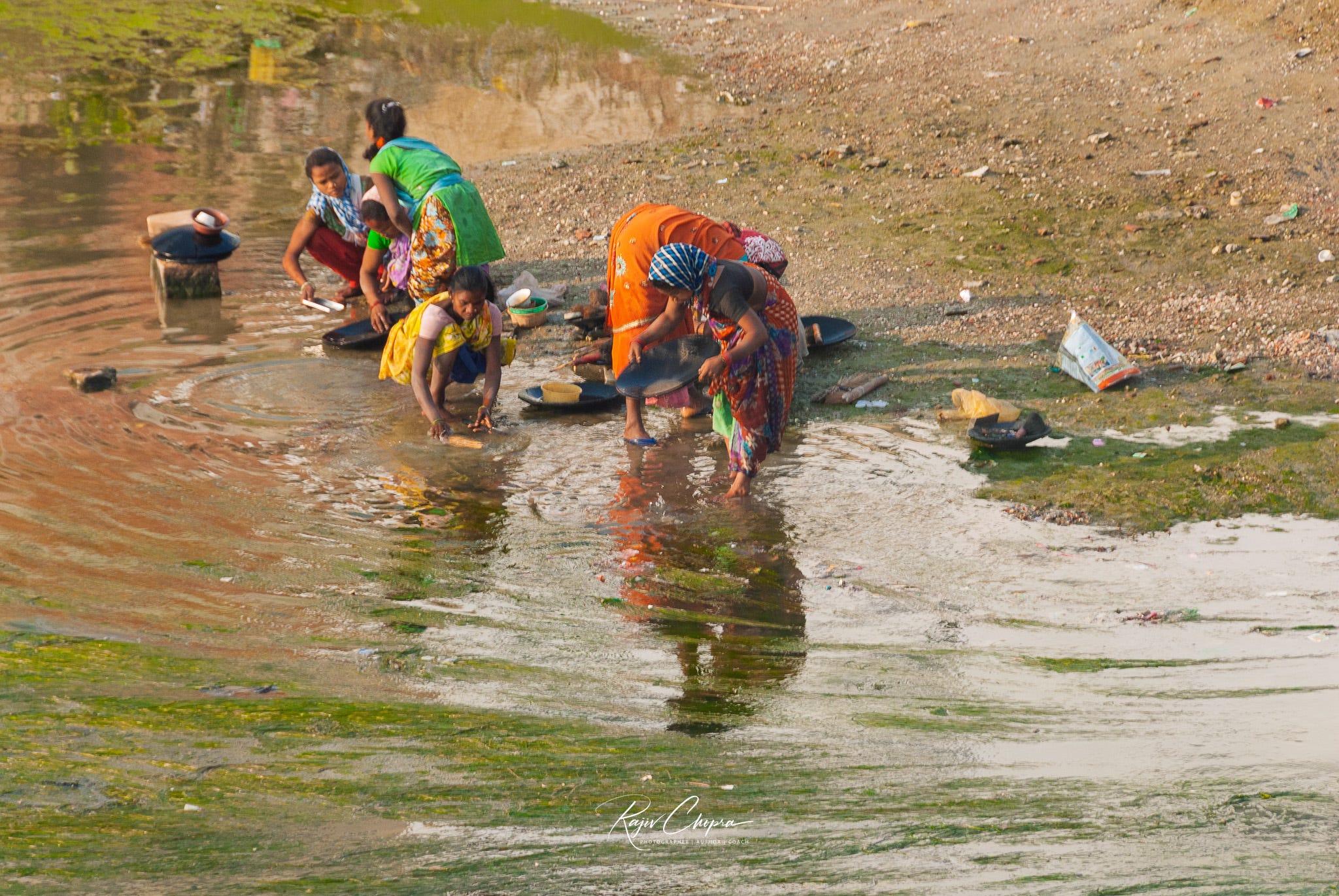
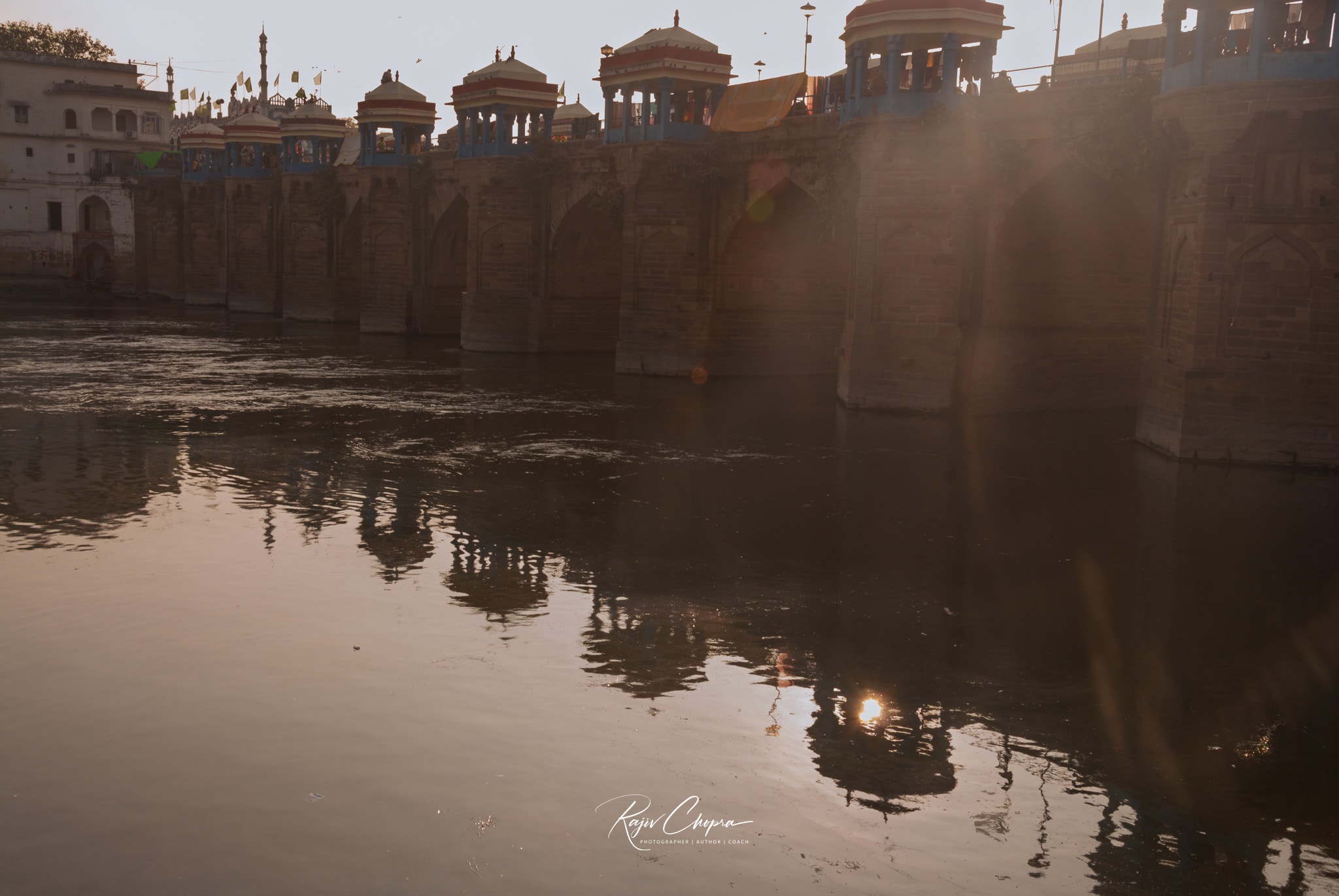
When I did my brief historical research before leaving for Jaunpur, I learned of the old Shahi Bridge that spanned the Saryu River. The word ‘Shahi’ may be a corruption of the word ‘Sharqi,’ and everyone I spoke to referred to the bridge as the ‘Shahi Bridge.’ Assuming the Sharqi rulers built the bridge, it would then be about five and a half centuries old.
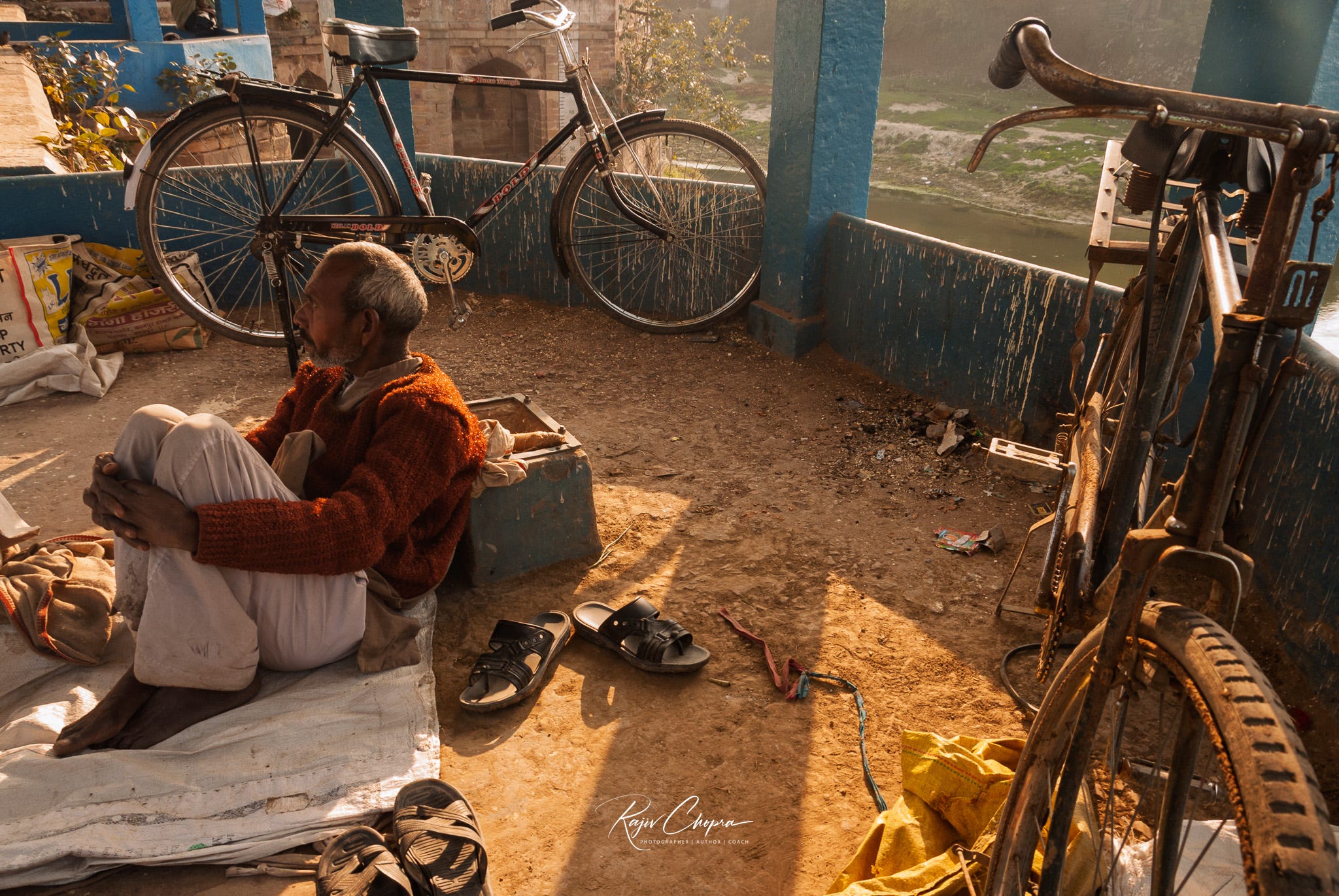
I spent about an hour on the bridge, enjoying the sunshine. The locals use the bridge as a marketplace, a place to rest and gossip, and as a public toilet. I stood on the bridge, looking over at a few medieval structures glittering in the haze. Even though mobile phones and other signs of modern culture have permeated the town, mentally everyone is – to use the horrible word – provincial.
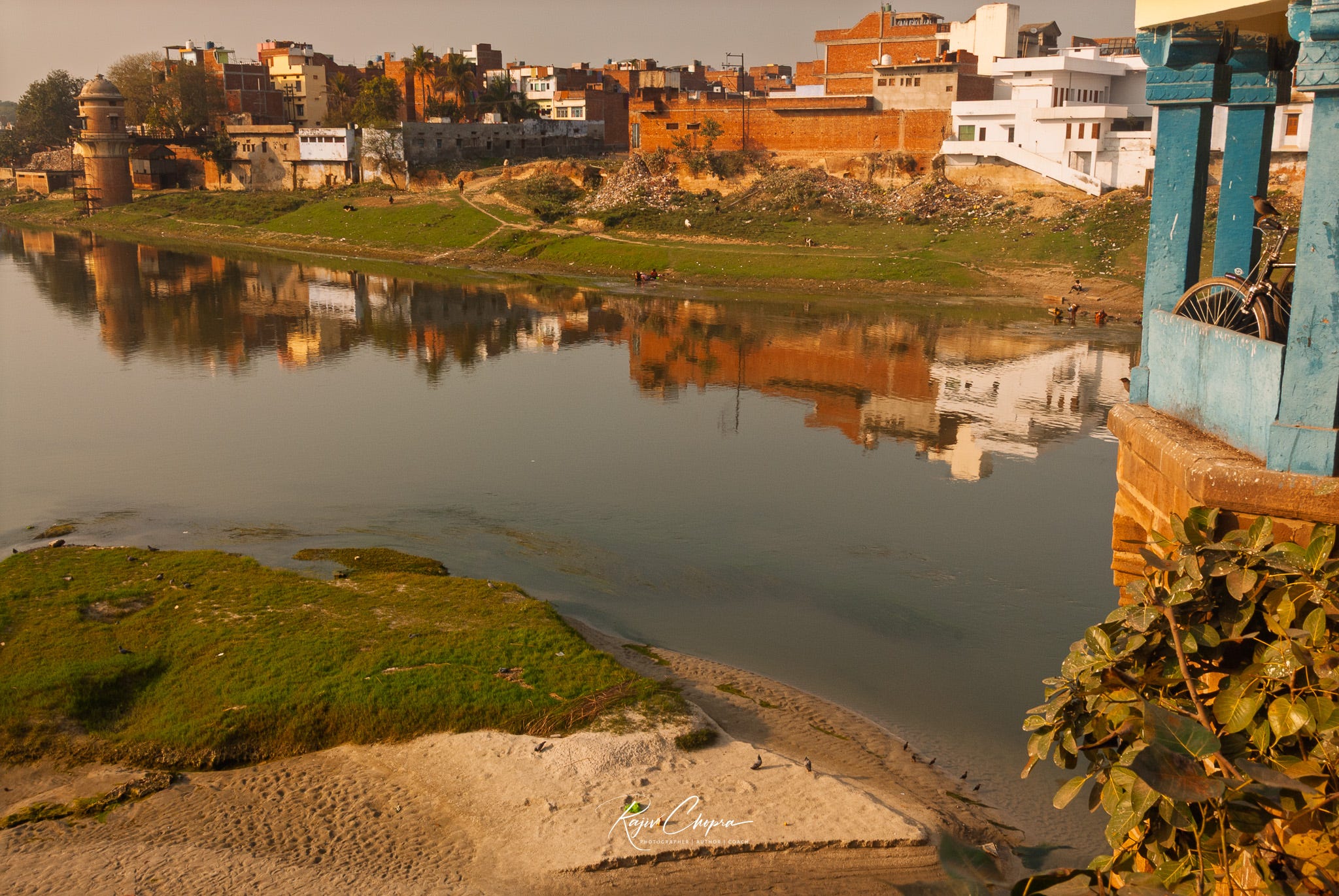
I looked at the waters of the Saryu River, green slime coating the water’s surface. Women washed their family’s clothes in the water, squatting on the rocks to gossip as they went about their domestic chores. Standing on the bridge that day, a sacrilegious thought crossed my mind. The Saryu passes by Ayodhya, and I wondered what the god, Ram, would have to say about the green slime floating on the water. In hindsight, I wonder if the women’s family members developed skin disease due to the toxic slime on the water.
Then, I climbed down to the river’s shore and photographed some of the slime and junk in the water. As I squatted on a rock, an old woman squatting on the neighboring rock looked over at me with curiosity. She probably termed me insane. A few young kids decided I was a curiosity worth exploring, especially after noticing me with my camera. After joking with me for a while, they insisted I photograph them. I was lucky. The warm afternoon light was perfect.
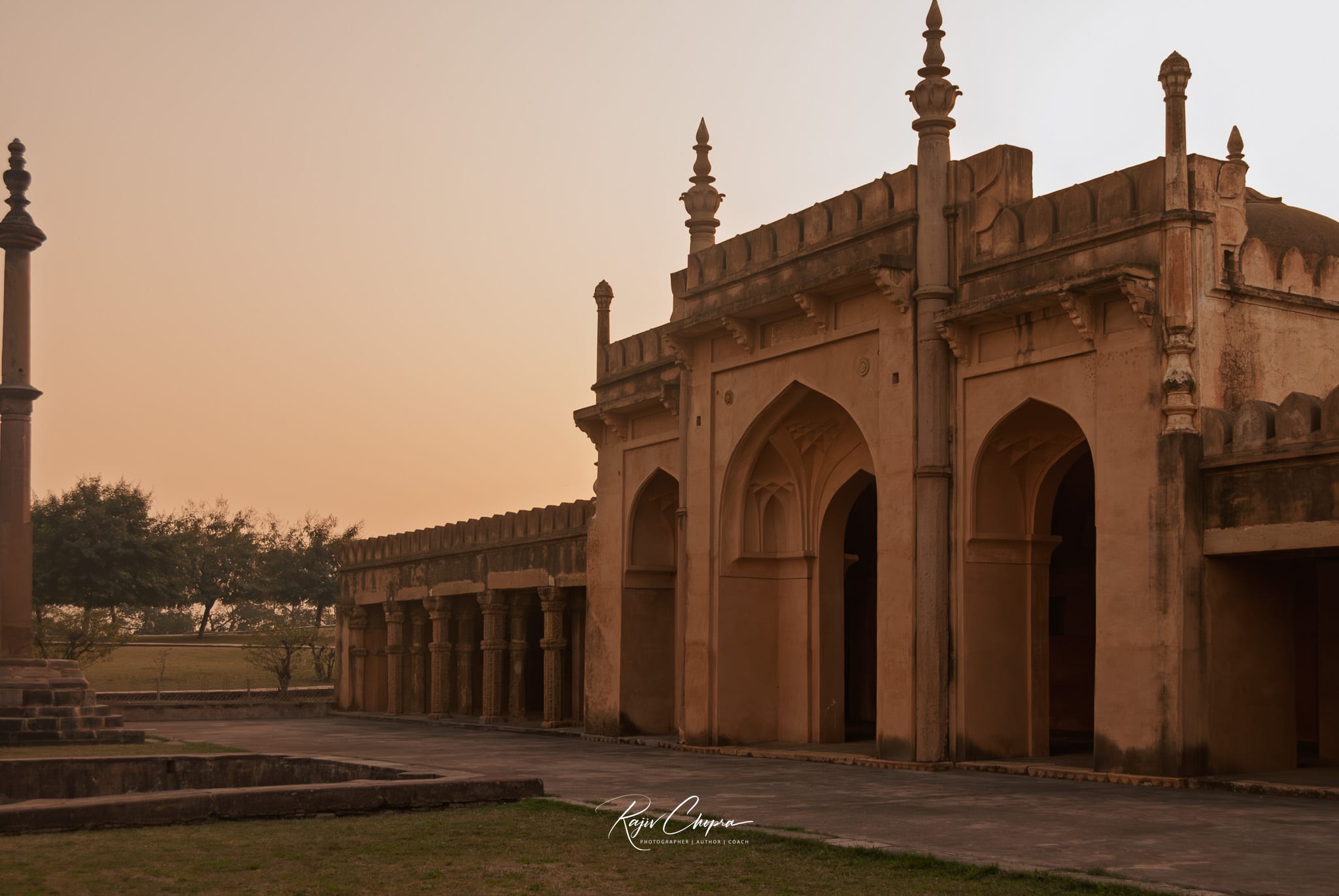
Then, I noticed the light beginning to fade, and quickly walked to the fort. I did not have much time inside, and today I am unsure whether I visited a fort or a mosque. The Sharqi dynasty built some of their mosques like forts, and the signboard at the entrance was suitably vague. A mosque stood on the premises, and the ruins may have housed both the seat of power and the seat of prayer.
The light was failing fast, and I had about thirty minutes before I had to leave. At one end was the wall looking down on the street and heavy traffic below. The mosque lay in the centre, and at the entrance were the heavy walls and gates.
A man walked around the premises with his daughter, and I noticed he was busy explaining things and pointing out features of the ruins to his daughter. The man may be one of the few who wished to educate his children on the history of his town. Whilst leaving, I met two men who evinced no deep interest in the old fort. They had come to sit in the sun, and when they met me, they wanted a photograph.
Almost no one remembers the Sharqi Dynasty. Maybe no one outside historians and a few writer-photographers like me. Yet, their memory survives in their construction and in the walls of the structures they built.
I admit to a small bit of joy: referring to my ex-boss as a jackass!
I photographed these images with my old Nikon D200 and edited them in Lightroom Cloud.
such an intriguing post
Interesting story about your ex-boss and his lack of understanding about India. And then about Mustafa born in Jaunpur, when to Singapore at age 9 and started an incredibly successful store in Singapore. And emperors who long ago wanted to rebuild, older faded towns. The problem now seems to be there are too many faded towns that need to be rebuild but developers go down the road and have to build something completely new that won't last as long or is bereft of any intrinsic value.