Kunjapuri: Greeting the dawn.
Kunjapuri is a Shaktipeeth. When I visited, it was calm and beautiful.
I’d like to visit Kunjapuri again.
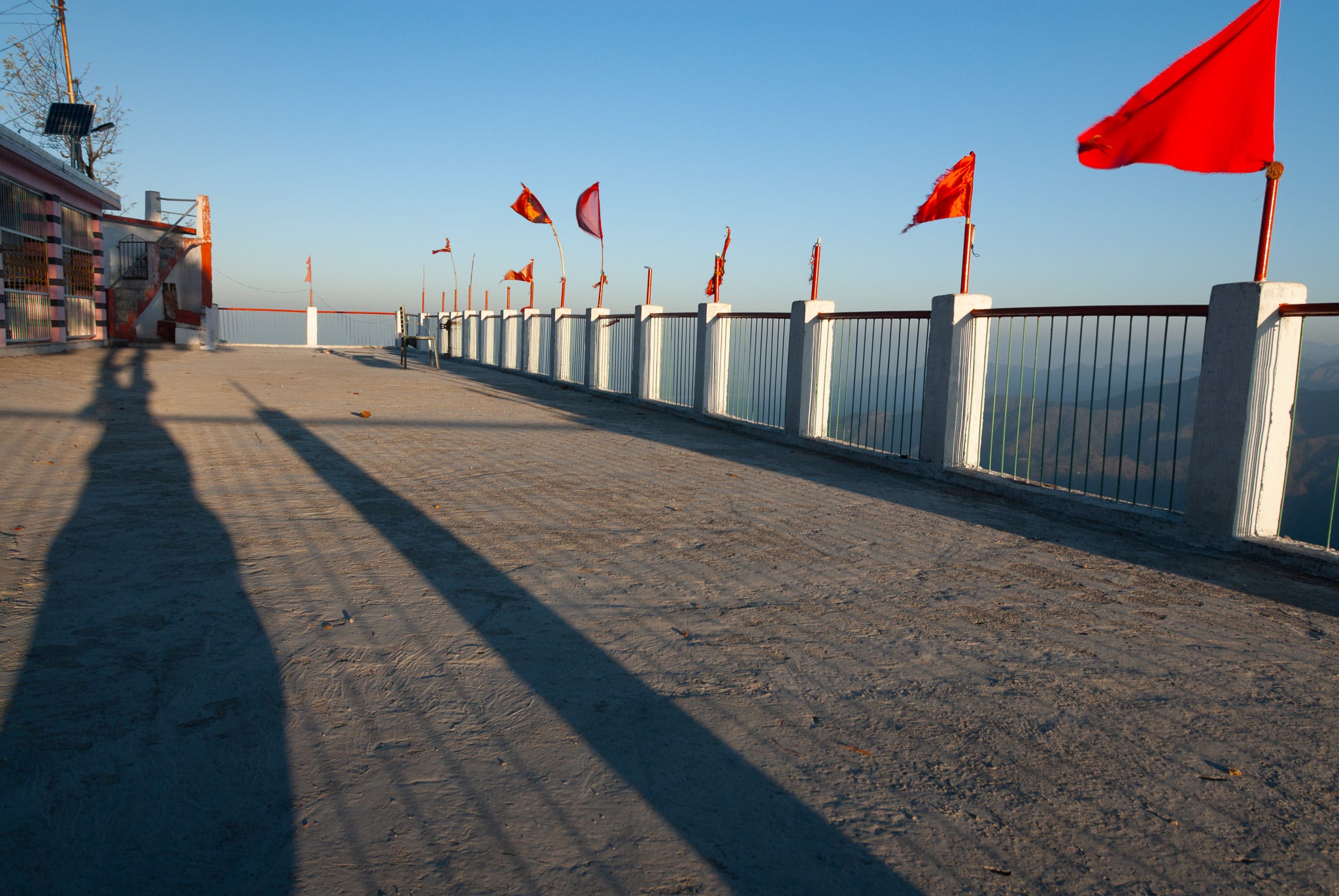
I’d like to visit Rishikesh again, climb up to Kunjapuri one more time, and do it before the government installs a cable car that goes almost to the top. Maybe you’d like to accuse me of being old school, or maybe you will say that I have allowed Michael Easter’s book, “The Comfort Crisis,” to captivate me, but I believe that if you make things too easy, they lose their value.
Kunjapuri is a shaktipeeth, one of the 51(or 52). People believe this is the place where the chest of the goddess Sati fell to earth.
The story is old, originating in ancient texts known as the Puranas, notably the Vayu Purana, the Shiva Purana, the Bhagavata Purana, and the Devi Bhagavata Purana. Sati, the daughter of Daksha Prajapati, marries Shiva against her father’s wishes. Daksha Prajapati organizes a grand ritual, the Daksha Yajna, but does not invite Shiva and Sati. Sati cannot bear the insult and self-immolates in the sacrificial fire. A furious Shiva creates Virabhadra, destroys the yajna, decapitates Daksha, and then dances the Tandava Nritya, a cosmic dance threatening to destroy the world.
Alarmed, Vishnu uses his ‘cosmic wheel,’ the Sudarshan Chakra, that cuts Sati’s body into 51 (or, 52) pieces. The places where the pieces of her body fall are called shaktipeeths.
We climbed up, and I thought my friend would collapse.
I was in Kunjapuri many years back. My friend and I left our hotel at about 3:30 in the morning and drove for almost an hour to reach the base of the hill. Then, we climbed. Kunjapuri is about 1,676 meters (5,498 ft) above sea level. I don’t remember how many steps I climbed- it seemed like 500, but Google Aunty informs me that, from the base of the hill, you climb 312 steps. Once the cable car is installed, you will be able to fly halfway to the top, but you will still need to climb 80 steps. Most people will balk at the prospect of climbing 80 steps, and the rich and lazy will lobby for a helipad to be constructed at the temple on the hill. In fact, they will even importune Surya (the Vedic sun god) to delay sunrise for their manicured and pedicured benefit.
We climbed. I am much fitter than I was a decade ago, but I would still consider the climb challenging. My friend was corpulent and wheezed his way up the steps. His wheezing was so loud that I worried he was about to get a myocardial infarction. We stopped halfway up the hill to get some chai. We stopped at the chaiwallah’s stall on the way down, also, to get chai and Maggi noodles. I don’t know why, but Nestle’s Maggi brand of instant noodles is popular in the hills, and it is almost a rite of passage for anyone traveling to the hills to have Maggi noodles at a chaiwallah at least once. They add onions, tomatoes, and chilies (if you wish for the spicy version), and it is imperative that you wash it down with chai. If you avoid the chai, the spice of the chilies may make you hop from foot to foot.
Each Shaktipeeth contains a piece of Sati’s body, and becomes a concentrated form of divine/cosmic/nature’s energy, called ‘shakti.’ In this form, shakti is feminine, and not a form of masculine, muscular strength (also shakti). The word, shakti, represents energy or strength and has many forms, depending on the context. Sati is shakti, the energy underlying the universe. The fallen pieces of her body map physical and divine spaces and energy. India is a ‘sacred geography.’ Each shaktipeeth contains a piece of Sati’s body and a form of Shiva (Bhairava). They go together. Without Sati (Shakti), Shiva is inert. Without Shiva, Sati (shakti) is directionless.
Greeting the blue dawn.
We reached the temple on the hill before the sun was up. I noticed a sliver of orange light in the blue sky of the civil dawn and made a mental note to reach Kunjapuri half an hour earlier on my next trip.
But damn: glory be! When you get up there, the view is magnificent. You get a panoramic view of the Garhwali range. The cool breeze blew, even in April, and all seemed well with the world.
We were lucky to reach the last moments of civil dawn, when the sun was still a few degrees below the horizon. As the sun reached the horizon, shades of red and orange mingled with the blue, and then blue gave way to orange and yellow; and then orange gave way to yellow until finally, the blue sky of the morning light asserted its presence once again.
Westerners populate Rishikesh these days
Westerners, with their pale white faces and sincere expressions, populate Rishikesh. They come to Rishikesh to learn yoga and often stay for months. They are all sincere and walk around with books by Jiddu Krishnamurthy, a deceased New Age Indian philosopher. You will encounter these people practicing yoga and discussing Indian philosophy with solemn expressions on their faces. To their credit, they do some good work and try to keep the town clean. Most of them do not make a ruckus, and thankfully, the genocidal Israelis have not yet discovered Rishikesh.
A few Westerners arrived that morning, sat on the ledges, and turned their faces to the sun in silent meditation. They were deeper into their meditation than some of my fellow countrymen who wandered along the temple’s platform.
Photography at the temple
My friend kept sticking his bum between my camera and the landscape in front of me. The sun washed over the white temple walls, and the red temple flags lining the platform fluttered in the cool mountain breeze.
When you are photographing the scenery at dawn or dusk, don’t just look into the sun. While that is one way to do it, look away from the sun. Observe how the sun lights up foliage, buildings, people’s faces, or anything the light falls on.
The sun lit the faces of the Western women sitting and enjoying the sun. Years ago, when I edited their faces, I increased the saturation, making them almost yellow. This time, I reduced the saturated colors created by the morning sun to give their skin tone a more natural hue.
Peace reigned supreme
It was too early for pilgrims, and the place was peaceful. I count myself as half a ‘Pahari,’ a person of the hills, and I love the solitude of the mountains. During the peak tourist season in some parts of the hills, people from the plains drive up, honking, playing loud music, making a nuisance of themselves, and sometimes getting drunk on the streets. I wonder how many pilgrims will visit Kunjapuri in the years to come. I was in Benares in February, and the crowds stunned me. Ever since Modi widened the corridor to the Kashi Vishwanath temple (also creating a helipad for his exclusive use), the crowds have swelled, and it is almost impossible to walk in the Gadolia area near the ghats.
Will this be the fate of Kunjapuri, I wonder?
Even if you are an atheist, like me, you must understand and respect the underlying mythology and symbolism of India’s sacred and geographic spaces, and not give yourself over to cynicism or blind ritual. Only then will you begin to understand India, and to appreciate your journeys in my country.
We walked down after a few hours, did homage at the chaiwallah’s stall by consuming Maggi noodles and chai, and reached the bottom of the hill. I noticed someone had stuck a thick incense stick (dhoop) at the base of an electrical pole. Maybe they wished to bless those who supply us with electricity. I don’t know.
Kunjapuri is beautiful, peaceful, and I hope it stays that way. Whether it is the prospect of cacophonous tourists or throngs of pilgrims seeking divine blessings, the future cable car will change the place and may rob it of some of its peace and magic. Maybe I was lucky to be there at the right time.


