Lohri: A young, yet primeval festival.
A Punjabi Festival - my favorite of the year
Lohri: A Punjabi, midwinter, agrarian festival.
The Meaning.
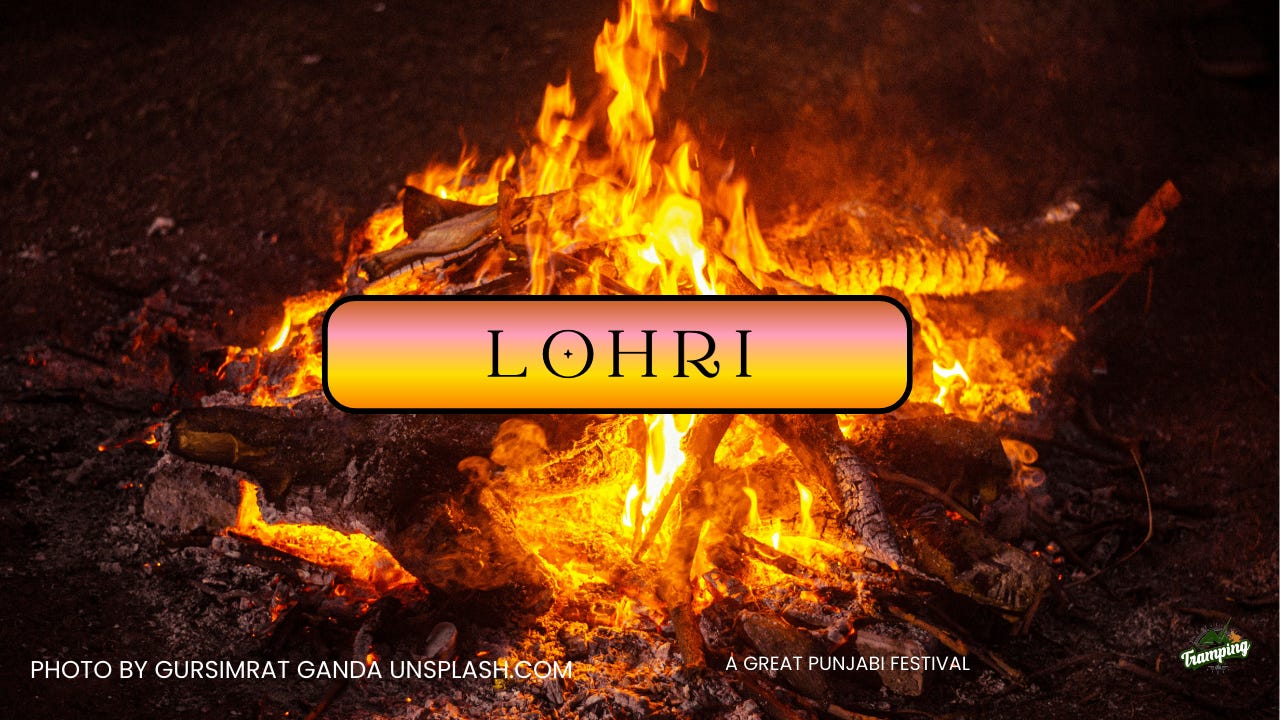
It was Lohri yesterday, on the 13th of January.
Most Westerners, including those of Indian origin, mispronounce the words ‘Punjab’ and ‘Punjabi.’
They pronounce the ‘Pun’ as ‘Poon,’ which is incorrect. The ‘un’ is pronounced the same way as ‘un’ in ‘unable.’ The word comes from the root that means ‘five,' and ‘ab’comes from the Persian root that means ‘five.’ The full word means ‘The Land of the Five Rivers,’ and a Punjabi is a person, or thing, that comes from the state that we call ‘Punjab.’
‘Lohri’ is a Punjabi festival, one that many people would call pagan and sneer at. But I don’t care, and recently, I surprised many people by telling them that Lohri is my favorite festival.
Lohri is a winter solstice and an agrarian festival. The festival is agrarian, celebrating the harvest of the winter ‘rabi’ crop. Therefore, we bring food and energy to the home. From Lohri, winter begins to recede, and you can start to smell spring around the corner. It is a time for renewal.
Origins.
No one knows when Lohri originated, but it seems to be about five hundred years old in its current form. Yet the practice of circumambulating a huge community bonfire three times, feeding it with groundnuts and jaggery, and wishing well for the family and community is primal.
Then, we normally gather round and eat dinner (sarson saag and makki ki roti - cannot translate, sorry) together, before returning home.
There’s always a story
There is a popular Lohri song, ‘Sundar Mundriye’, based on the exploits of one young man, Dulla Bhatti, who lived during Akbar’s reign (1556-1605 CE), and was a kind of Punjabi Robin Hood. The legend also speaks to the tradition of Punjabi resistance to any sort of rule, and their desire for independence.
Why do I love Lohri?
One, unlike Diwali, which has become a commercial festival like Christmas in Delhi, Lohri remains very primal. To me, it harks back to an ancient time when our ancestors probably sat around a fire, gazing at the stars, keeping each other warm, sharing stories, and protecting themselves from predators.
While Lohri has, no doubt, moved far from its roots, there is something about its simplicity and brevity that keeps the festival relatively pure.
I believe that Lohri speaks to the essence of humanity and the human spirit and, can only wish that the festival retains its purity in the centuries ahead.


Rajiv,
It amazes me how you discover instances of premodern feminism in Indian history. As in the story of this festival where Dulla Bhatti arranges for the safety of two girls who are about to be sold into slavery. Strictly speaking the festival of Lohri is not feminist just because a guy prevents two girls from being sold into slavery. Because in the modern idiom, marriage is a modern slavery, especially modern Western marriages. But Indian culture and its subset Punjabi soul is so distinctly oriented towards individuality in the best Eastern formulation. It would not surprise me if the missing later part of the story would be that all because of Dulla Bhatti's kindness Sundri and Mundri became Punjabi warrior queens. Sundri and Mundri to me intuitively sound like "Any" and "All" to me but that is Western and probably has nothing to do with the Sanskrit roots or origins of their names.
But I still think Dulla Bhatti is a traditional male feminist hero because he took action and rescued and prevented the two girls, Sundri and Mundri from being sold into slavery which was more kind and thoughtful than any other male in the realm at that time would have ever been capable of realizing. Even if he was unable to offer much material wealth, he still provided them with safety, arranged their marriages, and lit bonfires for their passage, with people contributing jaggery and grains.
This is great and would like to see more instances of this (if there are any) in Indian history.