
Reclaiming History II: Genghis Khan
There is more to the old Khan than is revealed by Voltaire's writings.

Voltaire distorted Genghis Khan’s legacy
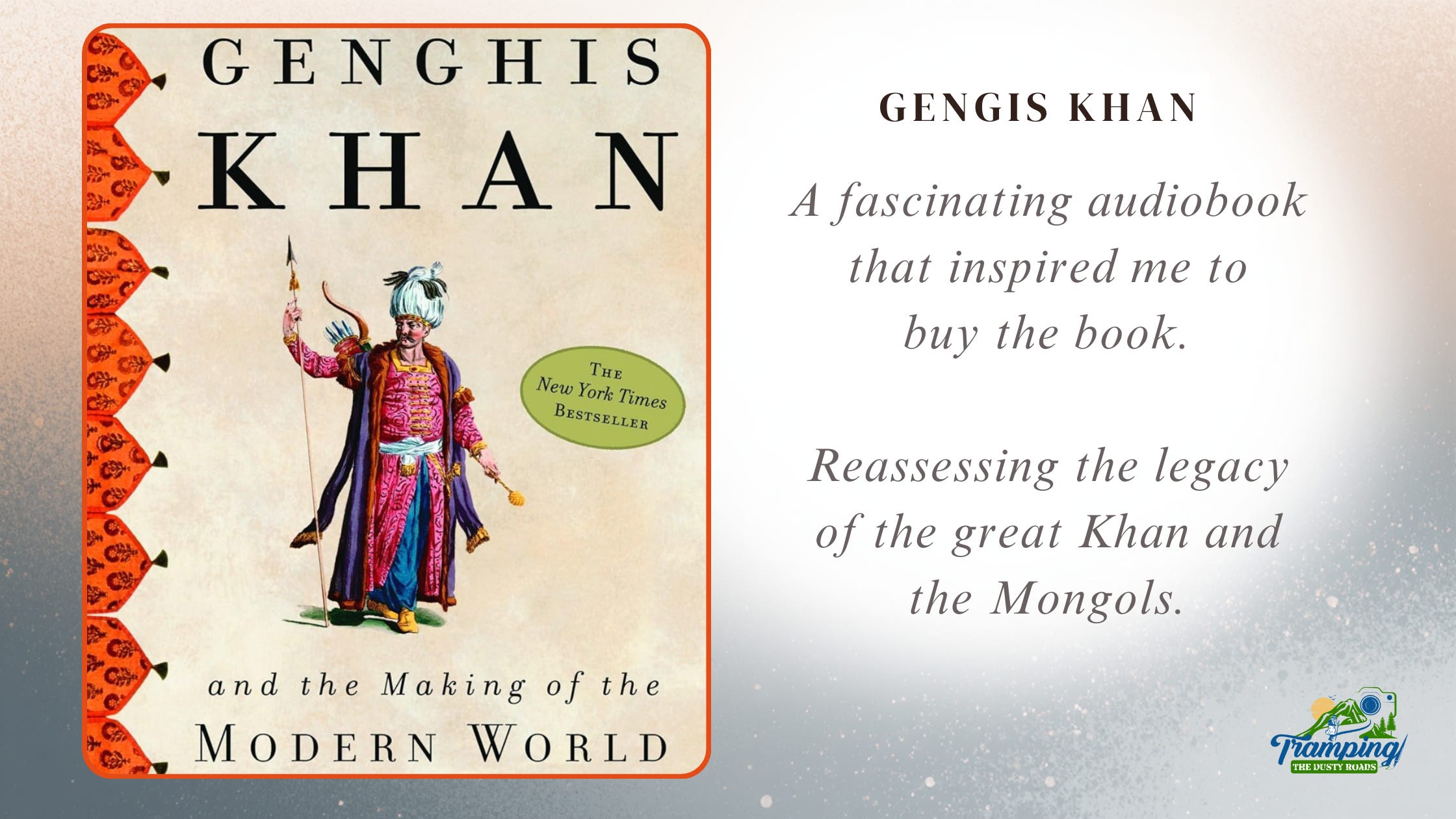
I have not read the book, but I listened to the audiobook and liked it so much that I bought it afterward. I have a selfish interest in Genghis Khan because Babur, the founder of the Mughal Dynasty, is a descendant of Genghis Khan (and Timur). Maybe I have one strand of DNA that comes from both great warriors.
One reason I like the book is that the author prompts us to reassess the legacy of Genghis Khan; it is time for the Mongols to reclaim their history and legacy.
From the audiobook, I gained the impression that the person who ruined Genghis Khan’s legacy was Voltaire. The author writes that Voltaire had a problem with the French royalty, but did not dare to mention them by name. He used Genghis Khan’s name as an allegory, ruining the great Khan’s legacy in the process. I have seen this happening far too often: Western political writers castigate people from other cultures, accusing them of barbarity while colonizing people, committing genocide, and starting world wars! This habit continues today and must stop!
Voltaire’s writing stands in stark contrast to that of earlier Western writers, like Geoffrey Chaucer, who wrote a fascinating tale called ‘The Squire’s Tale,’ as part of his Canterbury Tales.
Renaissance writers treated Genghis Khan’s legacy with respect, whereas enlightenment writers treated the great Khan, the Mongols, and all things Asian with contempt. I have not capitalized the word, enlightenment’ on purpose!
A brief digression into Temujin’s history.
Genghis Khan’s childhood name was Temujin. Before I continue, I have started researching the name Khan. Over the centuries, it has degraded, become a family name, and become associated with Muslims. My theory is that the name came to us from the Persians, who got it from the descendants of Genghis Khan, the Mongol ruler of Persia.
During the early days, a person had to earn the right to be called ‘Khan.’ ‘Khan’ was a title given to a great ruler and was not a patronymic. The Mongols were animists, as I discovered. They worshiped ‘The Eternal Blue Sky,’ so the title obviously had nothing to do with Muslims – this association came much later.
I am quite intrigued by how the name/title Khan and the language Urdu have become associated with Islam, so I have decided to research this topic. It may be a few months before my findings find a space on this tiny publication of mine. Till then, we march on.
Temujin’s early childhood did not foreshadow his future achievements; he had plenty of them. Because his father had kidnapped his mother, the tribe considered them outsiders and, when his father died, they abandoned him, his brothers, his mother, and stepmother. His mother was a remarkable woman, protecting the family until, one day, Temujin stepped in to look after the family, not before he killed his older stepbrother.
Step by step, he built his alliances, conquering tribes until he took the title, Genghis Khan. The process took decades, and it was not until middle age or, near middle age, that he began looking outside Mongolia.
The Mongols were ruthless, but, as per the author, did not believe in torture or rape. We have Voltaire and his contemporaries to thank for this fiction.
There is another aspect of Genghis Khan worth noting. He did not believe in promoting people based on family connections or inheritance. Genghis Khan believed in meritocracy and often rewarded people for their performance and loyalty. He lived in dangerous, uncertain times, as do all of us even now. Loyalty and the test of a true companion were necessary qualities in a person.
Genghis Khan married several times but had one true love, and the book tells of how he rescued her after a rival tribe kidnapped her. We cannot judge people like Genghis Khan from the dubious moral standards we hold today. When a woman from a rival tribe was kidnapped, she often became his wife. Genghis Khan’s father kidnapped his mother, and when a rival tribesman kidnapped Borte (Genghis Khan’s wife), she may have become pregnant. The uncertain parentage of his elder son later caused problems when Genghis Khan discussed succession.
The Mongols produced nothing of their own, so they built trade routes across Asia and into Europe. Most of Western Europe was spared the Mongol invasions, writes the author, but it benefited from trade routes that led to the Renaissance. Keep one fact in mind: I am writing from memory. When I reread the book, I will update this post.
I will close this post with a few observations.
I have also been writing this post in a disjointed fashion. I will end now. My points are simple.
We cannot only blame the West for distorting our history.
First, as I mentioned earlier and in my last post, we need to reclaim our history. The Mongols did not write their history, and neither did we in India. This fact is changing, but when we reclaim our history, we must do so without politicians who wish to distort our stories, omit parts, ignore cultural connections, and create fanciful myths. We cannot only blame Western authors for distorting our histories if they create nonsensical versions of our past. None of us is a saint.
Our earlier writers did not write in English. Apologies.
Second, my statement in the previous paragraph is incorrect. At least in India, we wrote our histories, but not in English or any Western language. I will assume that the early writers like Al-Biruni, Abul Fazl, and others did not anticipate the arrival of the Europeans and their faulty interpretations of what they (Abul Fazl, etc.) wrote!
History is dynamic and subjective.
Third, and this point may give people food for thought: history is dynamic. Everyone who writes history changes the narrative. Consider an example: Akbar the Great commissions Abul Fazl to write a history of his reign. Since Akbar is going to pay Abul Fazl, there is a strong chance that Abul Fazl’s narrative will be friendly to Akbar and will omit information critical of Akbar.
The CIA tried to suppress Al McCoy’s book, “The Politics of Heroin in Southeast Asia.” As per the rumor mill, Narendra Modi’s government is trying to suppress Gen. Naravane’s book, “Four Stars of Destiny.”
Truth will raise its ugly head.
Truth always finds a way to raise its ugly head above the saintly voices that wish to strangle the life out of truth. Read history well. Read widely. Be democratic in your reading, and remember that you are reading only one version of history at a time. Unlike a coin that has two faces, history is like a multifaceted crystal, and you only see one face at a time until you manage to penetrate its core.