
Reclaiming History: Nalanda and The Cholas.
We must reclaim our history not just from biased people, but from our ignorance.

Two books that gave me food for thought.
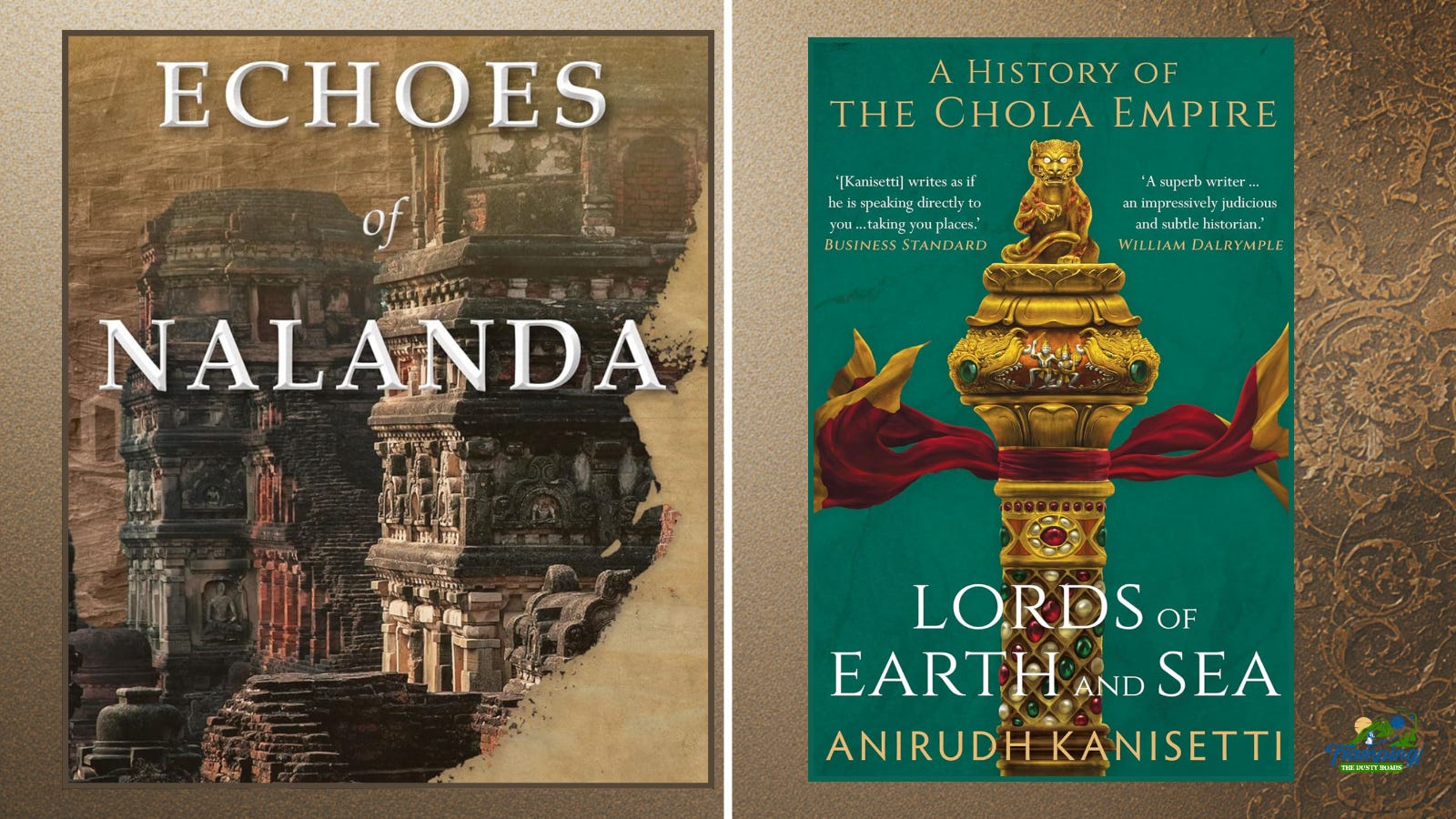
Recently, I read two books quickly. I had borrowed them from the library, and the librarians asked me to return them quickly, as there was a long waiting list for the books.
Sometime in the next few months, I will borrow these two - and another one - again. I confess I have had to fight the temptation to buy them, and I succeeded. Too many books jostle for space on my bookshelf and in my Kindle device and plead for my attention! We must read the books we place with so much pride on our bookshelves, else we will only be indulging in the wildest, most pompous activity ever!
You will see the book titles in the blog banner. Since I read the books too fast for my own good, I did not review them; they forced long-dormant issues to the surface from the deepest recesses of my brain.
We need to reclaim our history and read unbiased work.
The first issue is one I have been talking about for many months: we need to reclaim our history. When I write this, I am conscious of an internal struggle. From whom do we reclaim our history?
Allow me to make a racist comment. I will make this comment without the intent to be racist. Do we reclaim our history from the white man? Anyone who believes that we need to reclaim our history from the white man is stupid.
Yet we need to reclaim our history from the distorted versions that the early British colonialists created for us. Some wrote from the perspective of extreme prejudice, believing they were superior to us. Others tried to be fair but always analysed us from a British perspective.
We have many excellent Indian historians today – Romilla Thapar, Irfan Habib, Ruby Lal, and others like Jadunath Sarkar, Satish Chandra, and Rudrangshu Mukherjee.
Just because excellent historians have been around in India, and I deliberately exclude medieval writers from the list because few people read their writings, not all modern Indian historians are excellent or unprejudiced. There are too many who have allowed our current government to influence and corrupt them, and are working on converting mythology and political myths into a warped version of our history.
Excellent Western historians are filling the gap and writing our history. Richard Eaton and Audrey Truschke are two who spring to mind.
We need to reclaim our history from anyone seeking to write a warped version of our path, and must learn from brilliant historians, irrespective of color, nationality, caste, or creed.
We need to reclaim our history from our stupidity.
We also must reclaim our history from ourselves. And now I am arriving at the crux of my little essay. My fellow citizens, including politicians in this category, like to live in the belief that Mughal history is Indian history. Mughal history occupies only about 350 years of Indian history. The first two centuries were glorious, and the last century and a half was a study in decay and implosion.
However, the Mughals did not occupy all of the subcontinent; the only Mughal king whose territory encompassed ‘greater India,’ or ‘Akhand Bharat,’ was the much derided Aurangzeb.
There was a history that existed alongside Mughal history, before Mughal history, and after Mughal history.
Nalanda.
“Echoes of Nalanda” is fascinating because it situates the famous Nalanda University within a historical and Buddhist context. The emperor, Kumaragupta I of the Gupta Empire, established Nalanda University around 427 CE. Before Oxford, before Cambridge, before Harvard, before Yale, there was Nalanda, and it survived for 750 years before Muhammed Bhaktiyar Khilji destroyed it around 1200CE. At its peak, it was one of the most significant centers of Mahayana Buddhist learning and the world’s largest residential university. The book details the rise and decline of Nalanda. Many Indians of my generation know of some of the earliest Chinese travellers to India, like Faxian and Xuanzang, but one fact surprised me when I read the book. Chinese scholars and pilgrims visited the subcontinent and Nalanda for three centuries!
The Chinese classic, ‘Xi You Ji,’ or ‘Journey to the West,’ is based on Xuanzang’s journey to India to collect Buddhist scrolls. I have read the classic, and it is arguably my favorite of the four Chinese classics. The other two that I absolutely adore are ‘San Guo Yanyi’ (the Romance of the Three Kingdoms) and Shuihu Zhuan (Outlaws of the Marsh). I dislike Hong Lou Meng (or Dreams of the Red Mansions).
The Chola Empire.
We also need to reclaim our history from our ignorance, and I include myself in this category of idiots. Many people talk about the Chola bronzes, describing them as either exquisite works of art or valuable collectibles. These people have no clue about, or interest in, the history of the Chola Empire. I borrowed “Lords of Earth and Sea” from the library and discovered, to my shock, that the Chola Empire (which ruled between 848 CE and 1279 CE) was actually a longer-lasting dynasty than the Mughal dynasty. Not only that, the rulers had a decidedly international outlook, interacting with kingdoms in Southeast Asia and even sending delegations to Chinese kingdoms.
The Chola kingdom lasted 430 years, about 80 years longer than the Mughal Empire. This fact is a point worth noting!
Learning from Nalanda and the Chola Empire.
Both Nalanda and the Chola Empire should give us food for thought. First, there were vibrant intellectual developments in the subcontinent centuries before Europe discovered us and centuries before Babur founded the Mughal Empire.
Second, we South Asians did not discover international relations in the last fifty years. We engaged in international relations several centuries ago – in fact, over a thousand years ago – and these relations appeared cordial, not ridden with conflict as they are today. A relevant question we ought to ask is: what happened in the interim? When, and why, did we become such inward-looking people? I remember reading Jawaharlal Nehru’s book, “The Discovery of India,” and in my recollection, he theorized that we became inward-looking about a millennium ago, when Muslim invasions began. If his theory is correct, I further postulate that we turned inward when the likes of Mahmud of Ghazni started their invasions, not when we began trading with the Arabs around the seventh century.
Our current seeming surrender to Donald Trump and, maybe the EU, should be cause for alarm, and not fanciful theories about Muslim invasions.
Will we write our future?
My third point, therefore, is that we must learn the proper lessons from history and not allow bigotry to blind us. If we permit bigotry to blind us, we will lose our history again and allow colonizers to write our future for us.
Alert: this post contains affiliate links!
I am always interested in India's history because there are so many lessons that Americans can learn through reading Indian history. Such as how India put together it's constitution versus how America put together it's constitution. It seems to me that it is difficult for constitutions to work when they have to balance so many competing interests. But India seems to be holding better together lately. America seems to be fracturing badly beyond repair. And a look at India's history might be instructive as to why this is so much the case.