

An unplanned trip to Kodagu.
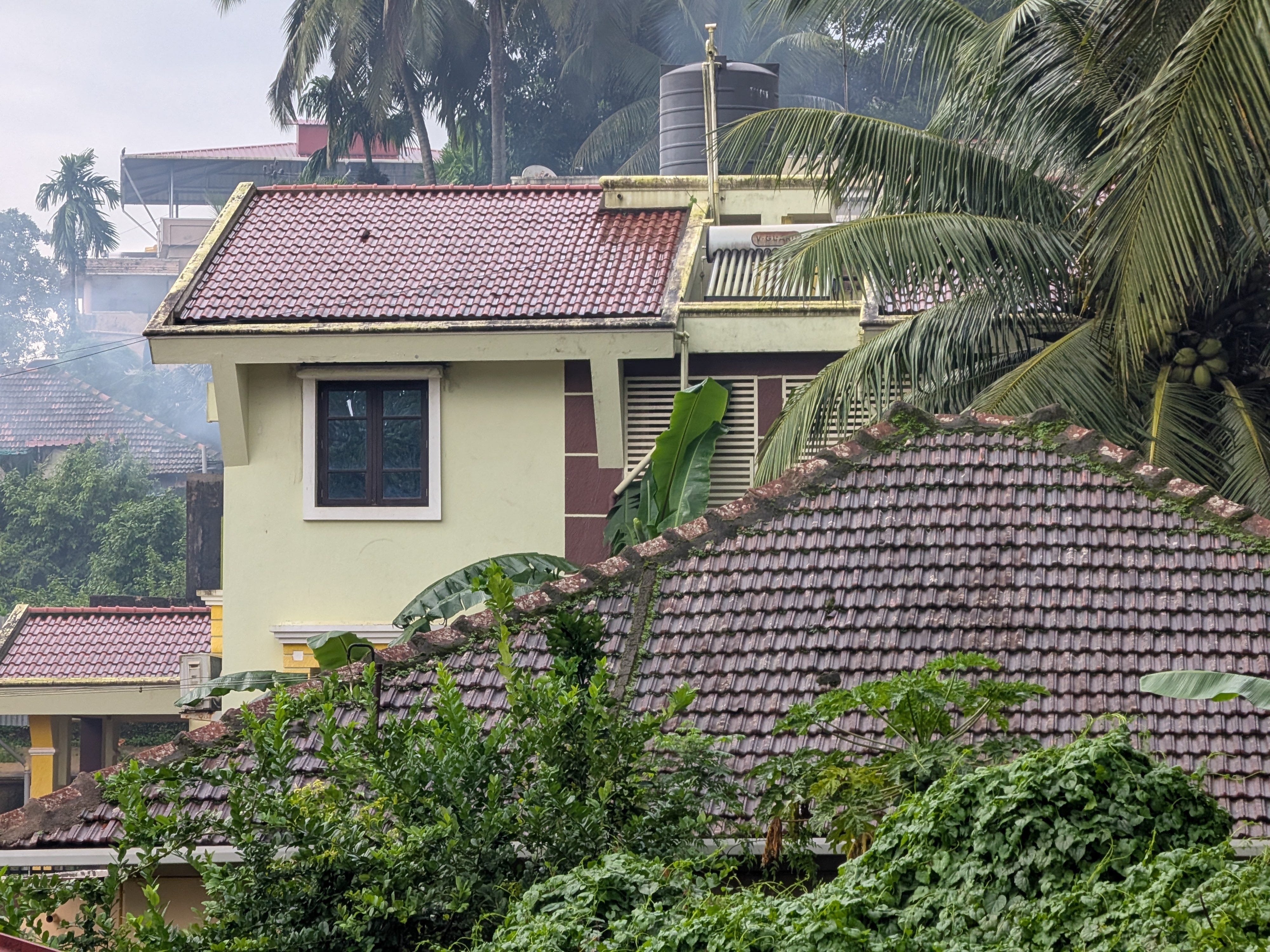
I was in Kodagu for about four days at the end of July. The trip to Kodagu (Kodagu is the traditional name for Coorg) was unplanned. Friends had planned to visit the place, and we added our names to the group without waiting for an invitation. I consider us fortunate to travel with a group that was warm, welcoming, and fun.
If you live in Delhi, you may discover that the journey to Coorg (Coorg is easier for a Westerner to pronounce than Kodagu) can be a pain in the neck. You need to fly to Mangalore (or Mangaluru, as it is officially called now and then) and then drive about 4 hours to your destination.
Traveling to Madikeri.
Kodagu is a district in Karnataka, and we had booked ourselves into the Taj Gateway at a small town called Madikeri. The Taj Group has two properties – the Gateway, and the fancier one called Taj Madikeri. All of us preferred the one we stayed at – the atmosphere in the hotel resort was warm, welcoming, and the restaurants were accessible, and this stands in stark contrast with the fancier hotel where, when it rains, you find yourselves compelled to call and bleat for a buggy to take you to the restaurant. Additionally, the food in the Gateway was much better than that of the Taj Madikeri.
There is only one direct flight from Delhi to Mangalore, getting you there at about 1930 hours, which means you need to spend the night in Mangalore before heading out to Madikeri.
We caught a morning flight from Delhi to Bangalore (now called Bengaluru), and then caught a connecting flight to Mangalore, before getting into our bus for the four-hour drive. En route we stopped for chai at a local dhaba, bought up the town’s stock of booze, and stopped for a pee-break. We finally reached our destination past 9 pm, and despite everyone’s firm commitment to skipping dinner, we stuffed ourselves to the gills and beyond.
Never eat the paneer tikka sandwich in Indigo Airlines.
I must warn people: if you travel with Indigo Airlines in India, never, ever order their paneer tikka sandwich. This sandwich is one of the foulest things you will ever eat, and it would serve well as a meal for people you wish to torture.
Now that I have shared the details of how we got there, I wish to inform you that I will make a YouTube video about the trip and will share that video here on Substack. Do watch the video when it is out.
Short notes on the trip. Free Flow.
There were twelve of us on the trip, and since it was a holiday trip, I didn’t do any planning. I went with the flow. It was one of those rare occasions when I let democracy rule and kept my mouth shut. We visited Coorg during the monsoon season, so I only had my GoPro Hero Black 11 and my mobile phone. I had bought a rain cover for my mobile phone, a rain cover for my shoes, and leech-protection leggings for our walk through the coffee plantation. We didn’t need the leech-protection leggings because the guide took us along the well-trodden path where leeches don’t attack humans. We’ve gone so far from nature that we end up buying all sorts of protective gear. Nature terrifies humans and terrifies urban Indians even more.
I count ourselves lucky because it rained on us only when we walked through the coffee plantation, and not otherwise. The heavens were kind and only let the rain loose on the landscape when we were safely ensconced in the bus or our hotel.
Which places did we visit? The coffee plantation. Our bus driver took us to his preferred plantation, no doubt getting a nice commission from the plantation owners. We also went to a waterfall – the Abby Waterfall, and to a reservoir. The reservoir was boring.
Madikeri is about 1,170 meters (3,840 feet) above sea level. The entire area is green, and the clouds water the woods regularly.
I’d like to move away from a recital of our trip’s itinerary and take the chance to make a few observations on the people and contrast the visible aspects of their behavior with those of people who live in Delhi, Haryana and Uttar Pradesh (collectively, ‘North India’ for the rest of this post).
I have not researched any of the material and base my observations on the conversations I had with a few of the local people.
A few reflections on Coorg and the N-S Divide.
Coorg vs Kodagu?
Coorg is the anglicized name of the district. The traditional name is Kodagu, and their local dialect is called Kodava Takk. The local people consider it a distinct language, and not a mere dialect. They also speak Kannada; some people speak a dialect called Arebashe. I gained the impression that Kodava Takk does not have a written script, which contrasts it with Mangalore’s local language, Tulu.
Locals in both regions noted that people from Bangalore (who mostly speak Kannada) do not understand Kodava Takk or Tulu, but the locals themselves understand and speak Kannada. Kannada, Tulu, and Kodava Takk are all Dravidian languages, distinct from North Indian languages in their roots.
North Indians like to believe that they are strong and brave, often sneering at South Indians, terming them to be peace-loving and weak. We can lay a large part of the blame on the English, who created the rather stupid concept of the ‘martial races of India,’ classifying Sikhs and Rajputs as the martial races. The myth endures in parts of North India. However, any reading of South Indian history ought to serve to dispel this self-serving myth.
One of the locals told me that the Coorgis are a martial race, and that every family owns weapons even today. The Coorgis have given the Indian Army two of its finest officers, Field Marshal Cariappa and General Thimayya. If Nehru had prevented General Thimayya from retiring in 1961 and had paid more heed to his advice, we may have had a different result in the 1962 war with China.
People told me that sports and hockey are close to the hearts of the locals, and that every local family has a hockey team. I spotted excellent hockey fields in the schools that we crossed.
Shashi Tharoor (the Congress MP) recently noted that India’s western coastline began trade relations with the Middle East about 1,500 years ago, and I agree with his statement. People from the Middle East came to our shores as traders, not as invaders. Our politicians love to exploit the deeds (and presumed misdeeds) of people like Mahmud of Ghazni and Mohammed of Ghor, but they did not come to convert: they came to loot.
There is no difference between Mahmud of Ghazni, Mohammed of Ghor, and the Western powers who colonized and looted many parts of the world and who continue to wage war for resources today. Iran did not attack the USA or Israel. Neither did Iraq attack the USA or Israel.
Contrasting the North and the South.
When I was in Mangalore (Mangaluru) and Kodava, I noticed a high percentage of Muslim men and women moving easily within the towns. Their presence did not stress anyone, and they were part of the landscape. I’d like to contrast this behavior with the spread of the violent Hindutva gangs in North India.
We Punjabis like to visualize ourselves as hard-drinking, meat-eating people who love a fight and to party. In short, we consider ourselves Indian versions of the Gauls, as exemplified by Asterix and Obelix. However, only 33% to 35% of Punjabis are non-vegetarian, contrasting with 79% to 81% in Karnataka. We love our myths.
I don’t know if the British presence in Coorg inspired people to start eating pork or not, but the local people love pork. I am terrified of pork in Delhi, visualizing worms snaking through my body. But I had no problem in ordering pork twice during our visit. And the pork was magnificent and succulent. They breed happy pigs in Coorg.
The conclusion I draw is that the Coorgis are closer to Asterix and Obelix than North Indians are!
The roads in Madikeri (a town in Coorg) are narrow and winding. Yet their traffic discipline astounded me. Not once did I hear people honking wildly, breaking rules, or driving the wrong way. Not once. Nor did I see anyone wantonly littering the roads.
People here are polite. Another contrast with North India.
A young man banged into our bus, and after a slightly heated exchange with our driver, his temper and our driver’s temper both cooled down. My friends and I had a pleasant conversation with him, and had to keep telling him to stop apologizing for the mishap. The poor man had hurt his shoulder, and I advised him to get an X-Ray and suggested a medicine to him. We wished him well for the examination he had to conduct in Mysuru the next day.
The police arrived, managed the traffic, and other drivers all waited patiently for their turn to move. Not one person filled the air with the blaring sound of their car horns.
When I conversed with another local, I commented on the lush greenery that surrounded us. He told me that people in the region are environmentally conscious and once blocked an industrialist from setting up a factory in the locality.
Yet, they are concerned about climate change. The year’s minimum temperature used to be 5 ° Celsius (41 ° Fahrenheit), and now it is 12 ° Celsius (53.6 ° Fahrenheit). Coffee beans fall to the earth before maturing.
Coffee. There is one type of expensive coffee in the area. Civets ingest coffee beans, and then, plantation workers sift through the civet’s excrement to extract the coffee beans. The plantation workers told me it is forbidden to breed civets, so they must wait for the civets to emerge from the forest to eat and then to excrete.
I don’t know if climate change will impact the population of civets. But when I was talking with the Muslim goat herders just before Bakri Eid in Delhi, they informed me that sometimes their goats die because of the heat. I know the rich and famous and unconcerned believe that technology (including sun-blocking technologies) will protect them from the impact of climate systems breakdown, but this belief is typical of the myths we live by.
Moving on.
I was reluctant to visit Coorg, but I am glad I did so. I last went there when I was doing my MBA. A bunch of us had rented a tempo and traveled to the Kemangundi Waterfalls. I don’t know when – or if – I will return to Coorg, but it is always good to travel to other parts of India. These visits are always a reminder that not every Indian is an insane ‘Gau Rakshak (Cow Protector),’ hiding their hooliganism under the thin garb of patriarchal, misogynistic, insecure religion.
Notes: Part One
You may gain the impression that South Indians are a bunch of saints and that North Indians are demonic. Nothing could be further from the truth. I am merely contrasting the behavior of the general public in South India with that of the general public in North India.
Notes: Part Two
The anglicized names of Mangaluru, Mysuru and Bengaluru are Mangalore, Mysore and Bangalore, respectively. While we stood on the highway following our collision (I hope the young man made it back to Mysuru in good shape), I Googled the meaning of the suffix ‘uru.’ ‘Uru’ refers to a town or township. The suffix ‘pur’ in towns like Sultanpur also refers to a town or township. The suffix ‘abad’ in names like Ahmedabad refers to a cultivated place or city and has Persian origin. The suffix ‘garh’ in names like Chandigarh refers to a fort.
PayPal
Stripe refuses to support Indians, so if you choose to support me on PayPal, click this button. If you do so, let me know, and I will add you to the Founding Members list.