
Rishis, Gurus & modern charlatans.
We have moved far away from the original concept of the rishi, the muni and the guru.

The Maharishi in Rishikesh
Maharishi Mahesh Yogi was probably amongst the first of India’s new-age godmen to burst on the international scene in the 1960s. Born in 1911 CE as Mahesh Prasad Varma, he studied physics and later rebranded himself as Maharishi and Yogi. He created the practice known as Transcendental Meditation and became famous for his association with the Beach Boys, the Beatles, Donovan, and Woodstock in 1969.
Was he a fraud? I won’t hazard a guess, but many (including him, I suppose) became wealthy as godmen and yogis – Osho Rajneesh, for instance. Rajneesh, or his Ashram, owned almost 100 Rolls-Royce cars by the time he died.
Some of these godmen – Sadhduru, Sri Sri Ravi Shankar – are excellent businessmen. Others, like Ram Rahim and Asaram, are rapists, and others, like Yogi Adityanath, are hate-filled politicians. Then, to round up the categories, you have those who wear saffron robes spouting hatred and who somehow manage to fool many people.
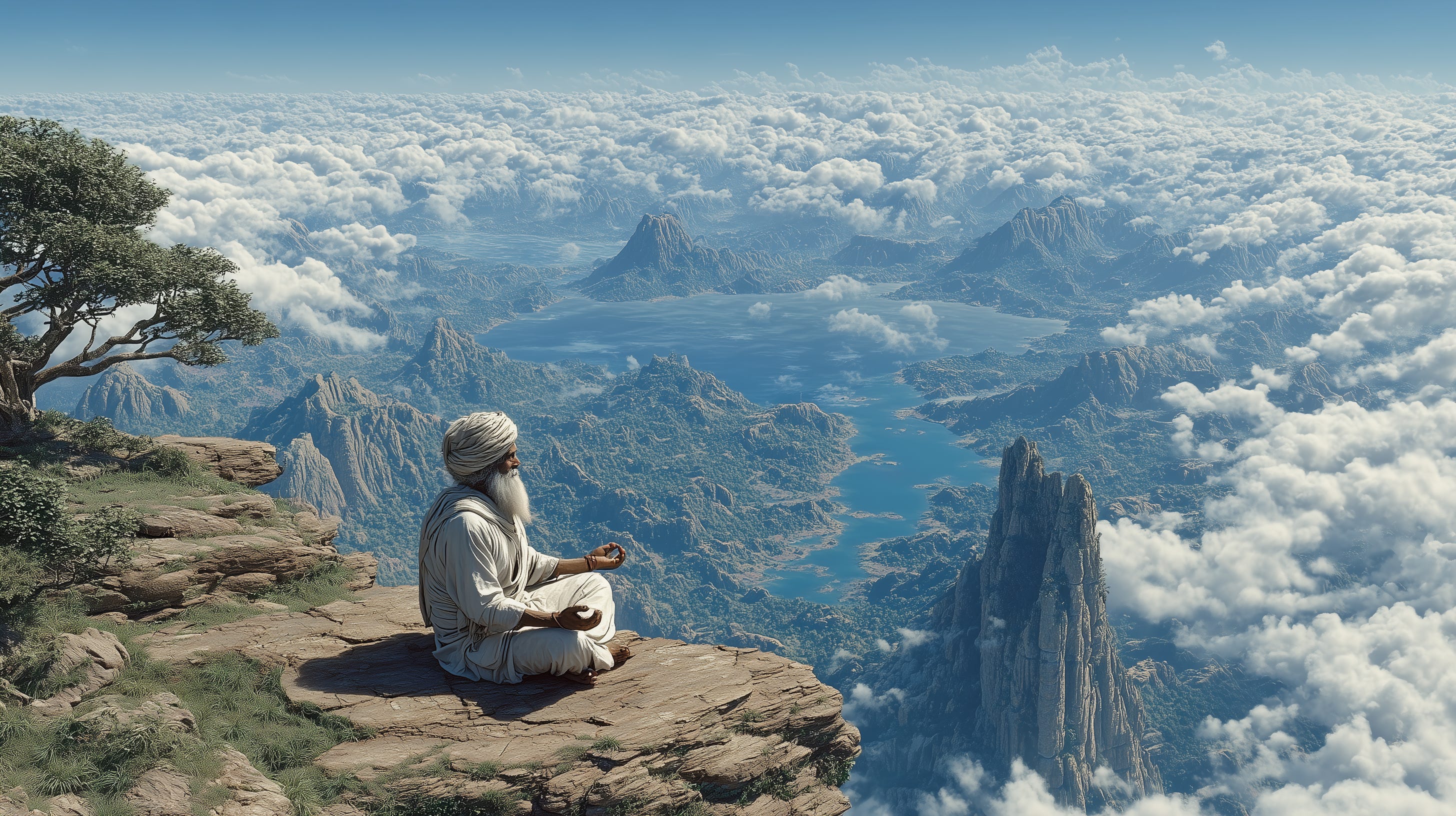
The list above is depressing, and if anyone studies the lives and fortunes of these people, I won’t blame them for believing that the institution of godmen constitutes one of the most sanctimonious groups of neoliberals. Yet, and while I have not met them, many genuine rishis, munis, and yogis live in India. You won’t meet them because they shun publicity. Some may live in the mountains or forests, others not.
I started with Maharishi Mahesh Yogi because of his association with the Beatles and Rishikesh, but, like Bertie Wooster of PG Wodehouse fame, I may have run away with myself and left my minuscule audience gasping for breath, wondering what I am writing about.
Shall we get into the subject? I can only touch on this subject briefly here in this tiny post, but I promise I will dive into it over the course of the year. India is, as Diana Eck wrote, a ‘sacred geography.’
Who were rishis?
Shall we start by asking the question: who or what were rishis? A rishi, or rsi (sorry, I don’t seem to be able to insert diacritic marks). In the earliest Vedic concept, a rishi was someone who perceived the sacred truth, the cosmic order, and who could express that truth in a mantra or poetry.
Technically, a rishi was not just your run-of-the-mill holy person. In the early traditions, the rishis did not write down their ‘truths.’ They passed it on by word-of-mouth. Oral methods of transmission were widespread in many cultures worldwide, and in the early days, the rishis did not pass on the knowledge of the Vedas in writing. The earliest transmissions were oral, with great emphasis placed on proper memorization of the verses and correct pronunciation. The Vedas were the revealed sound, as perceived by the Rishis, and the succeeding generations of Rishis guarded this knowledge closely, for fear that ‘democratization’ of this knowledge would somehow dilute the knowledge.
My theory: while the original intention may have been pure, the practice of hoarding knowledge became a source of power, especially when the caste system started to ossify.
Were all the rishis really detached? I wonder. There are many versions of the Jaya-Vijaya myths, but I will give you a condensed account of one.
Jaya and Vijaya were the gatekeepers of ‘Vaikuntha,’ the home of Vishnu. One day, the four Kumaras (the mind-born sons of Brahma) arrived at Vaikuntha to visit Vishnu. Jaya and Vijaya told them to return later, since Vishnu was resting. In one version, the Kumaras are furious, and in another version, they believe that Jaya and Vijaya must have some defect as they could not perceive the true nature of the Kumaras, and cursed them to multiple lives on earth. Vishnu told Jaya and Viajaya that he could not reverse the curse but could offer them two options. One, seven lives as virtuous people, and two, three lives as imperfect people whom one of Vishnu’s avatars would kill – a different avatar each time. The pair chose the second option, and in one of their lives, they were born as Ravana and Kumbharakarna, and so was born the Ramayana. After their three lives on earth, the pair returned to Vaikuntha to be with Vishnu.
In another version of the myth, seven rishis went to visit Vishnu, and the rebuff infuriated them. In the version I related above, the Kumaras believed that the pair did not recognize who they were and deemed them imperfect. Yet, if we flip the coin, we may realize that, maybe, the Kumaras did not understand Jaya and Vijaya’s true nature, and so were imperfect themselves.
Who were the munis?
Now, let us turn to the munis. A muni was not the same as a rishi. A rishi perceived the sacred truth and the cosmic order. In contrast, a muni was an ascetic who focused on silent meditation, contemplation, reflection, and – possibly – withdrawal from the world.
A rishi also meditated and gained insight from ‘tapas,’ or ‘inner heat,’ a concept almost impossible to understand and explain. I have not experienced tapas so, I guess you must experience it to know it.
As the years and centuries progressed, the rishis – unlike a muni – became associated with yoga, ayurveda, philosophy, ethics, and statecraft. The last is critical: while some became associated with statecraft, they did not allow statecraft to corrupt or tempt them. That is the theory, anyway: no one knows which way an individual Rishi danced.
However, in the original concept of the word, ‘rishi,’ the rishis did not seek wealth or power, quite unlike the modern rishis like Maharishi Mahesh Yogi and his successors.
Remember: this post is just a short introduction, and I will research this topic deeply in the next few months.
Now, we can talk about the yogis.
Now, let’s discuss the word ‘yogi,’ and you will understand that Yogi Adityanath does not possess any of the qualities of a yogi. Wearing an orange bathrobe does not make you a yogi.
The word, ‘yogi,’ is a practitioner of ‘yoga,’ and the word, ‘yoga’ comes from the toot, ‘yuj,’ which means ‘to yoke’ the body and mind together. A yogi, therefore, was a person who practiced yoga as a path of transformation.
Raja Yoga, unlike the more popular forms practiced today (hatha yoga and ashtanga yoga) is closest to the original purpose of yoga, as a means of disciplined consciousness, mental training, meditative absorption, and spiritual transformation. An Indian-origin yoga teacher in Singapore told me that one way of looking at the physical aspect of yoga, is to prepare the body so that it can sit quietly and comfortably in meditation.
Everyone loves the calisthenic aspect of yoga, so the poor man did not last long in the yoga studio. We now have lots of people across the world dancing with yoga mats, and saying, ‘namaste’! ‘Namaste is not a universal Indian greeting!
A yogi, therefore, was a person who attempted radical mastery over mind and self. In the old days, yogis stood outside the pale of society. I don’t know if they developed twists and turns in their spare time but, since mobile phones were not around to distract these old practitioners, my theory may be tenable.
The degradation.
There is a sect of yogis called ‘Nath’ yogis and Adityanath (or, Ajay Bisht) claims to be a Nath yogi. These people were religious ascetics, politically active, and upheld military traditions, especially when high on psychedelic stuff!
Yogi Adityanath has a warped sense of religion, is politically active, and violent. In my assessment, he has debased the Nath tradition, but that is for me to state, and others to dispute.
Have the words, ‘rishi,’ ‘muni,’ and ‘yogi,’ been debased? Yes. I don’t hear many people using the word, ‘muni’ anymore but, ‘rishi,’ ‘maharishi,’ ‘yogi,’ and ‘guru,’ yes.
I will return to this topic later.
A few links
or, if you are Indian, here:
rajiv.rajivchopra-2@okaxis