The brilliant era of the tawaifs is over.
When conservatism rules, and politics changes, culture dies
Umrao Jaan and Tawaifs
How many have seen the movie, ‘Umrao Jaan’? I have not seen the movie, but movie critics praised it for its depiction of tawaif culture
Those who have read my previous essays carefully may have noticed that I used the word ‘tawaif’ and referred to a dead tawaif. If not for this dead tawaif, I would not have explored Azamgarh’s history and would have allowed myself to remain content with relating the story of a hungry goat that thankfully did not bite through my trousers.
Tawaifs and Nautch Girls
Who, you may ask, were the tawaifs, and who were the nautch girls? I ask for your patience, and in the next few months, I will tell you about an incredible dead nautch girl, one who rose to fame, wealth, and power. The word ‘nautch’ comes from the word ‘naach,’ which means ‘to dance.’ The British could not pronounce ‘naach’ and pronounced it as ‘nautch.’ A nautch girl was a dancer who performed at public events and was of relatively low calibre. Their primary purpose was to entertain, and their dances were -and are- often salacious.
The era of the tawaifs is over, but nautch girls live on, pandering to the base appetites of local rowdies, goons, dacoits, low businessmen, young professionals, local politicians, etc., etc., etc. You get the idea.
A tawaif embodied refinement and culture.
A tawaif, on the other hand, was a refined courtesan who often performed at a salon, called a ‘kotha.’ I assume that the moralising British in the 19th century debased the word ‘kotha,’ and today it carries the aura of moral turpitude.
I could not find any source that indicated when the tawaif culture emerged; however, it is several centuries old. During the Tughlaq reign, public dance performances were restricted.
“He commanded that no musician or singer should perform in public places, and that such assemblies should be entirely suppressed.”
— Afif, Tarikh-i Firoz Shahi, Elliot & Dowson, Vol. III,
Was it then that the tawaif culture moved from public to private spaces, becoming refined?
The heyday of the tawaif culture seems to have been during the Mughal Empire.
“Music is one of the chief means of promoting cheerfulness, and His Majesty pays much attention to this science, and has many female singers of rare excellence.”
— Abu’l Fazl, Ain-i-Akbari, Vol. I, p. 251
The culture of poetry, music, and dance was popular during the era of kings and queens, and there is no indication that these were sexual performances.
Tawaifs all underwent intense years of training.
So, let’s come back to the original question: who were the tawaifs? The closest parallel I can find is the culture of the geishas in Japan. Tawaifs were highly skilled, highly trained courtesans, singers, and dancers. While they depended on royal patronage, there was no explicit sexual contract that emerged from this patronage.
A tawaif’s training began when she was a child, and she trained under a skilled master, referred to as ‘ustaad.’ In India, we will refer to a Muslim maestro as ‘ustaad,’ and a Hindu maestro as ‘pandit.’ So, you will have Pandit Ravi Shankar and Ustaad Zakir Hussain. Ustaads and Pandits often occupied the same universe, frequently playing together. Pandit Ravi Shankar, the sitar maestro, for instance, trained under the sarod maestro Ustaad Alauudin Khan, of the Maihar Gharana.
Shall we discuss a few essential words?
Now may be a good time to pause and introduce you to a few terms, and I will also discuss the gradual debasement of one of them.
The word ‘gharana’ probably derives from ‘ghar,’ meaning ‘house.’ A gharana, therefore, is a ‘house of music’ or a ‘house of musical tradition.’ I am no expert on gharanas, but those who love Indian musical tradition will be familiar with the various gharanas.’ When I use words like ‘gharana,’ I refer to North Indian traditions. The words and musical traditions in South India differ vastly from those of North India, but the concept remains consistent across South Asia.
Shall we dive deeper into this topic? It appears that the tawaif culture emerged during the Delhi Sultanate era in North India and reached its peak during the Mughal Empire. We must also divorce tawaifs from other dancers, such as devdasis, nautch girls, and the like.
Tawaifs were part of a highly sophisticated cultural tradition in premodern South Asian societies, and were not prostitutes or concubines.
As I mentioned, the training of a tawaif often began in childhood under a teacher, an ustaad (and, sometimes, a pandit). The practice sessions (riyaaz) were always intense. The training involved singing in the classical style, studying classical forms of music and dance (mujra), proper Urdu/Persian diction / refined behavior (tameez), and converting the kotha (salon) into a place of refinement, teaching, and patronage.
A tawaif who embodied the highest form of cultural refinement often became independently wealthy, though never free of royal patronage. She – the tawaif- also became famous, and many became icons of artistic refinement.
I used the word ‘mujra,’ which is now thoroughly debased and divorced from its original meaning. When modern Indians use the word ‘mujra,’ they often use it to refer to a salacious, usually sexualized dance, complete with lewd gestures.
However, the mujra often combined classical Indian dance forms like Kathak, one of the subcontinent’s great classical dance forms, with other forms of music and dance, such as the ghazal and thumri.
The ghazal is distinct from a qawwali; both forms are still extremely popular in India, particularly in North India. The Qawwali has its origins in the Sufi mystical tradition. In contrast, a ghazal has its roots in Arabia and is an ode that explores themes of spiritual or romantic love. Ghazal and qawwali singing styles are often entirely different. Me? I prefer the Qawwali.
The thumri is a vocal style deriving from the word ‘thumukna’, which means, ‘to walk with a dancing gait, in a way that the ankle-bells tinkle.’
A tawaif, trained in, for example, ghazal, thumri, Kathak, diction, and etiquette, was a woman raised to the highest level of cultural perfection. Consider the years of love and hard work a woman invested in becoming an iconic tawaif.
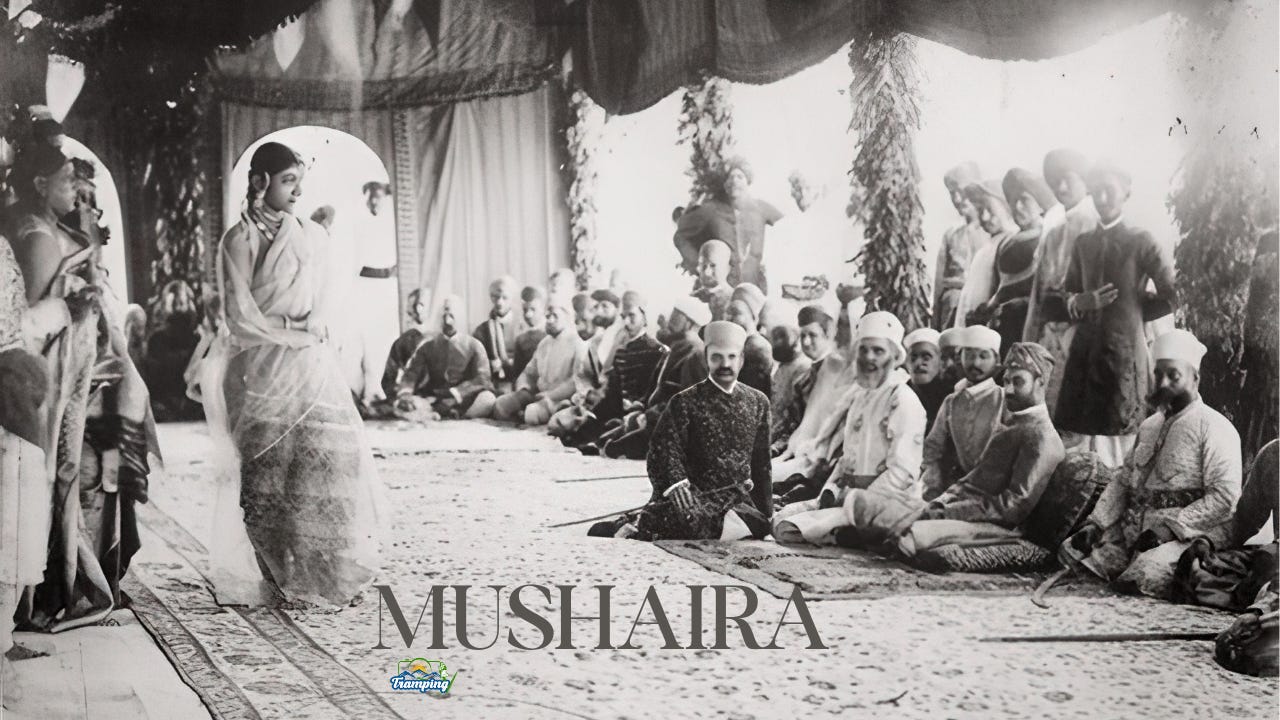
Where did the tawaif perform? They performed at the kotha or a ‘mehfil.’ A mehfil is an indoor place/space reserved for poetic symposiums, singing, music, and dance, part of the Ganga-Jamuni Tehzeeb culture. ‘Tehzeeb’ is an Urdu word that encompasses civilization, culture, refinement, and politeness. The word derives from the Arabic word ‘tahdib,’ meaning refinement or culture.
Consider also the level of cultural refinement a tawaif embodied if a king sometimes sent his sons and daughters to a tawaif to learn etiquette or ‘tameez.’
Yesterday, today, tomorrow.
Even today, we often ask someone to behave with ‘tameez,’ and we refer to a person who lacks etiquette as a ‘bad-tameez,’ or a person who is rude and crude. Modern standards of etiquette are quite different from those of premodern times. Royal, or old, standards of etiquette may seem stilted compared with ‘modern’ standards. Consider the British TV series, “Downton Abbey”, on which I gave up after a few series or seasons. These series depict a way of life that has almost vanished. In countries like England, you may find sections of the old nobility who embody such behavior.
We run into cultural barriers when comparing the etiquette of the old Brits as depicted in Downton Abbey with that of those who embody tezheeb, such as the Gunga-Jamuni tezheeb. I consider the behavior of the characters portrayed in ‘Downton Abbey’ to be quaint, antiquated, and stiff.
While I have not met many people who embody the cultural norms of the old Mughals, I have met a few who embody Lucknowi or Allahabadi tezheeb. I consider these people to be graceful, embodying a timeless charm, leaving me with the wistful desire that more people in India behave with tehzeeb.
The word, tawaif, has been debased, as has the word, mujra. A kotha can now symbolize the house of the matriarch of a circle of prostitutes, or a place where nautch girls dance.
Give tawaifs the respect they deserve.
While tameez now simply refers to manners, tahzeeb carries the scent of history, culture, and a bygone era. The Kathak is still a respected dance form, and a proper mehfil invites you – even now – to a world of grand music and poetry.
The Indian scholar and writer, Pran Neville, said this of tawaifs,
“The word ‘tawaif’ deserves respect, not disdain. A lot of them were singers and not sex workers. People think of them as prostitutes, undermining their value as great musicians.”
- Pran Neville
The Pakistani newspaper, Dawn (an excellent newspaper), in 2004, described tawaifs as “cultural idols and female intellectuals.”
In the concluding essay of the series that began with a goat and a towel, I shall write about Gauhar Jaan and Begum Akhtar, and about how the British and modern culture killed this old world.
In this short essay, I’ve not even scratched the surface of the world of the tawaifs, which is a pity. You can do a PhD thesis on their world. Also, I have not discussed tawaif traditions in other parts of the subcontinent or in Lahore’s Heera Mandi. Another time…
1. https://en.wikipedia.org/wiki/Tawaif
2. https://thecommonsjournal.org/articles/10.5334/ijc.1073?utm_source=chatgpt.com
3. https://ijcrt.org/papers/IJCRT2406463.pdf?utm_source=chatgpt.com
4. https://en.wikipedia.org/wiki/Mujra
5. https://en.wikipedia.org/wiki/Ustad
6. https://en.wikipedia.org/wiki/Riyaz
7. https://en.wikipedia.org/wiki/Gharana
8. https://ijcrt.org/papers/IJCRT2406463.pdf?utm_source=chatgpt.com
Time & technology change culture.


Me too. It's just an idea.
That's all up to you. But sometimes people like the personal note because they wonder what you think. And sometimes they might have thought the same. There are always the trolls but them seem to be less here or you can easily block them.