

Leaving Ludhiana
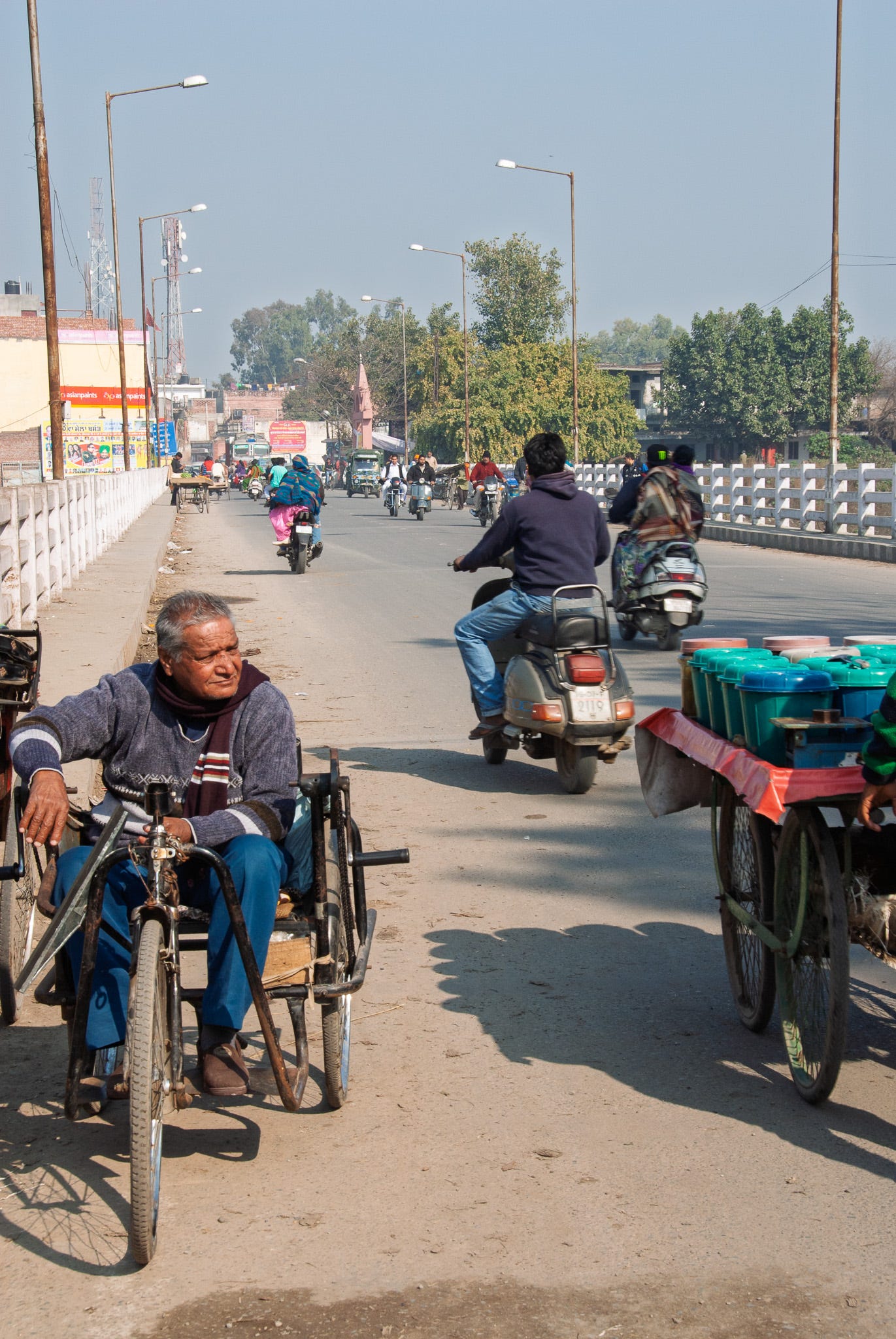
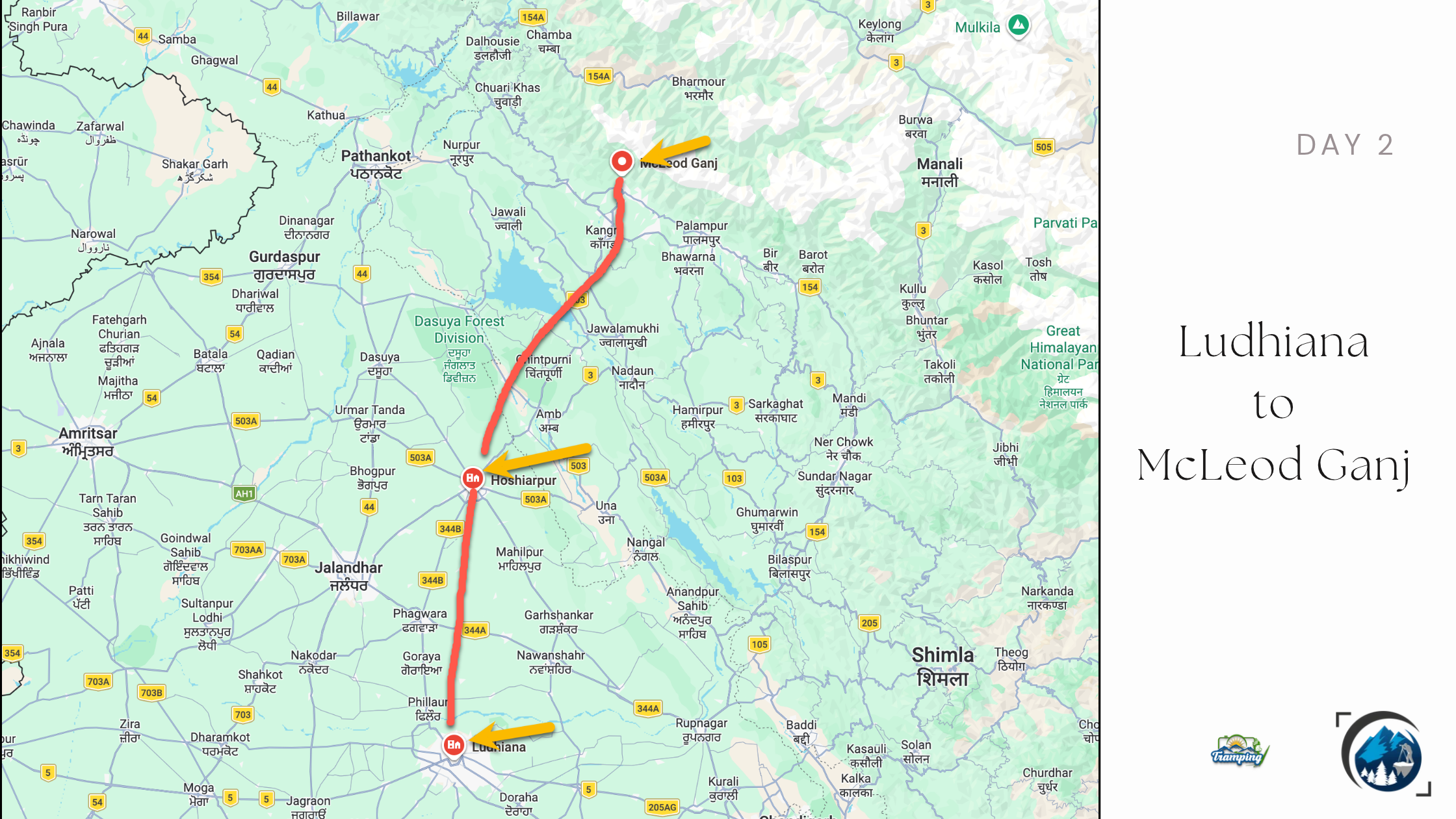
After a good breakfast, we left for McLeod Ganj. Ludhiana always has a strange effect on me. It is a wealthy town, home to many successful industrialists and entrepreneurs. Hero Cycles, Oswal Fabrics, and the food company Cremica all began in Ludhiana. Each started small and has grown since. Hero is one of the world’s largest bicycle manufacturers. Oswal makes fantastic woolens, and Cremica began as a producer of inexpensive, low-quality biscuits but is now a respectable packaged-foods manufacturer.
Ludhiana and Kanpur
Kanpur in Uttar Pradesh is another town with a rich entrepreneurial culture, but Kanpur and Ludhiana share one characteristic that makes me want to leave as soon as I arrive. Both towns are crowded and filthy, and I have never understood why the local industrialists don’t push the municipality to clean them up.
We left after an early breakfast. I wanted to beat the traffic, so we soon crossed a bridge over the Sutlej River. I was in Delhi Public School for a year, in grade four. They had named all the schoolhouses after the rivers of Punjab. I was in Sutlej House; our House color was green, and I have had a lifelong affinity for the Sutlej ever since. When we crossed the bridge, I turned my neck around like a corkscrew, hoping to see a magnificent river with rapid, flowing waters. Instead, I saw only a dry riverbed. That wasn’t the first, nor the last, time I have lamented our rivers' tragic fate. We have converted the Yamuna in Delhi into a toxic bog.
One section of the Yamuna is clean around the Bihari Festival, Chhat Puja. Our theatrical Prime Minister always puts on a show of pomp and piety, and the government creates a small section for his exclusive use, where they pump in fresh water so he can prance in piety and get the filmmakers to make reels. Meanwhile, just beyond the section carved out for his exclusive use, normal citizens dip themselves in the toxic foam and declare that the Goddess Yamuna has purified them.
Driving through Hoshiarpur.
KO and I drove on to Hoshiarpur, then crossed into Himachal Pradesh.
I had not paid attention to Hoshiarpur’s history. It was just a town I passed through, but many famous Indians have deep ties to Hoshiarpur, including Manmohan Singh, Intikhab Alam (a cricketer), Zail Singh (former President), Mohammed Nissar (former cricketer), and the Sufi singers, the Nooran Sisters.
On Sufi music. A digression.
One of my favorite performances by the Nooran Sisters is their rendition of the famous Sufi qawwali, ‘Damadam Mast Qalandar,’ in Dhaka.
If you want to see many of us Punjabis, including me, go wild, you must listen to Damadam Mast Qalandar. ‘Mast Qalandar’ refers to a person, usually a Sufi saint, who wanders as a mystic, intoxicated with love for God. The qawwali is dedicated to the Sufi mystic Lal Shahbaz Qalandar, who lived in India (now Pakistan) in the 13th century. People claim Amir Khusrau wrote the lyrics sometime in the 14th century and that Baba Bulleh Shah later modified them. Hindus and Muslims both claim Lal Shahbaz Qalandar for their own. Hindus call him ‘Jhulelal,’ and Muslims call him ‘Hazrat.’ We Punjabis love the poetry of Amir Khusrau, Baba Bulleh Shah, and Baba Farid. The lyrics have been modified again. Someone inserted a line: ‘Ali da pehla number,’ meaning ‘Ali is number one.’ The word ‘number’ could not have been in use when Amir Khusrau wrote the lyrics or Baba Bulleh Shah modified them. You can surmise that Damadam Mast Qalandar represents a living, thriving tradition that has evolved over centuries to stay relevant to today’s audience.
Sufism arrived in India centuries ago and influenced the rise of the ‘Bhakti movement’ in South Asia, as well as Sikhism. Unfortunately, thanks to Narendra Modi, we have now corrupted the word ‘bhakt,’ turning it into ‘Andh Bhakt,’ meaning ‘blind follower.’ ‘Andh Bhakt’ is an insult and a derogatory term for those who blindly follow the herd and ignore evidence that things in India are not hunky-dory.
We had to stop for a while in a crowded part of Hoshiarpur because my traveling buddy wanted to buy something. I remember hanging around my car nervously because the chaotic traffic threatened to smash my car. Still, I found time to have some chai and photograph some fascinating old doorways. I haven’t included any of these images in this post, but I will in Substack Notes.
The bridge
We crossed the town soon enough and stopped twice, once at the beginning of the bridge that took us into Himachal Pradesh and once at the bridge’s center.
Hoshiarpur stands at the border between Punjab and Himachal Pradesh. From the bridge, you get your first view of the snow-capped mountains, and your world changes. The mountains beckon.
The sow
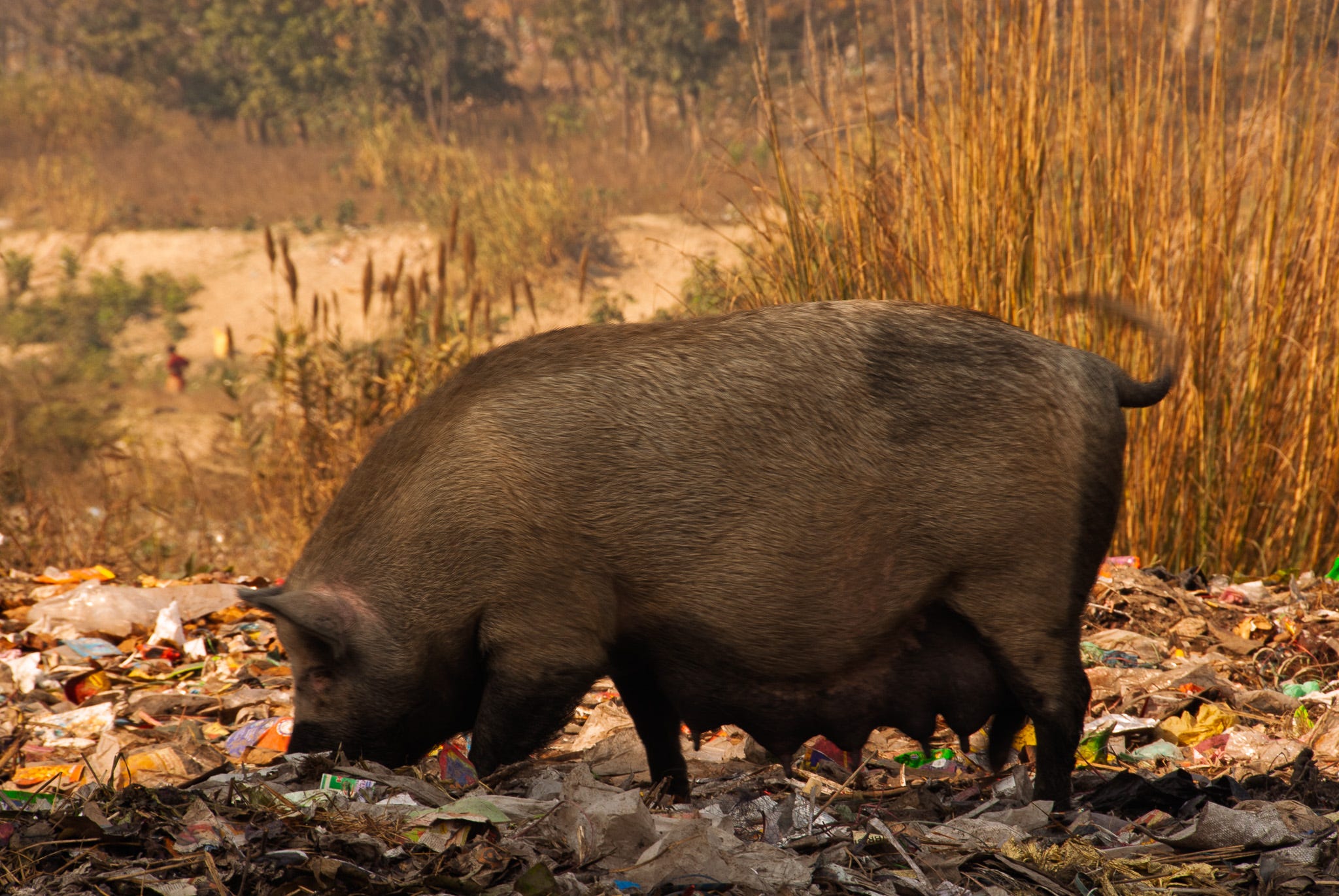
A huge sow fascinated me. She stood at one end of the bridge with her brood of piglets, and she was massive. I took a few photographs, but I was wary. She didn’t look friendly, and I was in no mood to run down the road, yelling and screaming, trying to escape a furious sow. Their immune systems are clearly stronger than ours. She rummaged through the municipal waste, foraging for food for herself and her family. My lady was clearly well fed and probably satisfied with her life. Many of us in North India avoid pork because of the risk of tapeworms. Yes, her future was secure, and she strutted about like a spoilt little film star!
The first sight of the hills is always magical.
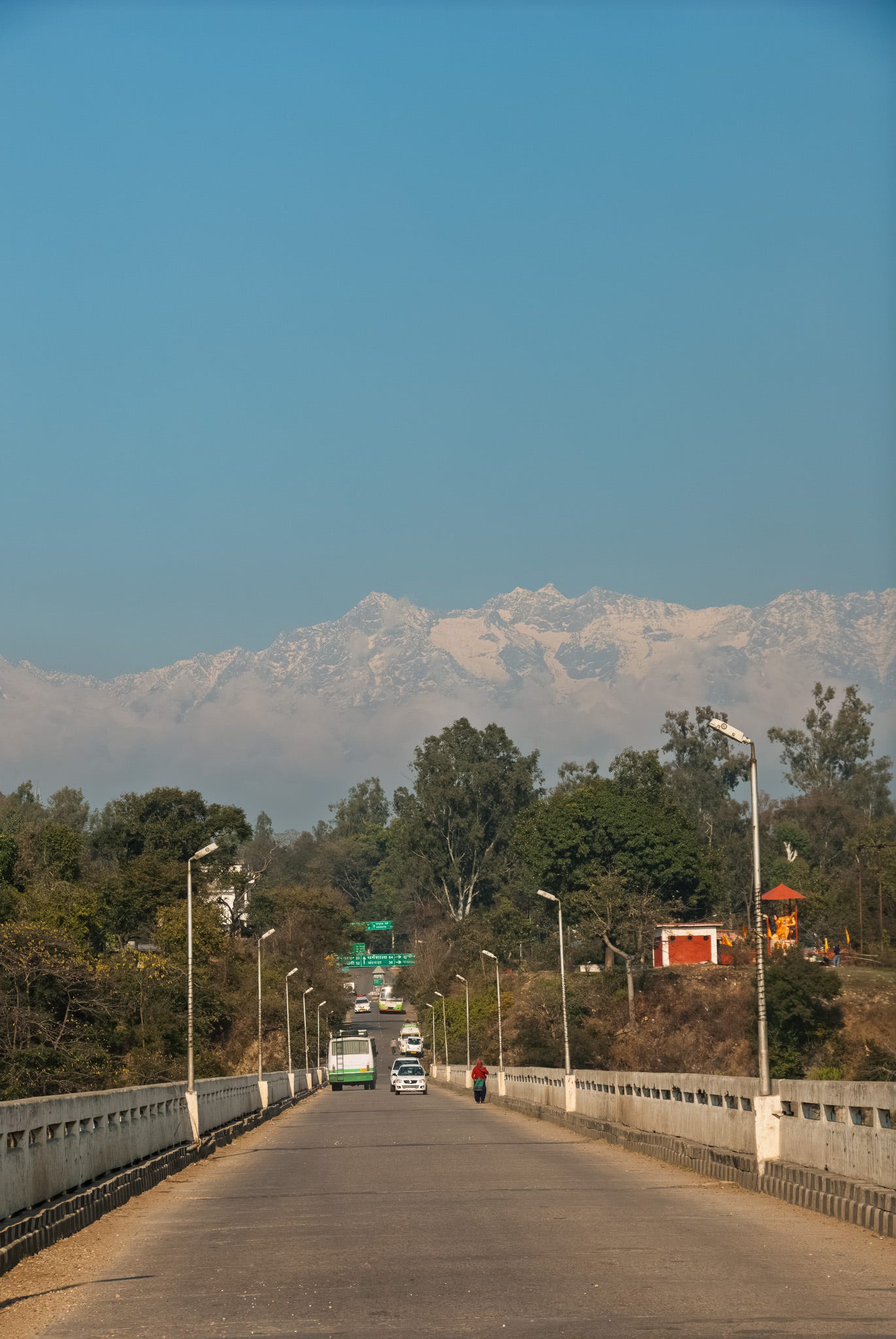
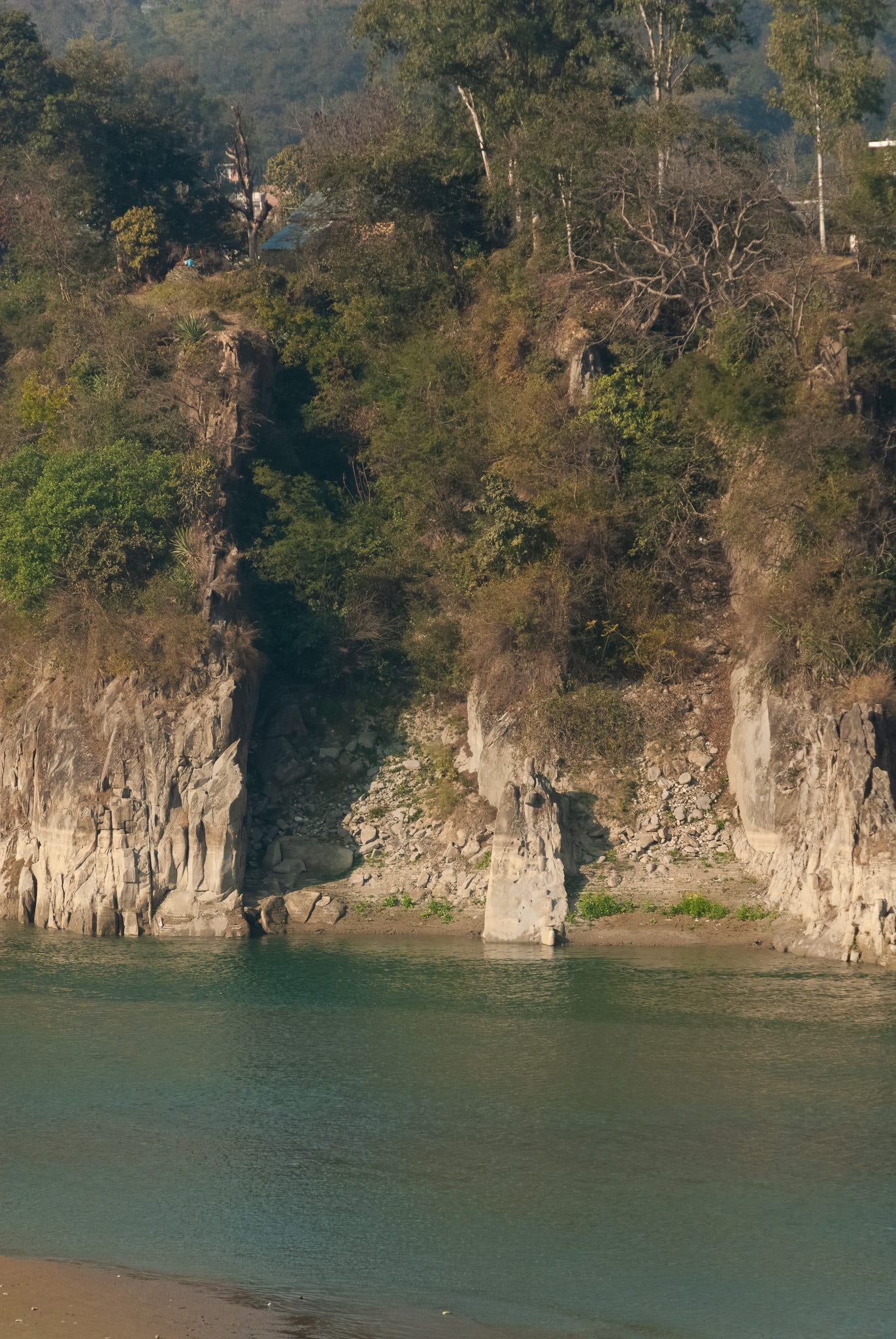
We stood in the middle of the bridge for a while. I photographed the river we were crossing and the mountain soaring above the trees. No matter how often I travel to the hills and mountains, the first sight of the hills, miraculously emerging from the plains’ dust haze, never fails to excite me. The hills possess an eternal magic, and it is unfortunate that many of us see them only as a resource to be exploited for humanity’s greed.
All you need to do is stand where the hills first appear in the haze, breathe the air, let the energy and magic seep into your body and soul, and you will realize there are things in this world far greater than man.
Crossing over into Himachal Pradesh.
Decomposing onions.
We crossed into Himachal Pradesh, and the air changed. The trees changed, and all was good. Well, not everything was good. We stopped at a chai stall, and then I wandered around. Someone, probably the owner, had strewn onion peels and other trash around the shack. I took a few photographs and watched the onions rot in the dappled light. ‘Organic,’ I thought. ‘Organic.’ At least the onion skins would decompose and blend into the soil, probably adding a few vitamins.
I went around to the loo and beat a hasty retreat. Malodorous waves wafted through the air, tickling my nostrils. If I could smell, I could tell you the stink was awful. That stink ranks among the world’s worst. Instead, I wandered over to a few trees and watered the ground.
A paratha and chai break.
Our next stop was at a dhaba halfway up the hill. We stopped there for a beautiful view of the mountains. The restaurant served fantastic potato-stuffed parathas. My buddy consumed three, I think, and I had one, resisting the temptation to have a second. Then we sat in the winter sun, my right hand contentedly stroking my belly as I sipped chai. Some of you must be wondering how much chai I drink.
In college, we’d gather around an aluminum teapot, drink chai from cracked china cups, and indulge in an adda that stretched for hours. Those were the days of tangential discussions.
Crash and bang in McLeod Ganj
We finally reached McLeod Ganj at about 5 pm. For clarity, let’s say we approached the town from the main road, which led straight to the main bazaar, where authorities restricted further access. Then, in a panic, we called the hotel, and the manager told us to reverse, go back past the Gurkha Regimental gate, and wait for a flunky to guide us to the hotel.
The back road is steep and winding, and the flunky buried himself in his phone, so we overshot the hotel.
‘Reverse,’ he screeched.
My brains left my skull, and I reversed down that steep, winding slope, which was a huge mistake. I swear the slope seemed to be 60°, even though it may have been closer to 40°. Isaac Newton and his awful laws of gravity stepped in, and my car careened down the slope, crashing into a lady’s water pipe.
She hopped out of her home, screeching and threatening to claw my eyes out. A crowd gathered, and my buddy hopped out and stood behind them like an interested bystander, leaving me to face her wrath.
I was lucky. The water pipe stood opposite the hotel, and the manager rushed out to protect my car and my limbs from damage. He assured me that someone broke her pipe daily. He calmed the crowd, and they all pooled in to help me get the car out of the ditch, into the hotel’s tiny parking spot, and to repair her pipe.
I tottered into the hotel and ordered a chai with pakoras to calm my jangling nerves!
The hotel room lighting was awful, and I regretted not bringing my Kindle. But the tiny dining room overlooked the valley, and their omelets were outstanding.
Ki Monastery. A future trip?
A photo of the magnificent Ki Monastery took center stage in the hotel’s reception. I swore I’d visit the monastery one day.
Insha’Allah, that will happen next year. Insha’Allah.

You can support me on Ko-Fi here.