

Even though politicians are scum, we can learn from them.
Politicians are scum, and there is almost nothing anyone can do or say to change my mind. Yet, even if we detest their morals, we must admire their administrative and other related skills.
I used politicians’ techniques to promote our business.
Years back, when I was a young Area Sales Manager, selling our products in Uttar Pradesh (a crazy state in North India) and trying to develop our business in the state’s rural areas, I spent considerable time figuring out ways to promote our brand and increase awareness and engagement.
I painted many walls bordering highways, rural roads, and near villages with our brand images. Billboards and wall paintings are, at best, reminder media and passive forms of advertising. After many arguments with snobbish brand managers, I got permission to use radio jingles. Our brand managers believed that the only way to promote our brands was through television advertising, ignoring the harsh reality that most villages lacked TV connections.
Culture varies across a state.
One day, I met someone who introduced me to a company called Jain Studios, which had a product called ‘Video on Wheels’ (’VOW’). They developed this service at the behest of politicians (the innovative scum) who wished to push their messaging to the deep rural hinterland.
I won’t describe the model in any detail. A sketchy description will suffice. They’d send a large van on a 26-day journey cycle, covering 52 villages. During the day, they’d get permission from the village elders and then make loudspeaker announcements inviting the villagers to the evening’s program.
Then, after sunset, they’d turn the van's back into a giant screen, install a large projector inside, and project ‘filmi’ movies and scenes onto it. We’d intersperse the hour-long program with our advertisements, sell our products, and give gifts to the villagers.
When I first started my ‘VOW’ journey, I designed a single program for the entire state. After one or two cycles, I came to understand that the culture of the western part of the state differed dramatically from that of the eastern part. In comparison, people in the West loved jazzy disco music; those in the East loved earthy, semi-rural, soulful music full of rhythm.
Under the starry skies, I watched villagers ‘jhoom.’
I remember the villagers in East UP stiffening with shock when I played jazzy music and relaxing when I switched to a different program. Once I changed the program, I saw the villagers relax as they squatted on the ground, their bodies swaying imperceptibly with the music. The Hindi/Urdu word I’d use is ‘jhoom,’ which translates literally as ‘to sway.’ Yet, the literal translation of the word ‘jhoom’ cannot cover its many shades, which range from a mere physical sway to the sway of a person in the throes of divine ecstasy.
I’ve spent many evenings sitting on a coir bed (a ‘khatiya’ in the ritual lingo), watching the program and the villagers gently sway. I am not being romantic when I write that the memory of those evenings, often under the stars, evokes the memory of a bygone era.
Those were the days when cable TV, the internet, and smartphones had not yet penetrated our lives, changing cultures and people’s behavior, forcing us into small screens and away from interaction with other people and from nature’s bounty.
Watch this fantastic YouTube video, with Naseebo Lal and Abeeda Parveen singing ‘Tu Jhoom’ at the Coke Studio in Pakistan.
Culture is not static
Culture is not static. Culture changes. New culture springs from old culture. Sometimes the remnants of old cultures persist for generations, albeit in modified forms; at other times, the old culture dies and lies forgotten, buried in the earth.
You may ask what the above memory has to do with Azamgarh and a dead tawaif, and, if you do, I understand your confusion. But stay with me, and, in the end, you will appreciate my logic.
Azamgarh was a vibrant literary town. Once.
I did some research on Azamgarh because I was curious about the town’s past. Azamgarh is an insignificant town, but once upon a time, its social and cultural life was vibrant.
A brief historical note about Azamgarh.
Azam Khan, son of the Mughal commander Vikramjit Singh, founded the town in 1665 CE. Please note: Vikramjit Singh was probably Hindu, and Azam Khan a Muslim. Pause here and reflect on one small truism. While there were differences between people of different religions in those days, it would seem that normal citizens could, and did, cross the religious divide without the hysteria that pervades modern cultures across the world. The internet and smartphones have not brought wisdom.
The word ‘Azam’ means great in Persian/Arabic, and the word ‘garh’ means ‘fort’ in Sanskrit. So, you have a town named with Persian and Sanskrit roots, which is fascinating.
A brief note about Azamgarh’s literary heritage.
Let’s move to the fun part of this brief essay. Azamgarh was not always a sleepy town. Once upon a time, the town was vibrant, with a thriving poetry culture. It appears to have been known as the ‘Land of Poets & Writers.’ If you click this link, you will see the names of famous poets born in Azamgarh. Kaifi Azmi is a renowned poet known to most Indians of my generation, but I confess to being astounded when I read the names of the people born in this city.
It turns out that Azamgarh has a few excellent colleges, including Shibli National College, founded by educator Shibli Nomani. This college has one of the largest libraries in Asia, handwritten copies of ‘Al-Arawah’ and ‘Sirre Akbar’ by Shah Jahan’s daughter, Jahan Ara. I have one of her books, but I will read it after I learn Persian.
The library also houses copies of the Upanishads and a Persian translation of the Mahabharata.
Shibli Nomani was a remarkable man, and wished to found something he called ‘Darul Musannifin,’ or ‘The House of Writers.’ He could not achieve this aim in his lifetime, but one of his disciples, Sulaiman Nadvi, opened the Darul Musannifin three days after Shibli Nomani’s death. It survives today as a part of the college. Sulaiman Nadvi himself was a remarkable man and one of the founders of Jamia Millia Islamia, a fantastic university.
Azamgarh also played a minor role during the Uprising of 1857-58, resisting the East India Company forces, who took the town after much difficulty.
Today, Azamgarh is a small agrarian town.
Azamgarh today is an agrarian town that few people know about. I have been there twice or thrice. If the most expensive room in the city cost me about $ 3 in those days, you can imagine what kind of place it was, and how far down it has slipped since its heyday.
I visited the town to sell our products at the market and expand our business into its rural hinterland. Otherwise, I would not have gone to see the place. If not for a hungry goat and a chance reading about the life of a dead tawaif, Azamgarh’s name would have passed into the deep recesses of my mind.
Even though some claim that the town’s residents are proud of their hometown’s peaceful, literary, and cultural history, they have allowed the city to sink into a quiet oblivion. How much of Azamgarh’s vibrant literary culture is left today?
Culture changes, and while I do not suggest we wallow in the past, I consider it a shame if we forget our heritage. I don’t believe that all cultural change is desirable. If you consider the bigotry, disinformation, and anger that are spreading in the world, you may agree that these are changes we can do without.
I don’t know whether Azamgarh has forgotten its literary and cultural past or is in the process of forgetting its heritage, settling into the quicksand of anonymity. Few seem to have returned to their birthplace to create new institutions of learning or culture, which is a pity.
We don’t know India. Not really.
I will repeat a line I’ve used often: were it not for a goat and a dead tawaif, I would have known nothing about this small town. Were it not for my writing on Substack, I would not have bothered to research its past. In my corporate days, we often told foreigners that ‘we are Indians, and know India. You don’t understand India. Allow us to translate our country for you.’
Once, I believed in the self-serving bullshit. We don’t know our country: our history and culture are too vast and deep for any of us to achieve complete knowledge. We can, however, admit our ignorance and seek to learn.

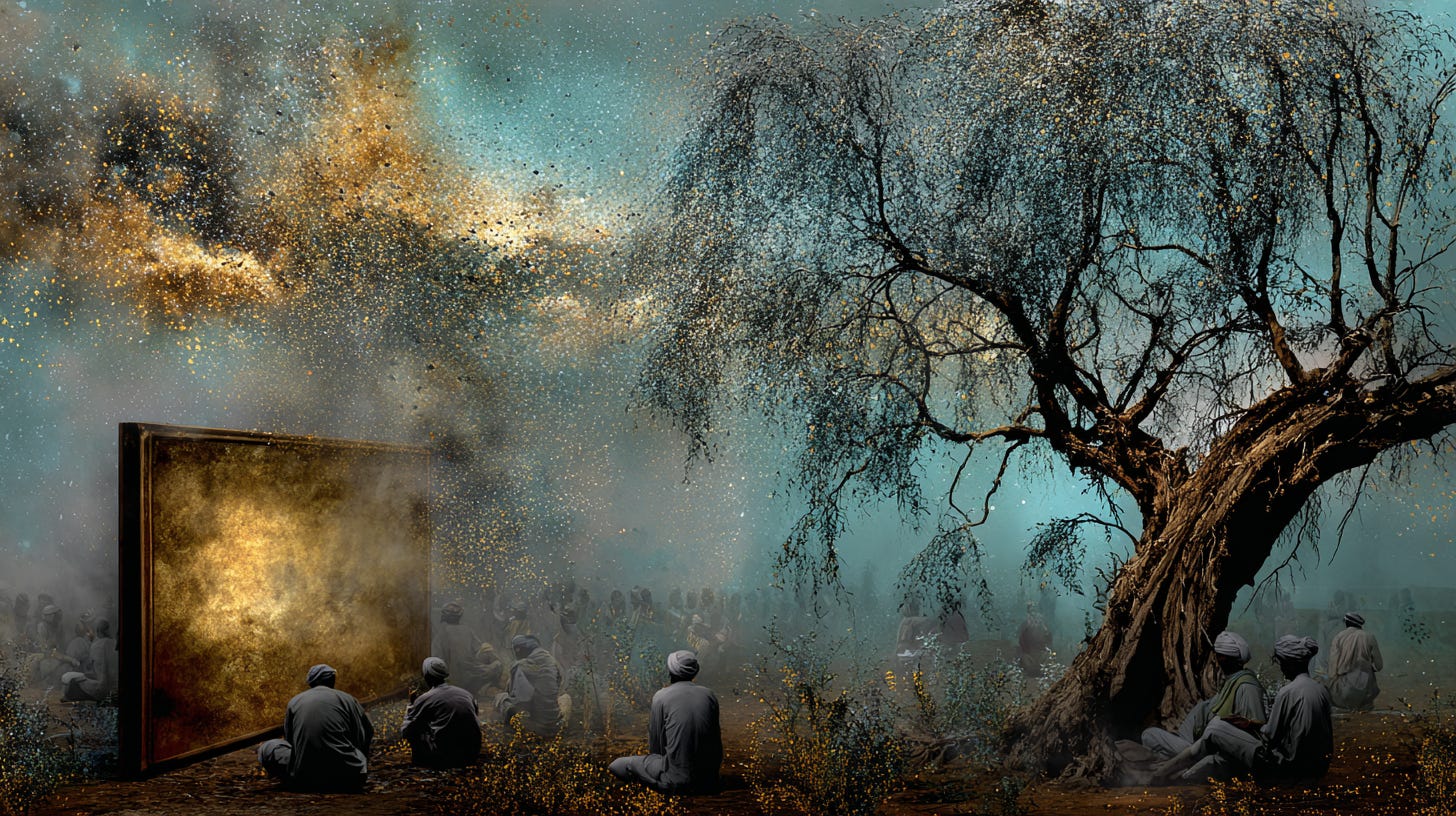
I created the image using Midjourney AI.
Totally agree with your assessment that politicians are scum. And it must have been and still is difficult to sell anything in Uttar Pradesh. On the town of Azamgarh, it is true culture changes and only someone really interested in India can find out what you were able to find out. Culture persists in the modern era by slipping it's way into modern forms. Poetry of the best Urdu or Persian kind slips into the best written Bollywood songs. No one notices unless they recognize the excellence of the lyrics. Older song forms respectfully remixed yet retaining the essence of the original, slip into the blockbuster film "Dhurandhar" which is a modern spy film that refuses to ignore amazing past Indian musical culture. Poetry shows up by slipping into The Great Indian Kapel Show. It is impromptu on the spot or poetry on demand for a visiting guest or celebrity or just if Navjot Singh Sidhu offers to do a spontaneous poem honoring Priyanka Chopra Jonas or the incredibly successful World Cup India Woman's Cricket Team. Is the poetry as good as Ghalib. No. But it is often quite excellent as impromptu poetry that revists the old India cultural custom of the old mushairas or evening poetry readings with food and drink and the poetry often set to music as in Mughal times. That tradition slipped into American culture with Bob Dylan poetry lyrics within his music that he performed in Greenwich Village bar poetry reading sessions. Probably there won't be another Bob Dylan. But in India, the poetry, like classical India dance will persist with it's best practitioners performing all over India in selected locals or worldwide. Probably the best antidote to scum politicians.