

Kangra’s history goes deep into the past.
Kangra’s history stretches back far into the past. Some say the region’s history stretches back 3,500 years and, if so, then we enter the world of prehistory where myth blends with historical memory.
The rulers of Kangra belong to the Katoch dynasty, one of the world’s longest dynasties, it seems. The Katoch dynasty, from the Kshatriya Chandravanshi (lunar) caste, ruled the ancient Trigarta Kingdom and participated in the famous war at Kurukshetra, as mentioned in the epic, the Mahabharata. People assume the term ‘Trigarta’ refers to three rivers – Sutlej, Beas, and Ravi.
Those of you who read my two posts on Ferozepore may remember the Sutlej River, and how it was the boundary between the Sikh and English territories before the outbreak of the Anglo-Sikh Wars. Those who wish to read them again can find the links here and here. Click away and read!
The Beas River also flows through Manali, which I will write about much later. There is much writing yet to do! As per legend, or myth, Maharaja Susharma Chandra, who fought on behalf of the Kaurava army, built the fort after the famous 18-day war in Kurukshetra. The old Maharaja picked the losing side and used the term ‘losing side’ in the modern context of war. The honorable old Maharaja evidently escaped to tell the tale and to build his fort.
One legend, or story, says the fort's original name was ‘KanGarh,’ from the two words ‘kan’ for ear and ‘Garh’ for fort. The legend also says that Shiva killed a massive demon called ‘Jalandhara,’ who was so massive that the head of his corpse lies buried deep in Kangra, with his ear under the Kangra Fort, and his feet now in Multan.
Kangra’s more recent history.
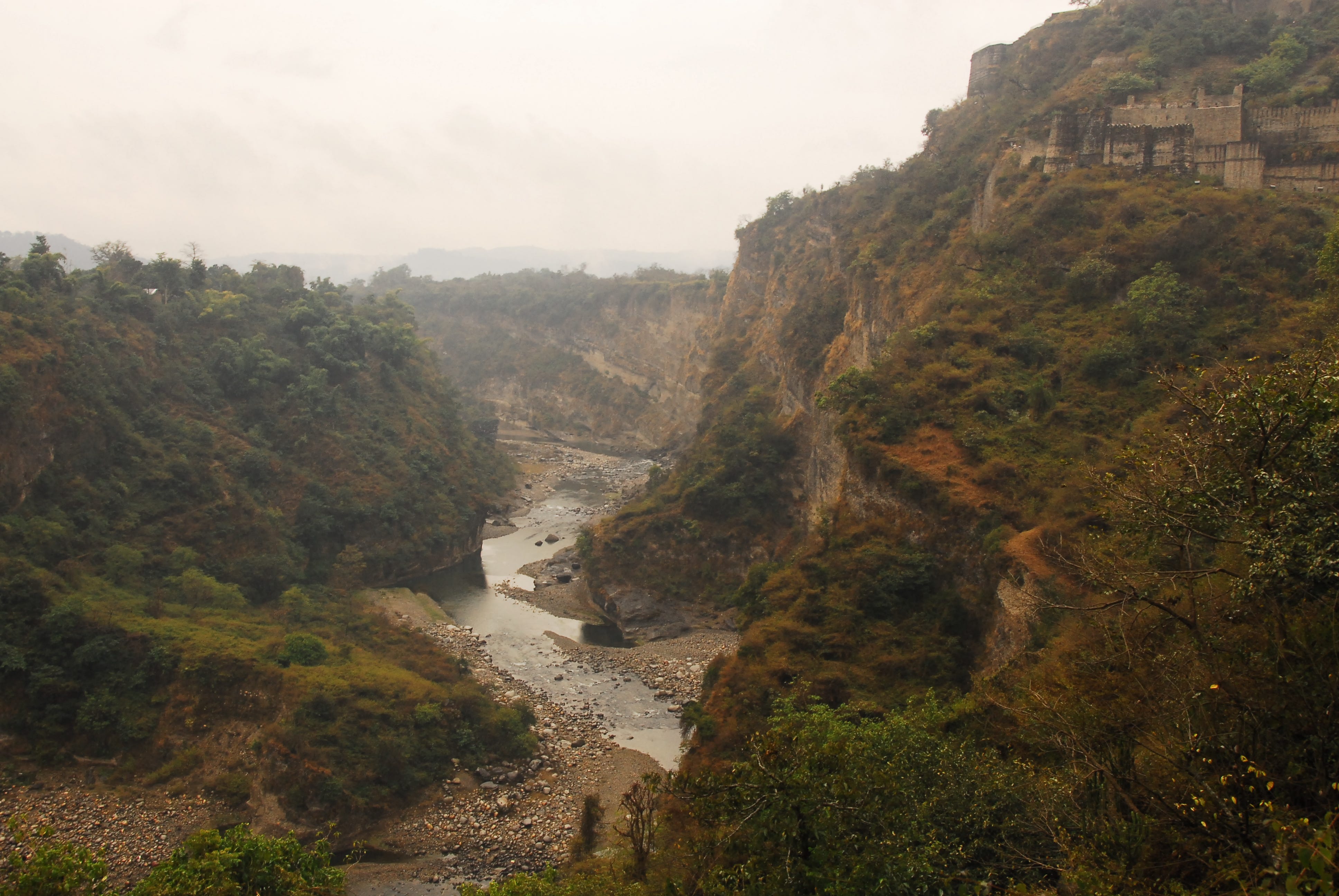
I’ve seen the fort but could not take a tour inside. Maybe I will rectify that omission. My friend and I had visited Kangra several years back, and it rained on the last two days. We originally planned to visit the fort on our return journey, but we left McLeod Ganj late. My travel companion was snoring until late in the morning, and then I wanted breakfast. By the time we left McLeod Ganj, the rain had started coming down hard and, for some reason, I hadn't brought umbrellas in the car. We stood on the highway, and I photographed the fort through the rain, using my Nikon D200. That was probably the last time I used my Nikon D200 as the primary camera on a trip.
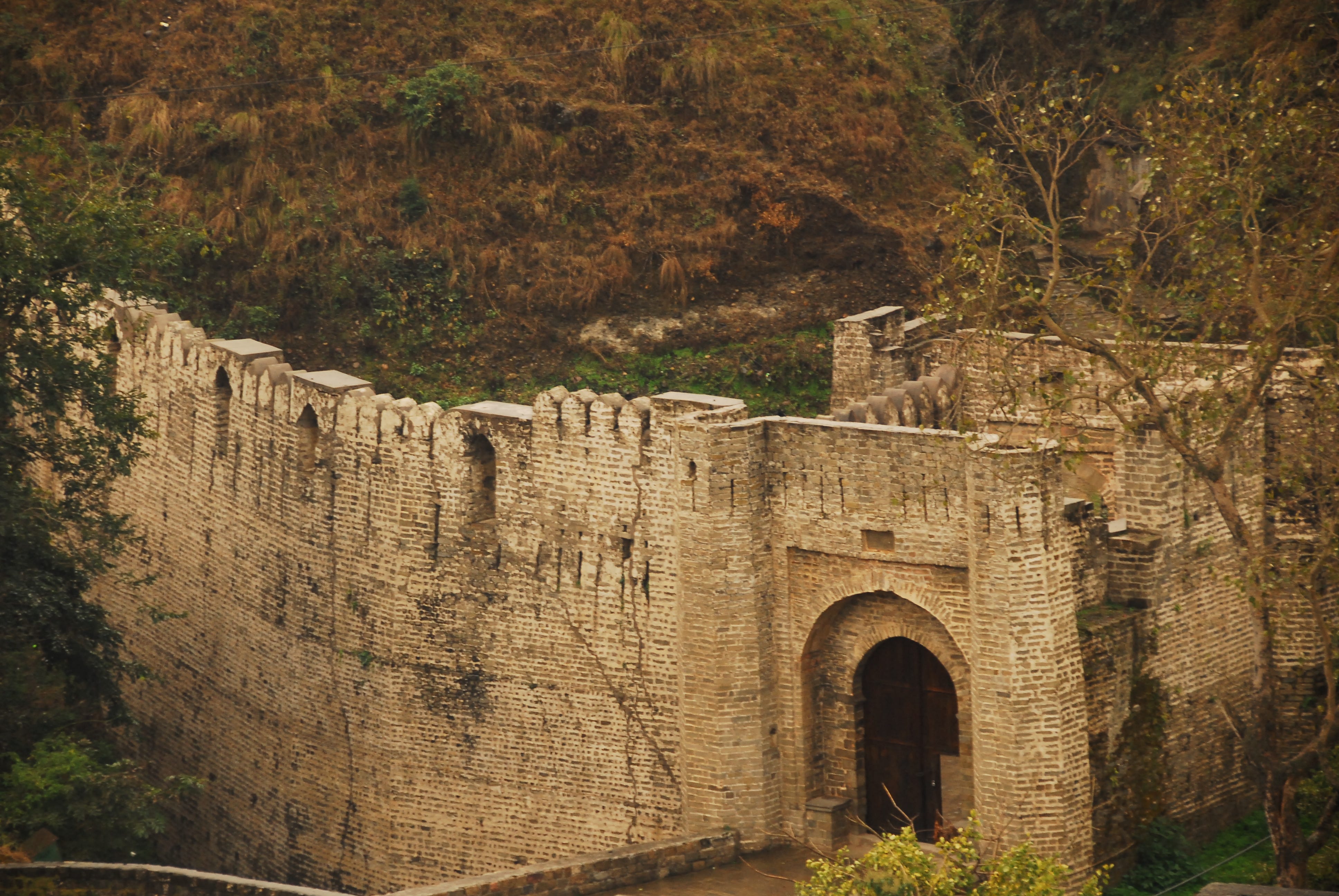
The photograph you see at the top of this post is a crappy picture I made of the Kangra Fort.
Now, whether Maharaja Susharma Chandra or one of his successors built the fort in its present form will always be a matter of debate, but it was remarkably difficult to conquer.
The locals told me that no one could conquer the fort until the Mughal Emperor Jehangir subdued it during his reign. Prior to that, Mahmud of Ghazni launched a punitive expedition in 1009 CE, followed by Firoz Shah Tughlaq in 1360 CE and Sher Shah in 1540 CE. Jehangir’s son, then called Prince Khurram, took the fort in 1620 CE after a 14-month siege.
Mughal power began declining after Aurangzeb’s death, but as per my analysis, Mughal influence in the region began to wane in the second half of Aurangzeb’s reign. Aurangzeb spent the second half of his half-century rule fighting the Marathas in the Deccan. Many principalities, like Awadh and Bengal, began pulling away towards the end of Aurangzeb’s reign, denying the Mughal crown influence and money.
The Katoch rulers began harassing Mughal areas, weakening their empire. Moreover, with Aurangzeb being distracted and being succeeded by weak rulers, Mughal influence further waned. The Sikhs, led by Banda Singh Bahadur, further weakened the Mughals, and then the Persian king Nadir Shah and the Afghan king Ahmad Shah Abdali compounded the worries of the puppet Mughal kings.
In 1858 CE, Ahmad Shah Abdali appointed Ghaman Chand, supposedly of the Katoch family, as governor of Jalandhar Province. The Kanhaiya Misl of Punjab helped Ghaman Chand’s grandson, Raja Sansar Chand, regain possession in 1789 CE.
Kangra and Punjab.
The misls of Punjab were twelve independent, autonomous military units that came together whenever they faced a common enemy. The word, ‘misl,’ is a derivative of the Arabic/Persian word that means, ‘equal.’ While the misls were not always equal in wealth or power, they made up a powerful confederacy that Maharaja Ranjit Singh dismantled when he built his short-lived empire.
Before I continue, I must point out that Kangra and Punjab are contiguous regions, with Kangra being 222 km from Chandigarh and 174 km from Ludhiana. Chandigarh, Ludhiana, and Kangra form a triangle.
I will now cut through to the Anglo-Sikh Wars. After the Treaty of Lahore, in 1846 CE, the Sikhs ceded Kangra to the East India Company. People must know that, while the East India Company ruled ‘India’ until 1858, the British Crown increasingly controlled the Company's activities in India from the late 18th century and prescribed and proscribed them.
I’d wager a guess to say that the British Crown directed the Company to grow opium in India and to sell it in China, while denying the Company a monopoly of the opium trade. But England, the Company, and their nefarious drug-peddling activities will be a story for another time, maybe a year into the future.
A British garrison occupied the fort until the devastating earthquake on 4 April 1905. Maybe the old demon’s ear got tired of listening to English chatter in the fort!
Today, the fort is a protected monument under the protection of the Architectural Society of India. The fort is magnificent, but I have not entered its gates. Who knows? One day I may just enter the fort and explore its history in some detail.
You can support me here on PayPal, since Stripe refuses to support Indians. If you do so, let me know!