

This will be my final post about Allahabad. I ramble.
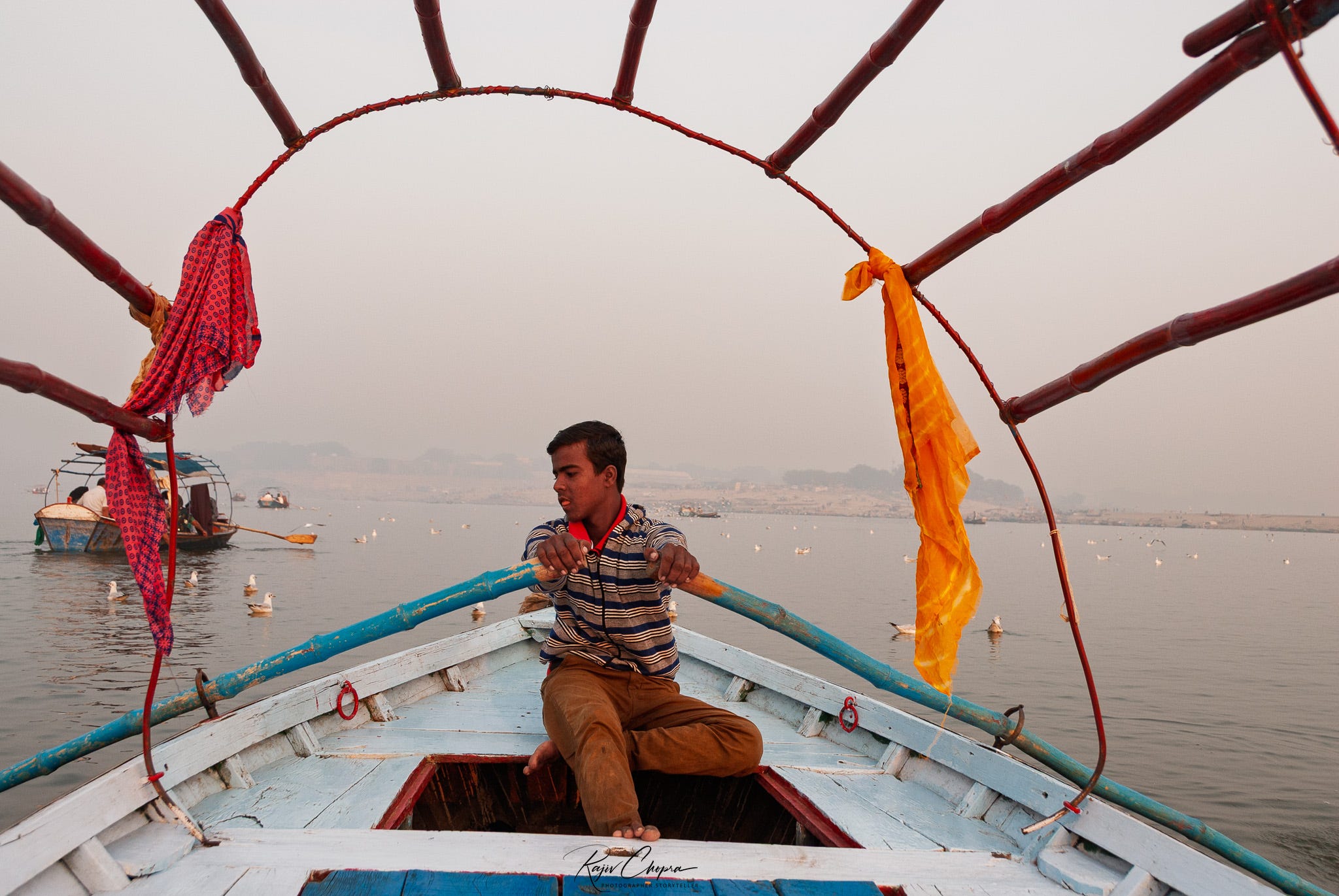
With this post, I will conclude the series of articles/essays/posts about Allahabad. I’ve been reading articles on JSTOR, and it transpires that my earlier research was correct. Even though the Chinese pilgrim Xuanzang visited the area in the seventh century, the city did not enter the historical record until Akbar built his fort on the banks of the confluence of the Ganga and Yamuna.
My earlier research was correct when I mentioned that the city became important when the British elevated the town in the middle of the nineteenth century to a proper colonial center. Now, as religious fervor grips India, the city is being remade again.
Every city is full of stories: wait for my next podcast episode!
We went to the river at dawn.
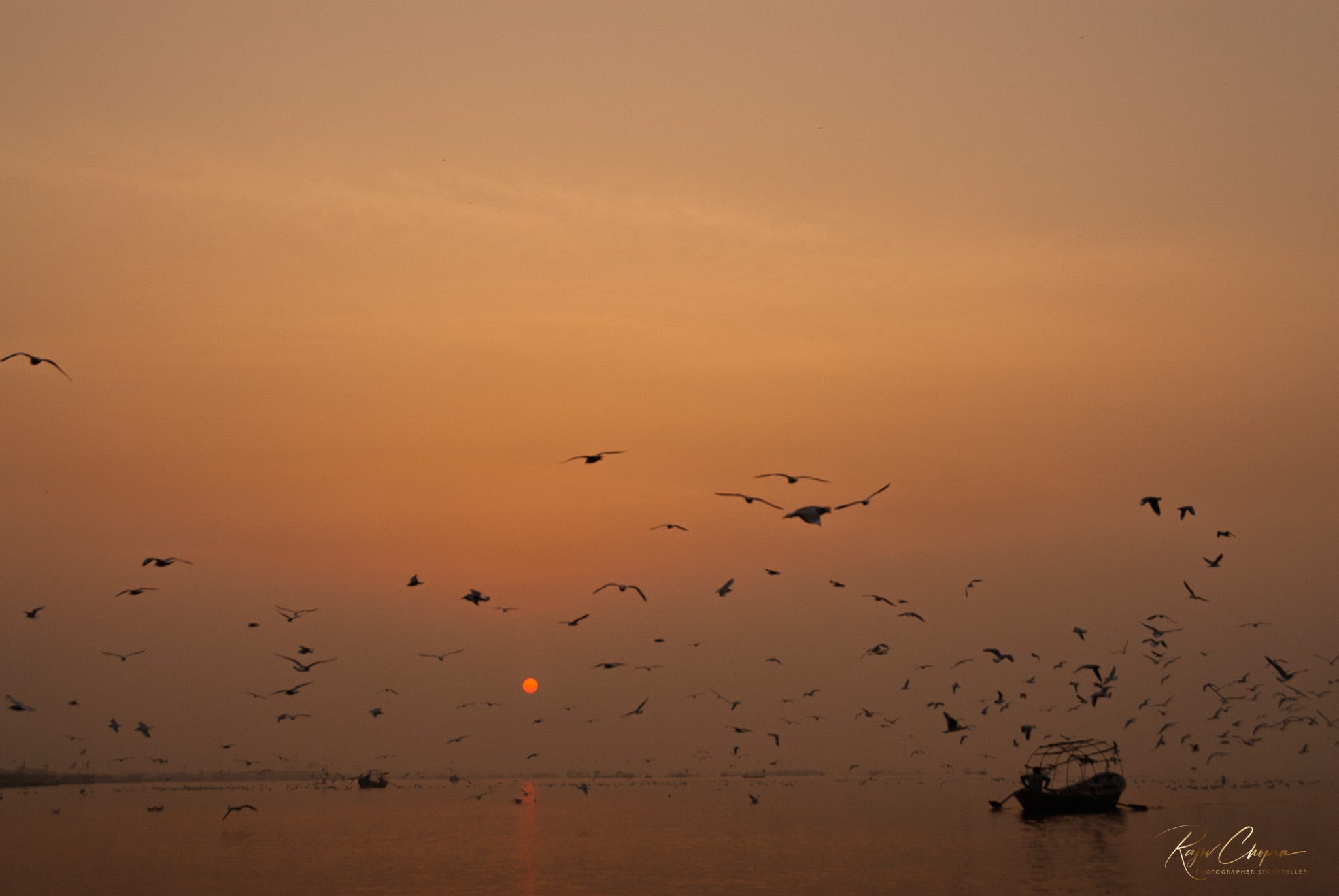
My friend and I arose early one morning during our trip to Allahabad, reached the riverbank at 5 am, and hired a boatman to take us to the Sangam, or the confluence of the Ganga and Yamuna. Diehard religious fanatics believe that a third, subterranean river – the Saraswati – meets the two rivers at the Sangam, which becomes the confluence of the three divine women – Ganga, Yamuna, and Saraswati.
I researched the topic a few years ago and discovered that a river, the Saraswati, once flowed across parts of the subcontinent but has since dried up. When you name rivers after gods and goddesses, religious fervor takes over, and sanity departs, allowing you to pray to the river while polluting the waters.
Festivals have become commercial affairs.
Over the last decade (since the previous government discovered the financial rewards of religious tourism), the Kumbh Mela has become a gigantic affair. My father moved to Chheoki in 1973, and if the Kumbh Mela were a huge affair, I would have witnessed crowds in Allahabad back then, but I did not. It appears that there was almost no mention of the Kumbh Mela before 1870 CE, after which the festival gradually acquired a mythological status.
All this religious stuff did not matter when we boarded the boat. Pilgrims and the local devout bathed in the water, each lost in their personal meditation. It was dark when we boarded the boat and sailed on the river’s waters. Pigeons flapped, waiting for the sun to appear over the horizon, and they continued flying around people who bathed, or sailed the waters, or just allowed the beauty of sunrise to engulf them.
Fall in love before you take photographs.
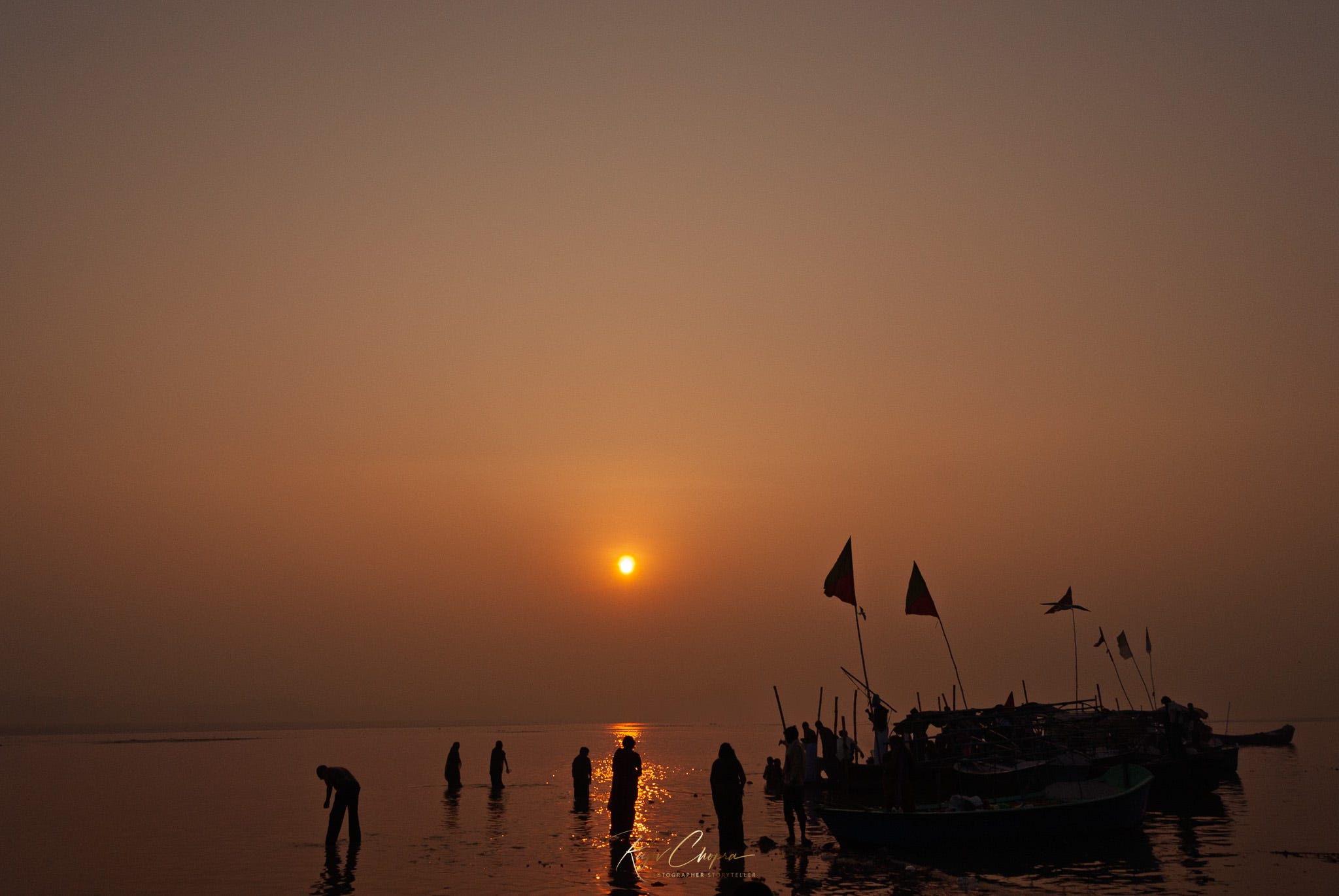
When you pick up your camera to take photographs, you place a barrier between yourself and the magic unfolding before you. Whether you are peering through the viewfinder or squinting at the screen at the back of your camera or phone, you are engaged in activity, composing the image, ensuring you expose the shot perfectly, and, somewhere in your brain, a niggling thought may make its presence felt: you want viewers to fall in love with your photos.
If you want people to fall in love with your photos, you must fall in love with what you are photographing; otherwise, the effort will show, and you will end up with labored photos.
Sitting on a mountainside or on a boat in the middle of the river, watching the sun rise or set, is a magical experience, made even more so when silence surrounds you. Silence never truly surrounds you, but when human cacophony does not disturb the sounds of nature, then the magic of the spirits takes over. I can never find the words to describe this experience, and the best I can do is encourage you to feel it for yourself.
Gigantic festivals are not spiritual events.
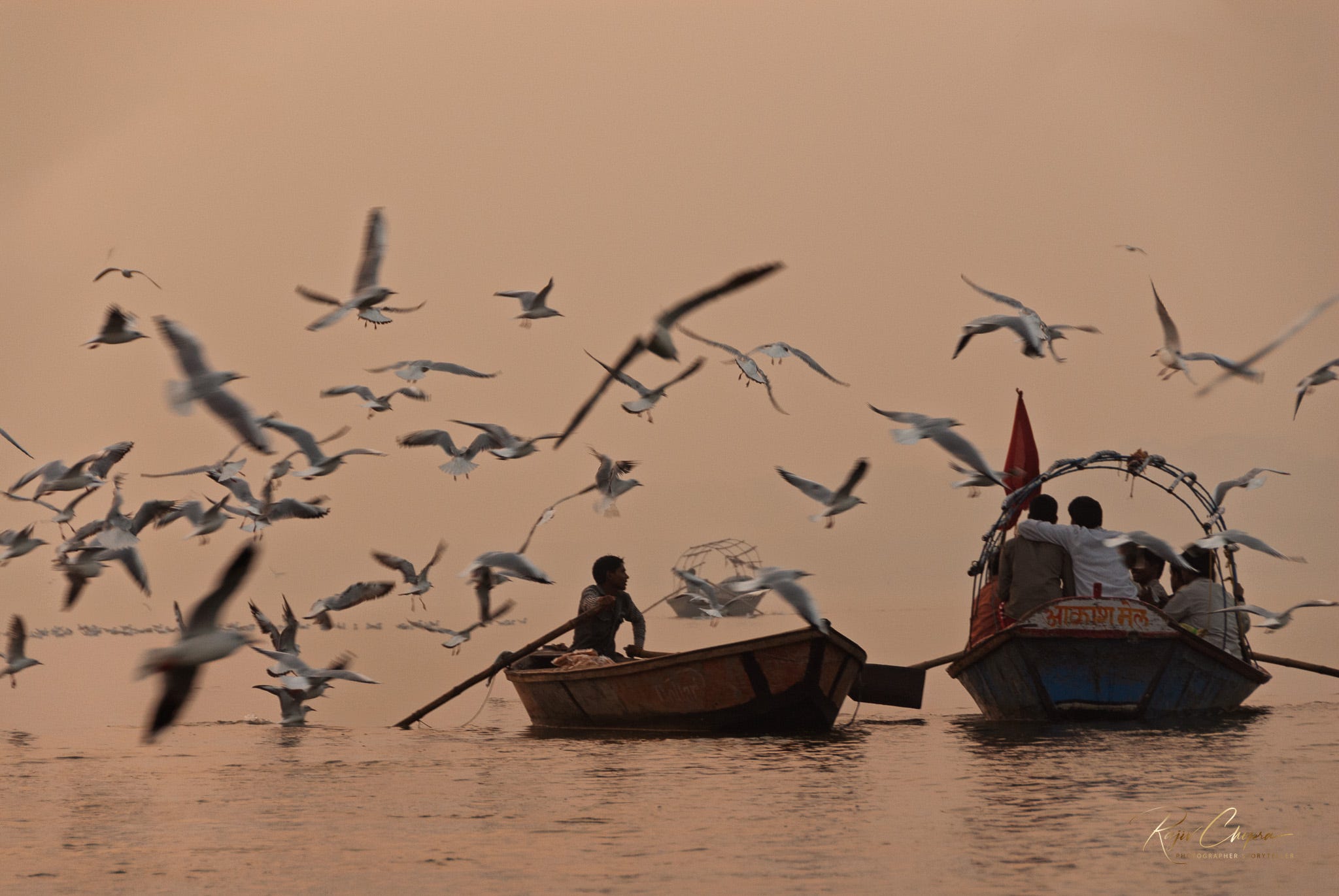
Events like the modern Kumbh Mela are neither spiritual nor religious; they have become political, commercial, noisy, dirty, polluting, and full of patronage. The devout believe that the rivers purify themselves, giving themselves the full right to continue polluting them. Self-deception rules with a vengeance.
I consider myself lucky to sit at the confluence of the rivers when the morning light is young, peaceful, and calming. Furthermore, I consider myself fortunate not to have attended the Kumbh Mela.
Organizing these festivals requires excellent logistics work.
We must acknowledge the immense organizational effort required to stage the festival on this scale. It is almost impossible to organize an event that attracts any number between 40 million and 60 million people unless administrative work runs smoothly. The authorities construct a temporary city, complete with tents, support workers, and many people in the town earn substantial sums of money during this period. As religiosity has gripped India, for whatever reason, the celebrations have become massive and politicized.
God awaits those who are rich and powerful.
If you are rich, powerful, and influential, then you have access to private ghats and can dip yourself in the waters at leisure while proclaiming yourself a person of god. On the other hand, if you belong to the junta (and, I use the word in the Indian context, not the western one), then you will contend with traffic jams, exorbitant prices, inadequate sanitation, and when you bathe in the water, you will have to step gingerly around turd.
Friends of mine who attended the Kumbh Mela this year told me they returned transformed, walking around with a non-existent halo over their heads. The spiritual transformation lasted until the next party, where they drank themselves silly and discussed the latest, most expensive watches they had bought.
I am a simple heathen.
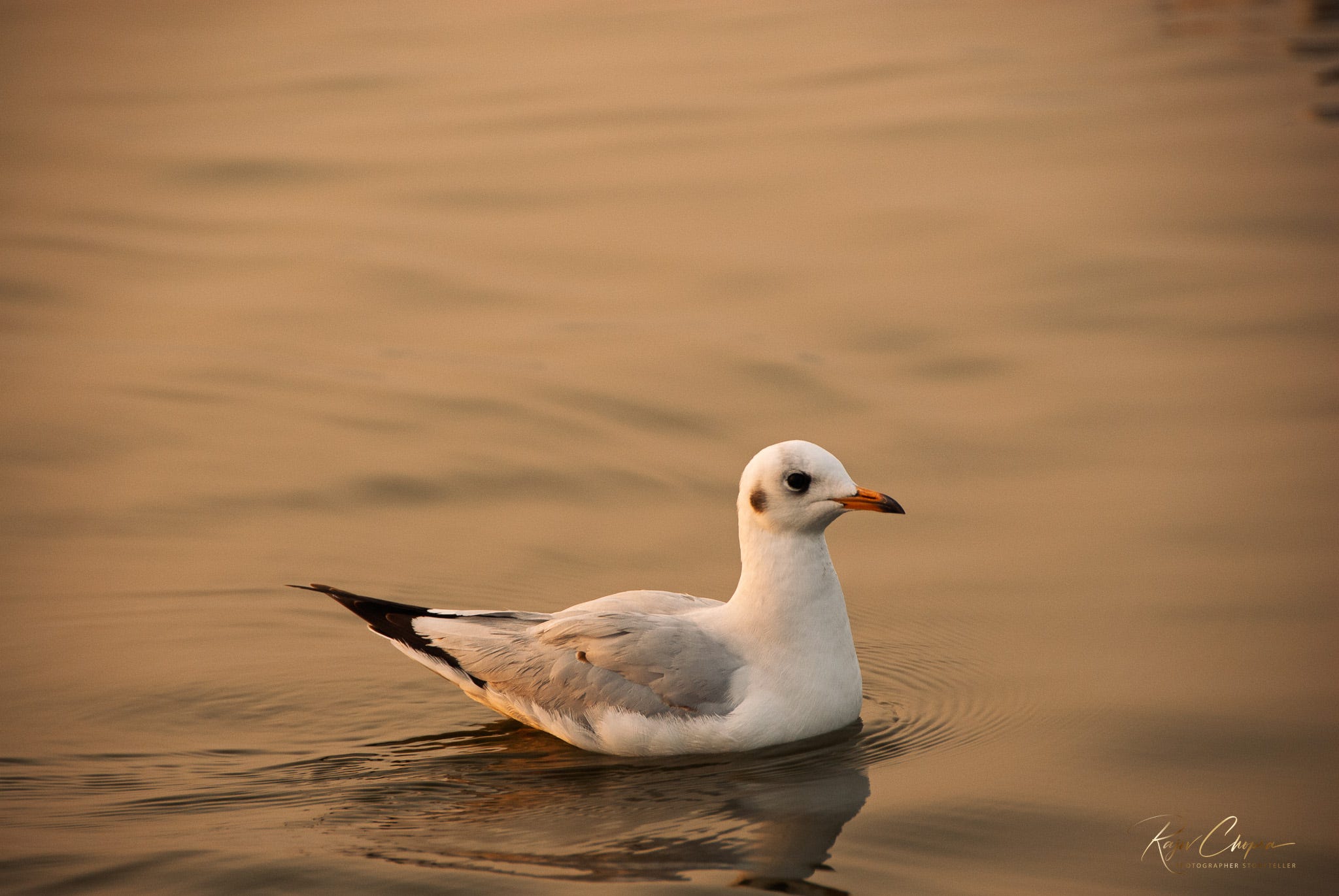
I do not claim to be religious, spiritual, or to have any special connection with the gods, both those who occupy the heavens or seats of power on earth. The calm and silence of the morning, with the sound of the water lapping against the boat, is enough for me. Call me Simple Simon if you must.
How many of you have listened to a beautiful song by Cat Stevens: ‘Morning has broken’? If not, click this link to listen to this short song. Close your eyes and focus when you play this melody.
I just finished reading a book, ‘The Sound Atlas.’ This book is easy to read and can be completed in one sitting. With thirty-six short chapters, the book is just 150 odd pages long, but reading the book makes you realize that we have become so accustomed to cacophony and jarring sounds that we cannot hear nature’s sounds. Of course, you have the option of listening to some of Brian Eno’s music.
In the meantime, find a quiet time when you can visit a mountain, lake, river, forest, or desert. Find that time when tourists are far away and listen.


Rajiv,
This is one of your best posts and as far as I am concerned, it should've be your last about Allahabad or the Sangam. It's your call but it would be awesome if wrote about how either Allahabad and the Sangam arrived at their current states of existence although you do go a little in to that in this. And I hadn't listened to "Morning has broken" in a long time. You may not be religious but you seem to really appreciate the somewhat religious nature of Nature. Which includes land based nature and nature of the oceans and vast unseen Nature beneath all the oceans' waters. It would be cool if you could attach links to this post on X, Instagram, Threads and LinkedIn if you aren't already doing so. Put in a shorter intro to your post on X and Instagram who only allow shorter word counts and a longer word count intro on Threads and LinkedIn. And you copy the full URL for the link and past it in at the end of the intros. You get more views that way.
Larry