Poles apart: Gauhar Jaan & Abu Salem
A brilliant singer. A notorious gangster and terrorist. Two poles.
Gauhar Jaan and Taylor Swift
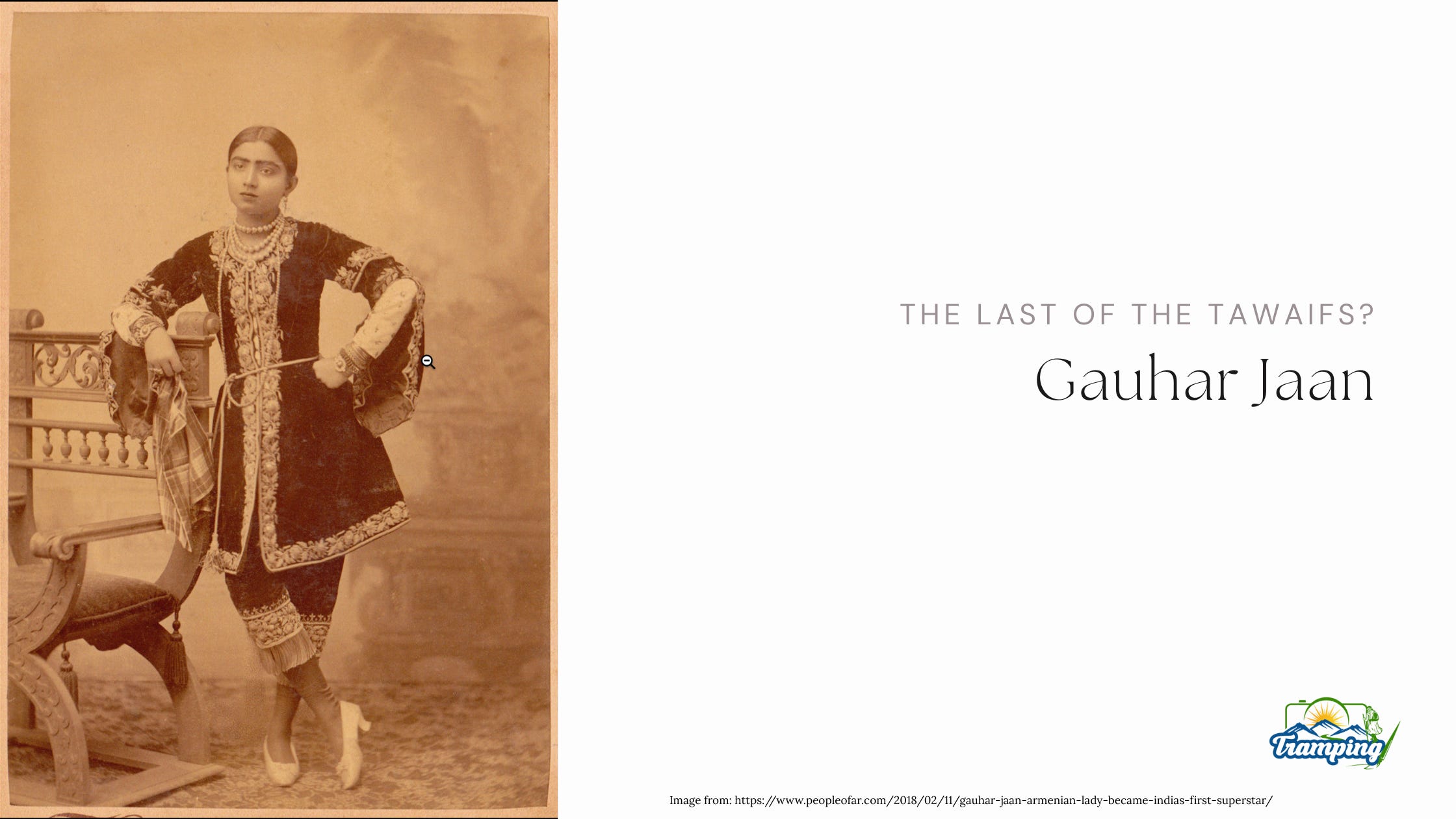
If you have allowed Taylor Swift to dominate your music tastes, there is a high possibility that you will not like Gauhar Jaan’s music. Nor will you appreciate Begum Akhtar’s music. Much though I want to claim that I am musically democratic, I confess that I find Gauhar Jaan’s music hard to swallow. Her music belongs – in large part – to an era that has almost vanished. I know a few appreciate her music. When I was growing up, Begum Akhtar had a formidable reputation.
Once, when I was looking for books on Amazon (this may have been during the Covid pandemic), I saw a book by Vikram Sampath titled “My Name Is Gauhar Jaan.” I did not know then that I was about to take the first step towards a reappraisal of my earlier impression of tawaifs, mujras, and other terms and genres of music and dance. I also read a book about tawaifs, and both books forced me to question many of my earlier assumptions and beliefs.
Revisiting my old assumptions.
Until then, I had always believed that the word ‘tawaif’ was a euphemism for a prostitute or a high-end concubine. I also thought that the word ‘mujra’ only referred to a low-end, cheap dance aimed at titillating jaded old men and arousing the wild fantasies of immature young men.
If you read my last post, you will understand that these terms have deep meanings and a long history.
Who were Gauhar Jaan & Malka Jaan?
Who was Gauhar Jaan, then? Her birth name was Angelina Yeoward, and she was born in Azamgarh on the 26th of June, 1873. Her mother was an Anglo-Indian named Victoria Hemmings, and her father was an Armenian Christian engineer named Robert Yeoward. After Robert abandoned Victoria, she met a Muslim man, converted to Islam, took the name Malka Jaan, and renamed Angelina as Gauhar Jaan.
The divorce was probably a blessing for Indian classical music at the time. Malka moved to Benares and then to Calcutta, where she established herself at the court of the last Nawab of Lucknow, Wajid Ali Shah. There were other singers named Malka Jaan as well. So, to distinguish her from the other singers with the same name, people called her ‘Badi’ (elder) Malka Jaan.
Malka Jaan ensured her daughter received an intense education in music and the arts. In time, the daughter’s fame eclipsed the mother’s.
Gauhar Jaan’s Education.
Gauhar Jaan made many terrible decisions in her personal life, including hiring a secretary who embezzled a large sum of her money. You can read an abridged biography by clicking this link. I’d like to focus on some of her achievements, highlighting the barriers she broke, and emphasizing the legacy of the mother-daughter duo.
First, she trained under many excellent teachers: Kale Khan (kathak), Ustad Ali Baksh of the Patiala gharana, and Ustad Jhande Khan (composition and thumri). She had exposure to the Benares, Lucknow, and Patiala traditions. By her teens, she had mastered khayal, thumri, dadra, ghazal, Rabindra Sangeet, and Dhrupad-ang. Most people specialize in one of those genres. Now, when you consider her mastery over this diverse range, you should pause and bow. She also mastered the diction of Urdu, Persian, and Bengali. Urdu and Persian are close, but there are subtle differences.
My father was excellent in Persian and Punjabi. My maternal grandfather was excellent in Urdu and Punjabi. Neither spoke Hindi well, and neither understood a word of Bengali!
Gauhar Jaan was flamboyant, a fashion icon, and known for her musical skills and etiquette (as expected of a tawaif).
Gauhar Jaan, the British and HMV.
Gauhar Jaan was both fortunate and unfortunate to be born when she was. She was a star and made lasting innovations in classical music by defining the aesthetic of the three-minute song. A typical mehfil often lasted two to four hours. Longer ones could last five to seven hours, and then there were the all-night sessions. A tawaif had to pace herself throughout the session, innovating as the performance progressed.
If you like a modern analogy, consider the jugalbandi, which is a kind of duet, sometimes competitive, mainly known in Hindustani classical music. The players innovate through the performance, and these can stretch for a long, long time! If you have the good fortune to attend a musical performance in which there is a jugalbandi, bless your stars.
In 1901 CE, the British Gramophone Company established The Gramophone Company of India and introduced the brand ‘His Master’s Voice,’ or ‘HMV.’ Most people of my generation grew up with the brand, and I doubt many people are aware of its British origins.
In 1902 CE, they began producing 78rpm records. The technology imposed a three-minute twenty-five-second constraint on the artists, however. Gauhar Jaan – or, her advisors – spotted the opportunity and she grabbed it, becoming one of the first, if not the first, recording artists in India. Gauhar Jaan ended her recordings with the following sentence, ‘My name is Gauhar Jaan.’
The first innovation was to shorten longer performances to a three-minute recording; given the length of a proper mehfil, this must have been a complex undertaking.
The second, when she ended her recordings with her ‘My name is Gauhar Jaan’ sentence, she created a brand for herself and broke out from the private confines of kotha performances. She may have been the first music star in India with widespread appeal.
Over the following decades, she continued to record and to perform in private mehfils. But patronage for these performances dwindled as the kings’ age waned, nationalism rose, and calls for self-determination and independence gained ground. Gauhar Jaan died in Mysore, under the patronage of the Raja of Mysore, one of the last bastions of kotha culture.
The Brits, Nationalism, and Tawaifs.
I blame the British for the first attacks on tawaifs and their culture. When the British first started gaining ground in India in the 18th century, many Englishmen adopted South Asian lifestyles, often dressing as white nawabs, or ‘nabobs,’ as people called them. Many had mistresses, spoke our language, smoked the hookah, and adopted many local customs. Then came Lord Wellesley, a true imperialist, followed by the priests, with their puritanical outlook on life.
The combination of imperialism and puritanism changed the lifestyles of the Englishmen who lived in the subcontinent, creating barriers that no one cared to break or jump over. Even those who studied our culture did so from a narrow English perspective. I don’t blame the British for this perspective – we are all guilty of analysing others through our narrow prisms.
As we South Asians became aware of how the British viewed us, we began asking ourselves who we are, and we have still not stopped trying to figure out our identity.
I will avoid a lengthy, flawed analysis and content myself with a single concluding statement. The combination of British sneering and the rising tide of nationalism (and probably prudishness) amongst Indians changed our attitude towards tawaifs and kothas, and proved fatal to their culture.
Remember, I grew up associating the words tawaif, mujra, and kotha with low prostitution, and not with a sophisticated culture.
I believe there is a revival of interest in tawaif culture and people like Gauhar Jaan, and if so, I am glad. It is time we reclaimed our history and culture.
Also note: if not for Vikram Sampath’s book, ‘My Name Is Gauhar Jaan,’ and my discovery of Gauhar Jaan’s birthplace – Azamgarh – I may never have cared to write about the town. Thanks to her, I discovered facts about Azamgarh that I otherwise would not have bothered to research.
Begum Akhtar, Gauhar Jaan, and Malka Jaan
Akhtari Bai Faizabadi was born in Faizabad, Uttar Pradesh, on the 7th of October, 1914. She shares her birthday with my son! While another singer, Chandra Bai, influenced her, the turning point in her life came when she listened to the music of Malka Jaan and Gauhar Jaan. When she heard these two women sing, she abandoned her desire to become a mere film heroine and focused on classical and semi-classical music. Like Gauhar Jaan, Akhtari Bai Faizabadi studied under Ustad Jhande Khan. The world is a small place! Akhtari Bai Faizabadi was, by the way, a stunningly beautiful woman and later became known as Begum Akhtar. People referred to her as ‘Mallika-e-Ghazal,’ or the ‘Queen of Ghazals.’
I’ve been to Faizabad but will write about its neighboring town, Ayodhya, a month from now.
Abu Salem: the gangster from Azamgarh.
Shall we move to the opposite end of the spectrum? I won’t spend much time on this section because it provides a depressing contrast to Gauhar Jaan’s mesmerizing genius. Abu Salem, a gangster and terrorist, was also born in Azamgarh. Serving a life sentence in prison, he was known for his influence on Bollywood celebrities and had a partner/mistress, a Punjabi woman named Monica Bedi. She studied in Norway and Oxford, so I do not understand the almost-fatal charm Abu Salem exercised over her.
I’ve never met Abu Salem, and I don’t wish to do so either. Monica Bedi seems attractive, but I would avoid her: I am sure she still has underworld connections!
Some say that Gauhar Jaan is to Indian music what Enrico Caruso (an opera singer) is to Western music. Let’s leave it at that and move on from Azamgarh for now.
My posts in February may be more whimsical and fake literary. Stay with me!


I agree with what you say - a musical conversation. I've not heard much of Gauhar Jaan because not much of her music is available. This is a three-minute recording. I've heard longer pieces and the voice control is outstanding. But yeah... I hope lots of people read and listen!
This is interesting. The music in particular is amazing. I especially like when the sitar duets with the lady singing. They have a musical conversation which seems poetic in the she may sing the first poetic line. And the 2nd verse of the song answers and takes the thought forward. This may or may not be quite the case as I am not a music expert. Gauhar Jaan has a high voice a little like Joni Mitchell but Jaan sings almost solely in the higher registers. It is is good that interest in this cultural music is returning. And Saragama has preserved much of India's musical legacy. This is an excellent post that I hope will be read or the podcast listened to by many.